Can High Blood Pressure Affect Your Eyes?
Can High Blood Pressure Affect Your Eyes?
When most people hear:
“Your blood pressure is high.”
they immediately think about:
- The heart
- Stroke
- Kidney disease
Very few people think about their eyes.
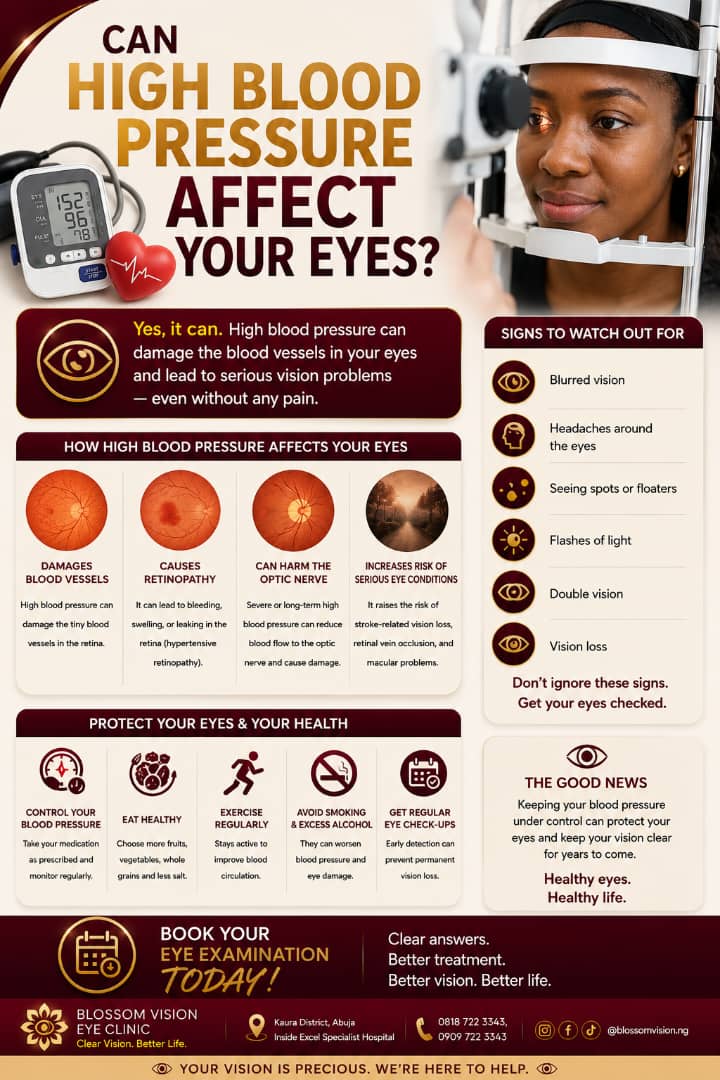
But high blood pressure can affect the tiny blood vessels at the back of the eye.
The retina is one of the few places in the body where healthcare professionals can directly examine small blood vessels without surgery.
That means an eye examination may sometimes reveal changes that are associated with long-standing or severe high blood pressure.
But there is an important distinction:
An eye examination can show changes that may be related to hypertension.
It does not, by itself, diagnose high blood pressure.
Blood pressure still needs to be properly measured and managed by the appropriate healthcare professional.
Quick Answer: Can High Blood Pressure Damage Your Eyes?
Yes.
High blood pressure can damage blood vessels supplying the:
- Retina
- Optic nerve
- Other structures inside the eye
One important condition is called hypertensive retinopathy.
This means retinal blood-vessel damage associated with high blood pressure.
Possible retinal findings can include:
- Narrowing of small blood vessels
- Changes where retinal arteries and veins cross
- Retinal bleeding
- Areas of reduced blood supply
- Leakage
- Retinal swelling
- Optic-disc swelling in severe hypertension
Many people with chronic hypertension have no obvious eye symptoms, especially early on.
That is why:
“My vision is fine”
does not necessarily mean:
“High blood pressure cannot be affecting my eyes.”
Book Appointment
What Is High Blood Pressure?
Your heart pumps blood around your body through blood vessels.
Blood pressure measures the force of that blood against the vessel walls.
When that pressure remains too high over time, it can gradually damage blood vessels throughout the body.
That includes the very small blood vessels inside the retina.
High blood pressure usually causes no obvious symptoms, which is why checking your actual blood-pressure reading matters.
What Is Hypertensive Retinopathy?
The word sounds complicated.
Break it into two pieces:
Hypertensive = related to high blood pressure.
Retinopathy = damage or disease affecting the retina.
So:
Hypertensive retinopathy means changes or damage in the retina associated with high blood pressure.
The retina is the light-sensitive tissue lining the back of your eye.
It receives light and sends visual information toward your brain.
Healthy retinal circulation is therefore extremely important for vision.
How Does High Blood Pressure Damage the Retina?
Imagine repeatedly pushing water through tiny pipes at excessive pressure.
Over time, those pipes can change.
Something similar can happen to small blood vessels exposed to persistent high blood pressure.
Chronic hypertension can cause retinal arterioles to become narrowed and their walls to change.
With more severe hypertension, damaged vessels may leak blood or fluid and parts of the retina may receive inadequate blood supply.
The amount of retinal damage depends on factors such as:
- How high the blood pressure is
- How long it has been elevated
- How well it is controlled
- Other vascular risk factors
Can High Blood Pressure Affect My Eyes Even If I See Clearly?
Yes.
This is perhaps the most important part of this article.
Many chronic hypertensive retinal changes may cause no obvious symptoms initially.
So someone can say:
“But Doctor, I see perfectly.”
and still have retinal blood-vessel changes.
Clear central vision is not a complete test of retinal health.
The same principle applies to some other eye conditions too.
What Changes Might an Optometrist See?
Depending on the severity and duration of hypertension, retinal examination may reveal findings such as:
- Narrowed retinal arterioles
- Changes where arteries cross veins
- Increased vessel-wall reflex
- Retinal haemorrhages
- Cotton-wool spots
- Hard exudates
- Retinal swelling
- Optic-disc swelling in severe cases
Some chronic changes are sometimes described as copper wiring or silver wiring because of changes in the appearance of the retinal arterioles.
These findings need to be interpreted alongside:
- Your actual blood-pressure measurements
- Medical history
- Diabetes status
- Medications
- Other examination findings
An eye finding alone should not be used to diagnose hypertension.
Can an Eye Test Tell Me I Have High Blood Pressure?
Not by itself.
This is important.
An optometrist may see retinal changes that make us say:
“These blood vessels look concerning. Please have your blood pressure checked.”
But hypertension is confirmed through proper blood-pressure measurement and medical assessment.
So an eye examination can provide an important clue.
It is not a replacement for a blood-pressure monitor or your physician.
Can High Blood Pressure Cause Blurry Vision?
It can, particularly when hypertension is severe or has caused complications affecting the retina, optic nerve or retinal circulation.
But blurry vision has many much more common causes, including:
- A changing glasses prescription
- Dry eye
- Cataract
- Diabetes-related changes
- Corneal problems
- Retinal disease
So do not automatically think:
“My vision is blurry, therefore my blood pressure must be high.”
And do not think:
“My blood pressure is high, therefore it explains every visual symptom.”
The eyes still need to be assessed properly.
If your vision repeatedly becomes blurry and then clear again, read Why Does My Vision Go Blurry Then Clear Again?.
Can High Blood Pressure Cause Sudden Vision Loss?
Severe hypertension and hypertension-related vascular complications can sometimes threaten vision.
Hypertension is associated with retinal blood-vessel problems, including retinal artery and retinal vein occlusions.
In simple English:
A blood vessel supplying or draining the retina can become blocked.
That can produce sudden visual loss or other significant vision changes.
Sudden loss of vision should always be treated seriously regardless of whether you have hypertension.
Can High Blood Pressure Cause Bleeding Inside the Eye?
Severe hypertensive retinal damage can produce retinal haemorrhages.
Hypertension is also associated with retinal vascular diseases that can sometimes lead to more serious bleeding or retinal complications.
If you suddenly develop:
- Many black spots
- New floaters
- Hazy vision
- Significant vision reduction
do not automatically assume that hypertension is the cause.
Those symptoms have several possible explanations.
Read Why Do I See Black Spots Floating in My Vision?.
Can High Blood Pressure Cause Headaches and Blurry Vision?
This needs careful explanation.
Ordinary chronic hypertension is frequently silent.
Headaches alone are not a reliable way of knowing your blood pressure is high.
However, extremely high blood pressure together with symptoms such as:
- Vision changes
- Severe headache
- Weakness
- Numbness
- Difficulty speaking
- Chest pain
- Shortness of breath
can represent a hypertensive emergency.
If a blood-pressure reading remains above 180/120 mmHg and you have new vision changes or other concerning symptoms, seek emergency medical care immediately.
Can High Blood Pressure Cause Eye Pain?
Ordinary chronic hypertension does not typically present as eye pain.
Severely elevated or malignant hypertension may occasionally be associated with headache, reduced vision and ocular symptoms, but eye pain has many other possible causes.
So if your eye hurts:
do not simply blame your blood pressure.
A painful eye needs its own evaluation.
Is High Blood Pressure the Same as High Eye Pressure?
No.
This is an extremely important distinction.
Blood Pressure
This is the pressure of blood circulating through blood vessels throughout your body.
Eye Pressure
This is the pressure inside the eyeball.
The medical term is intraocular pressure, often shortened to IOP.
These are two completely different measurements.
Having high blood pressure does not automatically mean your eye pressure is high.
And having high eye pressure does not automatically mean your blood pressure is high.
Eye pressure is relevant when assessing conditions such as glaucoma.
If you are concerned about glaucoma, read How Do I Know If I Have Glaucoma?.
Does High Blood Pressure Cause Glaucoma?
Do not tell patients:
“High blood pressure causes glaucoma.”
The relationship between blood pressure, eye pressure and optic-nerve circulation is more complicated than that.
Hypertension may be one factor considered when assessing overall vascular and ocular health, but glaucoma cannot be diagnosed because someone has hypertension.
Glaucoma assessment needs to look at things such as:
- Optic nerve
- Eye pressure
- Visual field
- Other risk factors and examination findings
So:
hypertensive retinopathy and glaucoma are not the same disease.
Book Appointment
Can High Blood Pressure Affect the Optic Nerve?
Very severe hypertension can affect the optic nerve.
In hypertensive emergencies, swelling of the optic disc may occur alongside severe retinal changes.
That is a serious finding because it may indicate severe systemic disease affecting more than just the eye.
The priority then is not simply:
“Which eye drop should I use?”
The blood pressure and overall medical condition need urgent management.
What Is Malignant Hypertension?
The word malignant here does not mean cancer.
It refers to very severe hypertension associated with acute damage to organs.
The eyes may show:
- Retinal haemorrhages
- Cotton-wool spots
- Leakage
- Optic-disc swelling
- Reduced vision
But severe hypertension can simultaneously threaten:
- Brain
- Heart
- Kidneys
- Blood vessels
So severe hypertensive retinal findings can be a warning about the patient's whole body, not just the eye.
Can High Blood Pressure Cause a Retinal Vein Occlusion?
Hypertension is an important vascular risk factor for retinal vein occlusion.
A retinal vein occlusion means one of the veins draining blood from the retina becomes blocked.
Depending on which vessel is involved, this may lead to:
- Sudden blurry vision
- Reduced vision
- Retinal bleeding
- Retinal swelling
These conditions may require specialist retinal assessment and treatment.
What About Retinal Artery Occlusion?
Hypertension is also associated with vascular disease affecting retinal arteries.
Sudden loss of blood supply to the retina can cause severe visual loss.
A sudden painless loss of vision is an emergency.
Do not wait to see whether:
“My glasses will clear it.”
Can High Blood Pressure and Diabetes Affect My Eyes Together?
Yes.
This combination deserves particular attention.
Diabetes can damage retinal blood vessels.
High blood pressure can also damage retinal circulation.
When somebody lives with both conditions, good control of both matters.
Do not think:
“My sugar is controlled, so my blood pressure doesn't matter.”
or:
“My blood pressure is controlled, so diabetes cannot affect my retina.”
Both require appropriate medical management.
Read Can Diabetes Affect My Eyes Even If I Can See Clearly?.
Does Everyone With High Blood Pressure Develop Hypertensive Retinopathy?
No.
The risk and severity vary.
Important factors include:
- Duration of hypertension
- Degree of blood-pressure elevation
- Blood-pressure control
- Other vascular conditions
Some people with hypertension have little obvious retinal change.
Others develop more significant findings.
That is why we examine the individual rather than assuming everybody with the same blood-pressure diagnosis has the same eyes.
Can I Have Hypertensive Retinopathy Without Knowing I Have High Blood Pressure?
Potentially.
Because hypertension often causes no symptoms, some people discover that their blood pressure is high only after routine medical testing.
Occasionally, an eye-care professional may notice retinal vascular changes that raise suspicion and advise the patient to have their blood pressure checked.
But again:
the eye finding is a reason to investigate the blood pressure, not proof of the diagnosis.
Does Red Eye Mean My Blood Pressure Is High?
Usually, no.
This is another important myth.
The ordinary bloodshot appearance of the white of the eye is not a reliable way to tell whether somebody has hypertension.
Red eyes are more commonly associated with things such as:
- Dry eye
- Allergy
- Irritation
- Infection
- Eyelid problems
- Other eye-surface conditions
High blood pressure affects the retinal circulation inside the eye, not simply whether the white part looks red.
What About a Bright Red Patch on the White of My Eye?
A sharply defined red patch on the white of the eye may be a subconjunctival haemorrhage.
That means a tiny surface blood vessel has broken.
These are often painless and may look much more frightening than they actually are.
They can occur for many reasons, including:
- Coughing
- Sneezing
- Straining
- Minor trauma
- Blood-thinning medicines
- Sometimes hypertension
But one red patch does not diagnose high blood pressure.
If these haemorrhages repeatedly occur, assessment may include checking blood pressure and reviewing medications or other health factors.
Can Lowering My Blood Pressure Improve My Eyes?
Controlling blood pressure is the main systemic treatment for hypertensive retinopathy and helps reduce the risk of further damage.
Some acute retinal changes associated with severe hypertension may improve as the blood pressure is safely controlled.
But not every established structural change completely reverses.
For example, long-standing narrowing and vessel-wall changes may persist, while damage affecting the optic nerve or macula can sometimes leave permanent visual loss.
So the goal is:
control blood pressure before serious irreversible damage develops.
Should I Stop My Blood Pressure Medicine If My Eyes Are Fine?
No.
Never stop prescribed blood-pressure medication because:
“My eyes look fine.”
Your physician prescribed treatment to protect many organs, including:
- Heart
- Brain
- Kidneys
- Blood vessels
and indirectly your eyes.
Take medication according to your healthcare professional's instructions.
If you experience side effects or have concerns, speak with the person managing your hypertension rather than stopping treatment yourself.
How Can I Protect My Eyes If I Have High Blood Pressure?
The most important protection comes from controlling the underlying hypertension.
That may include:
Know Your Blood Pressure
Do not guess based on symptoms.
Measure it appropriately.
Take Your Prescribed Medication
Follow the treatment plan given by your healthcare professional.
Attend Medical Reviews
Blood pressure management is not something an eye clinic should handle alone.
Manage Diabetes
If you also have diabetes, good management of both conditions matters.
Avoid Smoking
Smoking adds further cardiovascular and vascular risk.
Exercise and Eat Appropriately
Follow the lifestyle advice given by your physician or healthcare team.
Have Your Eyes Assessed as Recommended
Especially if hypertension is long-standing, poorly controlled, associated with diabetes, or retinal changes have previously been found.
How Often Should Someone With High Blood Pressure Have an Eye Examination?
I would not give every hypertensive patient one fixed interval.
The appropriate interval depends on factors such as:
- How well the blood pressure is controlled
- How long you have had hypertension
- Your age
- Whether you also have diabetes
- Previous retinal findings
- Visual symptoms
- Other eye conditions
Someone with stable hypertension and a normal retinal examination may need a different schedule from somebody with significant hypertensive retinopathy.
The best question to ask after your examination is:
“Based on what you found today, when should I return?”
What Happens During an Eye Examination for Someone With Hypertension?
At Blossom Vision Eye Clinic in Games Village, Abuja, we do more than ask:
“Can you read the smallest letters?”
Depending on your individual needs, assessment may include:
- Visual acuity
- Glasses prescription
- Eye pressure
- Slit-lamp examination
- Retina assessment
- Optic-nerve assessment
- Examination of retinal blood vessels
- Retinal photography where clinically appropriate
- Visual-field testing where indicated
- Additional investigation or referral when necessary
If we see retinal findings that may be related to systemic hypertension, we can explain what we found and recommend appropriate medical follow-up.
Can an Optometrist Treat High Blood Pressure?
No.
This needs to be very clear.
An optometrist can:
- Examine the eyes
- Detect ocular changes
- Document findings
- Monitor relevant eye health
- Refer appropriately
But systemic hypertension needs to be managed by the appropriate physician or medical team.
If severe retinal changes suggest dangerously uncontrolled blood pressure, the priority may be urgent medical referral, not simply another eye appointment.
When Should I Seek Emergency Care?
Seek urgent medical attention for sudden symptoms such as:
- Significant sudden vision loss
- Severe new blurry vision
- New weakness or numbness
- Difficulty speaking
- Severe headache with visual or neurological changes
- Chest pain
- Shortness of breath
If your blood pressure is above 180/120 mmHg, repeat the measurement after about a minute. If it remains that high and you have new vision changes, weakness, numbness, difficulty speaking, chest pain or shortness of breath, this can represent a hypertensive emergency and requires immediate medical care.
Do not drive yourself around comparing eye clinics in that situation.
What If My Blood Pressure Is Above 180/120 but I Feel Fine?
If a reading is unexpectedly above 180/120 mmHg, the American Heart Association advises repeating it after at least one minute.
If it remains that high but you do not have symptoms suggesting acute organ damage, contact your healthcare professional urgently for guidance.
Again, an eye examination should not replace appropriate medical management of severe hypertension.
Frequently Asked Questions
Can high blood pressure affect your eyes?
Yes. Persistent or severe hypertension can damage retinal blood vessels and may affect other eye structures.
What is hypertensive retinopathy?
It means retinal vascular damage associated with high blood pressure.
Can high blood pressure affect my eyes without symptoms?
Yes. Chronic retinal vascular changes may exist without obvious early visual symptoms.
Can an eye examination diagnose high blood pressure?
No. An eye examination may reveal changes associated with hypertension, but blood pressure must be properly measured and medically assessed.
Can high blood pressure make my vision blurry?
Severe hypertension or complications affecting the retina or optic nerve can cause visual changes, but blurry vision has many other possible causes.
Does a red eye mean my blood pressure is high?
Usually not. Everyday bloodshot eyes are not a reliable sign of hypertension.
Is high blood pressure the same as high eye pressure?
No. Blood pressure measures pressure in your body's blood vessels. Eye pressure measures pressure inside the eye.
Does high blood pressure cause glaucoma?
The relationship is complex, and hypertension alone does not diagnose or directly explain glaucoma. Glaucoma requires its own eye assessment.
Can high blood pressure cause retinal bleeding?
Severe hypertensive retinopathy can cause retinal haemorrhages and other vascular complications.
Can controlling my blood pressure protect my vision?
Yes. Proper blood-pressure control is central to preventing or limiting further hypertensive retinal damage.
Can existing damage reverse after my blood pressure improves?
Some acute changes may improve, but established vascular, macular or optic-nerve damage may not completely reverse.
Should everyone with hypertension have the same eye-exam schedule?
No. Examination frequency should depend on blood-pressure control, retinal findings, symptoms, diabetes and other individual risk factors.
Where can I get my retina checked in Abuja?
Blossom Vision Eye Clinic provides comprehensive optometric eye examinations and retinal assessment in the Games Village/Kaura District area of Abuja.
Your Eyes Can Show Us Part of the Bigger Picture
High blood pressure is not simply:
“a heart problem.”
Over time it can affect blood vessels throughout the body.
And some of those blood vessels can be examined directly inside your eyes.
But remember:
An eye examination does not replace checking your blood pressure.
And a blood-pressure reading does not replace examining your eyes when there are visual concerns.
The two pieces of information work together.
At Blossom Vision Eye Clinic in Games Village, Abuja, we can examine your retina, optic nerve and retinal blood vessels and identify findings that may require monitoring or medical follow-up.
If you have hypertension, unexplained vision changes or have not had your retinal health assessed as recommended, book a comprehensive eye examination.