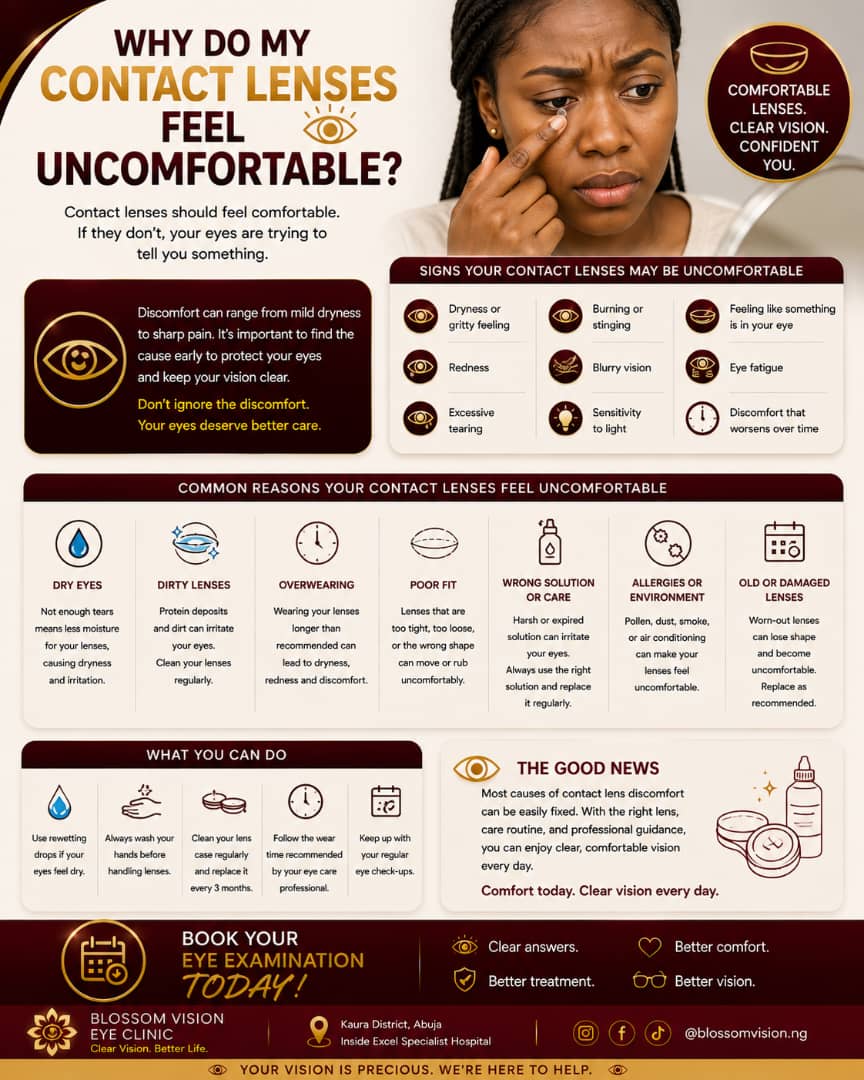
Why Do My Contact Lenses Feel Uncomfortable?
Contact lenses should feel comfortable most of the time. If they don't, something is usually wrong. Dry eyes, worn-out lenses, poor lens fit, deposits on the lenses or an eye infection are common causes. Persistent discomfort should never be ignored because it can lead to serious eye problems.
Why Do My Contact Lenses Feel Uncomfortable?
Some people assume this is just part of wearing contact lenses.
It isn't.
A properly fitted contact lens on a healthy eye should generally be comfortable enough that you are not constantly thinking about it.
Persistent:
- Dryness
- Scratchiness
- Burning
- Pain
- Redness
- Excessive watering
- Blurry vision
means something needs attention.
Sometimes the cause is simple.
But contact-lens discomfort can occasionally be the first warning sign of a corneal infection or injury, so it should not automatically be ignored.
Quick Answer: Why Are My Contact Lenses Uncomfortable?
Possible causes include:
- Dry eye
- Wearing lenses too long
- Poor lens fit
- A damaged lens
- A lens that is inside out
- Dust or debris under the lens
- Lens deposits
- Allergy
- Sensitivity to lens-care products
- Incorrect cleaning
- Sleeping in lenses
- Water exposure
- Eye-surface inflammation
- Contact-lens-related infection
The first question is not:
“Which eye drop should I buy?”
It is:
“Why has this lens become uncomfortable?”
Book Appointment
Should Contact Lenses Feel Completely Normal?
You may be briefly aware of a contact lens when you first insert it, especially if you are new to lenses.
But a lens should not continually feel:
sharp
painful
scratchy
or:
like something is stuck inside your eye.
If you constantly want to remove the lens, something may be wrong with:
the lens
the fit
the tear film
or:
the eye itself.
1. Can Dry Eye Make Contact Lenses Uncomfortable?
Yes.
Dry eye is an important cause of contact-lens discomfort.
A contact lens sits within the tear film covering the front of your eye.
If that tear film is unstable, the lens may become increasingly uncomfortable as the day continues.
You might notice:
- Dryness
- Burning
- Grittiness
- Excessive blinking
- Watering
- Intermittent blurry vision
- Discomfort later in the day
- Feeling better immediately after removing the lenses
Contact-lens wear itself may also make some dry-eye symptoms more noticeable.
If your vision repeatedly becomes blurry and clears again after blinking, read Why Does My Vision Go Blurry Then Clear Again?.
Why Do My Contact Lenses Feel Fine in the Morning but Dry Later?
This is a very common pattern.
Your lenses may feel excellent at 8am.
Then at 4pm:
everything changes.
Possible contributors include:
- Long hours of lens wear
- Air conditioning
- Low humidity
- Screen use
- Reduced or incomplete blinking
- Tear-film instability
- Lens deposits
- Environmental dust
In Abuja, Harmattan conditions may also make existing eye-surface dryness and irritation more noticeable.
If your eyes become particularly uncomfortable during Harmattan, read Why Do My Eyes Itch and Water During Harmattan?.
2. Can Computer or Phone Use Make My Contact Lenses Dry?
Yes, indirectly.
When concentrating on screens, people may blink less completely.
That can make the tear film less stable.
A contact-lens wearer may then experience:
- Dryness
- Burning
- Blurry vision
- Lens awareness
- Tired eyes
You may notice:
“My lenses are comfortable on weekends but uncomfortable after a full day at work.”
That pattern is worth mentioning during your contact-lens review.
For more on screen-related symptoms, read Why Do My Eyes Feel Tired After Using a Computer?.
3. Could My Contact Lens Be Inside Out?
Yes.
Some soft contact lenses can be inserted inside out.
An inside-out lens may:
- Feel uncomfortable
- Move unusually
- Produce unstable vision
- Feel as though it will fall out
- Become more noticeable when blinking
If you repeatedly have difficulty determining the correct orientation, ask your optometrist to show you how to recognise it.
Do not keep putting a painful lens back into the eye over and over.
4. Could There Be Something Under My Contact Lens?
Yes.
A tiny particle can feel enormous when trapped between a contact lens and your cornea.
Possible culprits include:
- Dust
- Makeup
- An eyelash
- Tiny debris
You may suddenly notice:
sharp discomfort
watering
redness
or:
foreign-body sensation.
Remove the lens.
If the eye remains painful after the lens is removed, do not automatically assume the particle is gone.
The cornea may have been scratched or another problem may be present.
5. Can a Torn or Damaged Contact Lens Hurt My Eye?
Yes.
Before inserting a lens, inspect it.
Do not wear a lens that appears:
- Torn
- Chipped
- Damaged
- Misshapen
- Contaminated
A damaged lens can irritate the eye surface.
If a lens suddenly becomes uncomfortable after previously feeling normal, removing and inspecting it is sensible.
6. Can My Contact Lenses Be the Wrong Fit?
Yes.
Contact lenses are not simply:
“small glasses you put inside your eye.”
They physically sit on the eye.
That means:
- Lens diameter
- Lens curvature
- Lens material
- Movement
- Position
- Tear interaction
all matter.
A lens that does not fit appropriately may move too much or behave poorly on the eye.
Problems may include:
- Discomfort
- Unstable vision
- Excessive movement
- Redness
- Poor wearing time
That is why contact lenses should be properly fitted rather than chosen only because:
“This brand is cheaper.”
Why Can't I Just Buy Any Contact Lens With My Glasses Power?
Because a contact-lens prescription involves more than spectacle power.
Depending on the lens, information may include:
- Lens power
- Brand
- Base curve
- Diameter
- Other fitting characteristics
And your glasses prescription is not always identical to your contact-lens prescription.
The FDA treats contact lenses as medical devices that require appropriate prescription and fitting.
7. Can My Old Contact-Lens Brand Stop Being Comfortable?
Yes.
A lens that worked well previously may become less comfortable because:
- Your tear film changed
- Your eye surface changed
- Your wearing habits changed
- Your working environment changed
- The fit is no longer ideal
- You developed allergy or inflammation
- Your prescription changed
That does not necessarily mean the brand suddenly became “bad.”
It means your current situation should be reassessed.
Should I Just Change Contact-Lens Brands Myself?
I would not recommend repeatedly experimenting with random lenses.
Different lenses have different:
- Materials
- Designs
- Curves
- Diameters
- Replacement schedules
A lens should be selected based on your eye, prescription and wearing needs.
If your current lens is uncomfortable, have the fit and eye surface checked rather than continuously buying new brands until something feels acceptable.
8. Can Lens Deposits Make Contact Lenses Uncomfortable?
Yes.
Reusable contact lenses can accumulate material from:
- Tears
- Oils
- Cosmetics
- Environmental particles
Deposits may reduce comfort and sometimes interfere with vision.
This is one reason replacement schedules matter.
A lens designed to be replaced after a particular period should not be stretched indefinitely because:
“It still looks okay.”
Follow the replacement schedule given for your lenses.
What Does “Monthly Contact Lens” Actually Mean?
This causes confusion.
If a lens is prescribed as a monthly replacement lens, it does not mean:
“Wear it until you've accumulated 30 individual wearing days.”
Replacement instructions depend on the specific product and prescription.
Follow the schedule given by your optometrist and the manufacturer's instructions.
Do not invent your own schedule because the lens still feels usable.
9. Am I Wearing My Contact Lenses for Too Many Hours?
Possibly.
Even when lenses are otherwise suitable, wearing them for longer than advised may reduce comfort.
Your safe and comfortable wearing time depends on:
- Lens type
- Eye surface
- Tear film
- Environment
- Individual response
- Your optometrist's advice
If your lenses consistently become uncomfortable after a certain number of hours, tell your optometrist.
Do not force yourself to continue wearing them because:
“I haven't reached bedtime yet.”
Should I Keep Wearing the Lens Until the End of the Day?
If the eye becomes irritated, painful, significantly red or vision changes:
No.
Remove the contact lens.
The FDA specifically advises lens wearers experiencing irritation or possible infection to remove their lenses immediately and contact their eye-care professional.
Carry backup glasses when possible.
That means if the lens becomes uncomfortable at work, you are not forced to choose between:
wearing a painful lens
and:
not seeing.
10. Is Sleeping in Contact Lenses Dangerous?
Sleeping in lenses increases concern for contact-lens complications.
Do not sleep in daily-wear lenses.
Some lenses are specifically prescribed and approved for overnight or extended wear, but this does not mean overnight contact-lens wear is risk-free.
CDC guidance advises not sleeping in contacts unless your eye-care professional has specifically said it is appropriate.
If you accidentally sleep in ordinary lenses and wake with:
- Redness
- Pain
- Significant irritation
- Light sensitivity
- Blurred vision
remove the lenses and seek prompt assessment.
Book Appointment
Why Do My Eyes Hurt After Sleeping in My Contact Lenses?
Sleeping in contact lenses changes the environment around the cornea and increases the risk of complications, including infection.
The concerning question is not:
“How do I make the lens comfortable again?”
It is:
“Has the cornea become injured or infected?”
Pain after sleeping in lenses should not be ignored, particularly if there is also redness, photophobia or reduced vision.
11. Can I Shower With My Contact Lenses?
It is better to keep contact lenses away from water.
The FDA advises against exposing contact lenses to tap water and recommends removing them before swimming because water can introduce organisms capable of causing serious corneal infection.
That includes avoiding contact-lens exposure during:
- Swimming
- Hot tubs
- Water activities
It is also safer to avoid showering with lenses in.
Why Is Water Bad for Contact Lenses?
Water is not sterile.
Tap, pool, lake and other water can contain microorganisms.
One particularly serious infection associated with water exposure is Acanthamoeba keratitis.
It is uncommon but can be difficult to treat and threaten vision.
This is why:
“I rinsed my lenses with clean tap water”
is not safe contact-lens care.
Clean-looking water is not the same thing as sterile contact-lens solution.
Can I Wash My Contact Lens With Bottled Water?
No.
The FDA advises not exposing lenses to tap, bottled, distilled, lake or ocean water.
Use the appropriate sterile contact-lens care system recommended for your lenses.
Can I Use Saliva to Wet My Contact Lens?
No.
Do not put a lens in your mouth or use saliva to wet it.
Your mouth contains microorganisms that do not belong on your cornea.
Use appropriate contact-lens products.
12. Could My Contact-Lens Solution Be Irritating My Eyes?
Possibly.
Some people may react to:
- Certain preservatives
- Specific care systems
- Incorrectly used solutions
- Residue from inadequate cleaning
- Improper neutralisation of hydrogen-peroxide systems
Do not switch randomly between care products without understanding how they should be used.
Hydrogen-peroxide lens systems, in particular, must be completely neutralised before the lens goes into the eye. Unneutralised hydrogen peroxide can cause intense burning and corneal injury.
Why Does My Eye Burn Immediately After Putting in My Contact Lens?
Immediate burning could be associated with:
- Solution irritation
- Debris
- A damaged lens
- Dry eye
- Eye-surface irritation
- Chemical exposure from incorrectly used lens solution
If the burning is significant:
remove the lens.
Do not keep blinking through severe pain hoping your eye will “get used to it.”
13. Can Allergies Make Contact Lenses Uncomfortable?
Yes.
Allergy may cause:
- Itching
- Watering
- Redness
- Puffy eyelids
- Increased lens awareness
Contact lenses may become especially uncomfortable during dusty or high-allergen periods.
If itching is a major symptom, read Why Are My Eyes Itchy All the Time in Abuja?.
If the eye is very itchy, avoid aggressive rubbing while the contact lens is still in place.
14. What Is Giant Papillary Conjunctivitis?
Some contact-lens wearers develop inflammation underneath the upper eyelid called giant papillary conjunctivitis, often shortened to GPC.
It may be associated with contact-lens wear and deposits.
Symptoms can include:
- Itching
- Excess mucus
- Lens discomfort
- Increasing lens movement
- Reduced wearing time
- Feeling as though the lens no longer sits properly
This requires professional assessment.
It is not something you can reliably diagnose simply by looking at your eye in the mirror.
15. Can Blepharitis Make Contact Lenses Uncomfortable?
Yes.
Inflammation around the eyelid margins and problems with the eyelid oil glands can contribute to:
- Tear-film instability
- Dryness
- Burning
- Grittiness
- Reduced contact-lens comfort
The problem may therefore be:
your eyelids and tear film
rather than the contact lens alone.
16. Why Do My Contact Lenses Make My Eyes Water?
Watering can be a response to irritation.
The eye detects discomfort and produces reflex tears.
Possible causes include:
- Dry-eye irritation
- A poorly fitting lens
- Debris
- Allergy
- Lens damage
- Eye-surface inflammation
Excess tearing does not automatically mean:
“My eyes are too wet for contact lenses.”
Sometimes watering actually occurs because the surface is irritated or dry.
If watering mainly occurs during reading, see Why Do My Eyes Water When I Read?.
17. Why Does My Vision Become Blurry With My Contact Lenses?
Several things can make contact-lens vision fluctuate.
Possible explanations include:
- Dry eye
- Lens movement
- Incorrect lens fit
- Deposits
- Incorrect prescription
- Lens rotation with some astigmatism lenses
- Lens damage
- Eye-surface problems
A useful clue is:
Does blinking make the vision clearer temporarily?
If yes, tear-film or lens-position issues may be contributing.
Persistent blur requires assessment.
Why Does My Contact Lens Move Every Time I Blink?
Some movement is expected with many soft lenses.
But excessive movement may cause:
- Unstable vision
- Lens awareness
- Discomfort
- Decentration
A contact-lens fitting looks at how the lens behaves on the actual eye.
It is not enough that:
“the power is correct.”
18. Can My Prescription Change?
Yes.
Your contact-lens prescription may need review over time.
Possible signs include:
- Distance blur
- Near-vision difficulty
- Squinting
- Headaches
- One lens seeming clearer than the other
But do not assume every uncomfortable lens needs a stronger prescription.
Comfort and optical power are different issues.
A perfectly accurate prescription can still feel terrible if the lens does not suit the eye surface.
19. Why Is Only One Contact Lens Uncomfortable?
This is useful information.
If one eye is comfortable and the other is not, possible causes include:
- A damaged lens
- Debris
- Different dry-eye severity
- Different fit
- Eyelash or eyelid irritation
- Corneal problem
- Infection or inflammation
Try not to repeatedly remove, rinse and reinsert the same painful lens for hours.
If one eye remains uncomfortable after the lens is removed, have it assessed.
20. Why Does a New Contact Lens Hurt?
A new lens should not be assumed to require:
“breaking in.”
Soft contact lenses should generally not require you to tolerate significant pain for days.
New-lens discomfort may be due to:
- Incorrect fit
- Inside-out insertion
- Debris
- Lens damage
- Solution irritation
- Existing eye-surface problems
Pain is not an adaptation exercise.
21. Can Makeup Make Contact Lenses Uncomfortable?
Yes.
Cosmetics can contaminate the lens or enter the eye.
Possible culprits include:
- Mascara
- Eyeliner
- Eye shadow
- Makeup remover
- False-lash products
- Facial sprays
FDA guidance recommends inserting contact lenses before applying makeup and removing the lenses before taking makeup off.
22. Can I Wear Contact Lenses When My Eyes Are Red?
Do not put a contact lens into an obviously red or irritated eye.
The FDA specifically advises removing lenses and contacting an eye-care professional when redness or irritation occurs.
A red eye in a contact-lens wearer deserves more caution than ordinary mild eye redness.
Why Is a Red Eye More Concerning in a Contact-Lens Wearer?
Because contact-lens wear increases the risk of certain corneal infections.
A dangerous infection may initially look like:
“just a red eye.”
Then pain and visual symptoms worsen.
That is why a contact-lens wearer with:
redness + pain + light sensitivity + blurred/reduced vision
should receive prompt eye assessment.
Do not simply buy redness-relief drops.
23. Can Contact Lenses Cause an Eye Infection?
Yes.
Contact-lens wear is associated with infections of the cornea.
The cornea is the clear front window of the eye.
A corneal infection can progress quickly and, in severe cases, threaten vision. The FDA warns that contact-lens-related infections and corneal ulcers can develop rapidly and occasionally cause blindness.
This is why contact-lens hygiene matters.
What Is Microbial Keratitis?
Keratitis means inflammation of the cornea.
Microbial keratitis means corneal inflammation caused by microorganisms such as bacteria, fungi or certain parasites.
Possible symptoms include:
- Significant eye pain
- Redness
- Light sensitivity
- Watering
- Blurred or reduced vision
- Discharge
- Difficulty keeping the eye open
- Sometimes a white spot on the cornea
This requires urgent professional assessment.
What Is the White Spot on My Eye?
A white or grey spot on the clear front part of the eye in a contact-lens wearer can be concerning for corneal inflammation or ulceration.
Do not wait several days trying different drops.
Especially if there is:
- Pain
- Redness
- Light sensitivity
- Reduced vision
seek urgent eye care.
24. Should I Use Antibiotic Eye Drops if My Contact Lens Hurts?
Not on your own.
Pain does not automatically mean bacterial infection.
Other causes include:
- Dry eye
- Abrasion
- Poor fit
- Inflammation
- Foreign body
And if infection is present, the correct treatment depends on what is happening.
Using random leftover antibiotic drops may delay appropriate assessment.
What About Steroid Eye Drops?
Do not self-medicate a painful contact-lens red eye with steroid drops.
Steroids can worsen certain infections and may cause other complications when used without appropriate supervision.
A painful red eye in a contact-lens wearer needs diagnosis first.
Can I Use Lubricating Drops With Contact Lenses?
Some lubricating drops are suitable for use with certain contact lenses.
Others may not be intended to be used while lenses are in the eye.
Use a product that is appropriate for your lenses and follow professional or manufacturer guidance.
Do not assume:
“It says eye drops, so it must be contact-lens safe.”
25. How Should I Clean Reusable Contact Lenses?
Follow the care system prescribed for your specific lenses.
Important principles include:
- Wash and dry your hands before touching the lenses
- Use appropriate fresh contact-lens disinfecting solution
- Rub and rinse reusable lenses when instructed
- Never use saliva
- Never use water
- Do not reuse old solution
- Do not “top off” yesterday's solution with fresh solution
The FDA specifically advises discarding leftover solution rather than adding new solution to old solution.
What Does “Don't Top Off Solution” Mean?
Imagine there is old solution sitting inside your contact-lens case.
Do not pour a little new solution on top and think:
“It's fresh again.”
Discard the used solution.
Use fresh solution according to the care instructions.
26. Do I Need to Clean My Contact-Lens Case?
Yes, if you use a reusable lens-care system.
The case itself can become contaminated.
Follow the manufacturer's and your optometrist's instructions for cleaning, drying and replacing it.
FDA guidance recommends regular case replacement and warns against cleaning lenses or cases with water.
27. Can Daily Disposable Lenses Be Reused?
No.
A daily disposable lens is intended to be used for the prescribed day and then discarded.
Do not:
wash it tonight
store it
and:
wear it tomorrow
to save money.
If daily lenses are too expensive for your intended wearing pattern, discuss a more appropriate lens strategy rather than turning single-use lenses into reusable lenses.
28. Can I Share Contact Lenses?
No.
Never share lenses with another person.
Contact lenses are individually prescribed and can transfer microorganisms between users.
The FDA specifically advises against swapping contact lenses.
That includes decorative or coloured contact lenses.
Are Coloured Contact Lenses Different?
Coloured or cosmetic lenses are still contact lenses.
They sit on the cornea.
They therefore still need:
- Appropriate fitting
- Proper hygiene
- Safe wear
- Correct replacement
They should not be treated like ordinary makeup.
Poorly fitted decorative lenses can injure the eye.
29. When Should I Remove My Contact Lenses Immediately?
Remove the lens if you develop:
- Significant discomfort
- Pain
- Unusual redness
- Excessive tearing
- New light sensitivity
- Blurred or reduced vision
- Swelling
- Concerning discharge
These are among the symptoms the FDA lists as possible warning signs of irritation or infection in contact-lens wearers.
Do not put the same lens straight back into an irritated eye.
When Is Contact-Lens Discomfort Urgent?
Seek prompt or urgent eye assessment if you develop:
- Significant eye pain
- A very red eye
- New light sensitivity
- Reduced vision
- Persistent blurred vision
- Thick discharge
- A white spot on the cornea
- Significant swelling
- Increasing symptoms after sleeping in lenses
- Symptoms after swimming or water exposure while wearing lenses
Especially remember:
Contact lens + red eye + pain + light sensitivity + reduced vision = do not wait.
What Should I Do if My Contact Lens Suddenly Becomes Painful?
Do this:
- Remove the lens.
- Do not keep reinserting it to “test” whether the pain has gone.
- Use your glasses instead if available.
- If pain, redness, photophobia or reduced vision persists, seek prompt professional assessment.
- Tell the clinician about recent sleeping, swimming, showering or other water exposure while wearing the lenses.
The FDA advises removing lenses immediately when symptoms of irritation or possible infection develop.
Should I Throw the Problem Lens Away Immediately?
If you are heading for urgent assessment because infection is suspected, it may be useful to keep the lens and its case rather than immediately discarding everything, because the eye-care team may want information about what you were wearing.
But do not put the lens back into your eye.
What Happens During a Contact-Lens Assessment?
At Blossom Vision Eye Clinic in Games Village, Abuja, we should not simply ask:
“What power do you wear?”
A contact-lens assessment may involve looking at:
- Your vision
- Your prescription
- The front surface of the eye
- The cornea
- Tear film
- Eyelids
- Contact-lens position
- Lens movement
- Lens comfort
- Wearing schedule
- Cleaning method
- Replacement routine
- Screen habits
- Water exposure
- Any redness or inflammation
If you still have the lens packaging, bring it.
That helps us know exactly what:
- Brand
- Power
- Base curve
- Diameter
you have been wearing.
Should I Bring My Contact Lenses to the Appointment?
Yes, when practical.
Bring:
- Your current lenses
- Lens packaging
- Lens-care solution
- Lens case if relevant
- Your glasses
- Previous prescription if available
And tell us:
exactly when the discomfort starts.
For example:
“They hurt immediately.”
is different from:
“They are perfect for six hours and then become dry.”
That difference gives useful clues.
How We Help at Blossom Vision Eye Clinic, Abuja
Contact-lens comfort is not simply about finding:
“a soft lens.”
The lens needs to work with:
- Your prescription
- Your corneal shape
- Your tear film
- Your eyelids
- Your lifestyle
- Your wearing schedule
At Blossom Vision Eye Clinic in Games Village, Abuja, we provide contact-lens assessment, fitting and follow-up.
If your current lenses are uncomfortable, we can assess the eye surface and lens fit and determine what may be contributing.
Sometimes the answer is as simple as changing:
- Wearing habits
- Replacement schedule
- Lens-care routine
Sometimes another lens design may be more suitable.
And sometimes we need to treat an eye-surface problem before contact-lens wear continues.
How Much Does an Eye Examination Cost in Abuja?
If your discomfort also requires a comprehensive assessment of your vision and eye health, see our guide to eye test costs in Abuja and what is included.
Frequently Asked Questions
Why do my contact lenses feel uncomfortable?
Possible causes include dry eye, poor lens fit, deposits, prolonged wear, debris, a damaged lens, allergy or eye-surface disease. Infection also needs to be considered when discomfort occurs with redness, pain, light sensitivity or reduced vision.
Should contact lenses hurt?
No. Significant or persistent pain is not something you should simply tolerate.
Why are my contact lenses comfortable in the morning but dry at night?
Long wearing time, dry air, air conditioning, screen use, tear-film instability and lens deposits may contribute.
Can dry eyes make contact lenses uncomfortable?
Yes. Tear-film problems can reduce contact-lens comfort and cause burning, grittiness, watering and fluctuating vision.
Why does blinking make my contact-lens vision clearer?
Blinking temporarily redistributes the tear film and may reposition the lens. If clarity changes repeatedly with blinking, tear-film or lens-fit issues may be contributing.
Why does one contact lens hurt but the other is fine?
Possible causes include lens damage, debris, a different fit, dry-eye differences or a problem affecting that particular eye.
Can I sleep in contact lenses?
Do not sleep in lenses unless they were specifically prescribed for overnight wear. Even then, follow the exact prescribed wearing schedule.
Can I shower with contact lenses?
It is safest to keep contact lenses away from water because water exposure can increase the risk of serious eye infection.
Can I rinse my contact lenses with tap water?
No. Use appropriate sterile contact-lens products, not tap or bottled water.
Can I swim with contact lenses?
The FDA advises removing contact lenses before swimming because water exposure can increase infection risk.
Why are my eyes red after removing my contact lenses?
Redness can result from irritation, dryness, prolonged wear, poor fit or infection. Persistent redness, especially with pain, photophobia or reduced vision, deserves prompt assessment.
What does a white spot on my eye mean when I wear contacts?
A white or grey corneal spot together with pain, redness or reduced vision can be concerning for corneal infection or ulceration and requires urgent assessment.
Should I wear contact lenses if my eye is red?
No. Remove the lens and have the eye assessed when redness is significant or accompanied by other symptoms.
Should I use antibiotic eye drops if my lenses hurt?
Not without appropriate assessment. Contact-lens discomfort has many causes, and the correct treatment depends on what is happening.
Can coloured contact lenses damage my eyes?
They can if they are poorly fitted, contaminated or worn incorrectly. Cosmetic lenses still require appropriate fitting and safe contact-lens care.
Can I wear daily disposable lenses more than once?
No. Daily disposable lenses should be discarded according to their prescribed single-use schedule.
How often should my contact lenses be reviewed?
There is no need for me to invent one universal interval here. Follow the review schedule recommended for your lens type, eye health and individual needs, and return sooner if comfort or vision changes.
Where can I have uncomfortable contact lenses checked in Abuja?
Blossom Vision Eye Clinic provides contact-lens assessment and fitting in the Games Village/Kaura District area of Abuja.
Contact Lenses Should Not Be Something You Have to Endure
If every evening ends with:
“I can't wait to take these lenses out,”
something is worth investigating.
The problem might be:
dry eye
the lens material
the fit
the wearing schedule
the care routine
or:
the health of the eye itself.
And if discomfort changes into:
pain + redness + light sensitivity + reduced vision,
stop treating it as ordinary contact-lens discomfort.
Remove the lenses and seek prompt eye assessment.
At Blossom Vision Eye Clinic in Games Village, Abuja, we can examine your eyes, assess your current lenses and help determine why they are uncomfortable.
Your contact lenses should work with your eyes, not make you spend the whole day wishing you could remove them.