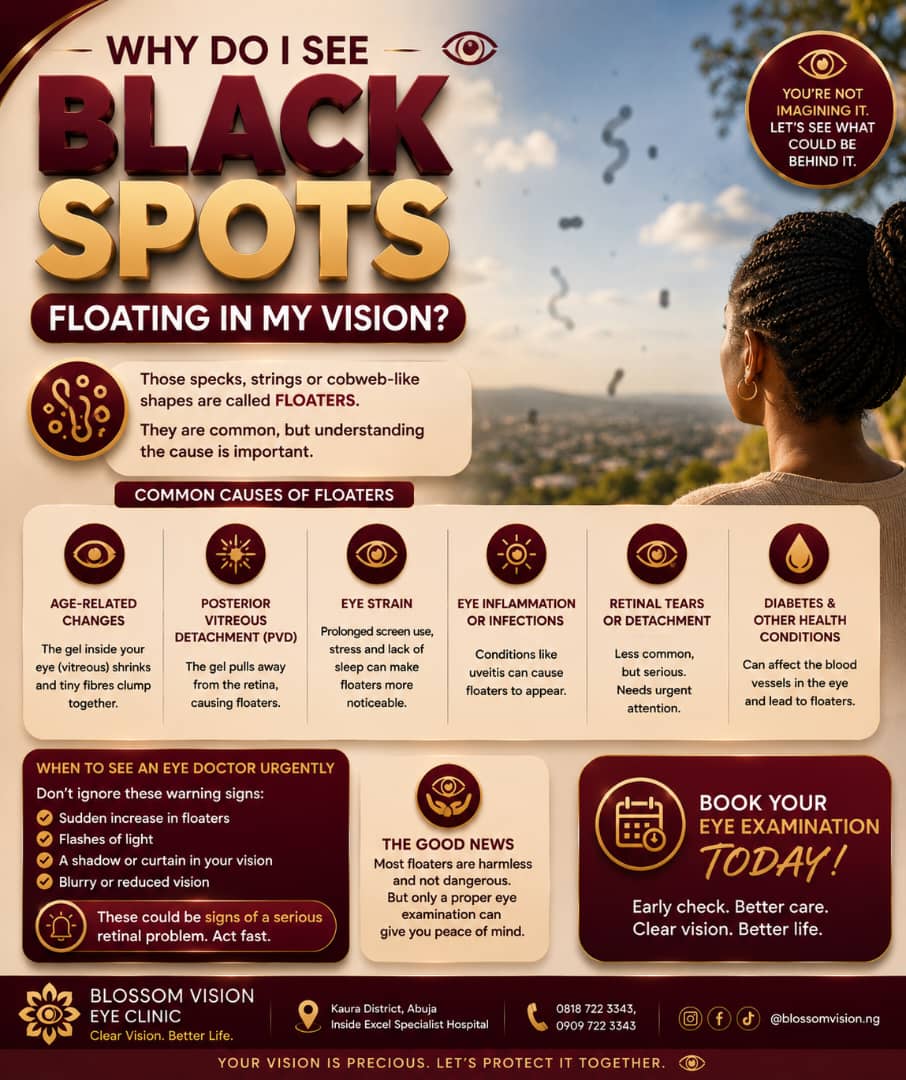
Why do i see black spot floating in my vision
Why Do I See Black Spots Floating in My Vision?
If you see black spots, strings, cobwebs or tiny shapes drifting across your vision, you may be experiencing eye floaters.
Many floaters are caused by normal changes in the clear gel inside the eye and are not dangerous.
However, a sudden increase in floaters, especially together with flashes of light, a curtain or shadow across your vision or sudden vision loss, can be a warning sign of a retinal tear or retinal detachment and requires urgent eye assessment.
Quick Answer
Eye floaters may look like:
- Tiny black dots
- Cobwebs
- Strings
- Squiggly lines
- Transparent shapes
- Small circles
- Floating specks
They often move when you move your eyes.
When you try to look directly at them, they may drift away.
Most longstanding floaters are harmless.
But new or suddenly increasing floaters should not be ignored.
The most important thing is not simply that you have floaters.
It is whether they are new, suddenly increasing or accompanied by other changes in your vision.
Book Appointment
What Are Eye Floaters?
The inside of your eye contains a clear gel-like substance called the vitreous.
As light enters the eye, small strands or clumps within this gel can cast shadows onto the retina at the back of your eye.
Those shadows are what you see as floaters.
That is why floaters may seem to move when your eyes move.
They are often easiest to notice when looking at a bright, plain background such as:
- A blue sky
- A white wall
- A computer screen
- A bright ceiling
- A blank sheet of paper
What Do Eye Floaters Look Like?
Different people describe floaters differently.
You may see:
- Black spots
- Grey dots
- Cobwebs
- Hair-like strands
- Rings
- Squiggly lines
- Transparent bubbles
- Floating specks
- Shapes that look like tiny insects
Some people notice only one or two.
Others see several.
The appearance alone cannot tell you whether a floater is harmless.
Why Do Floaters Happen?
One common cause is normal age-related change in the vitreous.
As we get older, the vitreous gradually becomes more liquid and its fine fibres may clump together.
These clumps can cast visible shadows on the retina.
Floaters may also occur in association with:
- Short-sightedness
- Changes in the vitreous
- Eye inflammation
- Bleeding inside the eye
- Eye injury
- Previous eye surgery
- Diabetic retinal disease
- Retinal tears
- Retinal detachment
This is why a sudden change in floaters deserves proper examination.
Are Eye Floaters Normal?
In many cases, yes.
A few floaters that appeared gradually and have remained stable for a long time are often harmless.
Many people notice them less over time as the brain learns to ignore them.
However, you should not assume that every new floater is harmless.
A sudden change in the number, size or appearance of floaters can be important.
When Should You Worry About Eye Floaters?
Seek urgent eye assessment if you notice:
- A sudden shower of new floaters
- Many new black spots appearing at once
- New flashes of light
- A curtain or shadow moving across your vision
- Part of your vision suddenly disappearing
- Sudden significant blurred vision
- Floaters after a significant eye injury
These symptoms can occur with a retinal tear or retinal detachment.
Early assessment matters because some retinal problems can permanently damage vision if treatment is delayed.
If you are also experiencing new unequal or blurred vision between the two eyes, read our guide on why one eye may be blurrier than the other.
What Are Flashes of Light?
Flashes may look like:
- Lightning streaks
- Camera flashes
- Sparkles
- Bright flickers
- Brief arcs of light
Flashes can occur when the vitreous pulls on or stimulates the retina.
New flashes occurring together with new floaters deserve prompt assessment.
This is particularly important if you also notice a curtain, shadow or missing area of vision.
What Is a Posterior Vitreous Detachment?
As the vitreous changes with age, it can gradually separate from the retina.
This is called a posterior vitreous detachment, often shortened to PVD.
PVD is common as people get older and often causes new floaters or flashes.
Most PVDs do not lead to retinal detachment.
However, during the separation process, the vitreous can occasionally pull hard enough to create a retinal tear.
That is why new floaters and flashes should be examined, even if your central vision still seems clear.
Can Floaters Cause Blurry Vision?
Floaters can sometimes pass across your line of sight and make part of the image seem temporarily unclear.
However, persistent or significant blurred vision should not automatically be blamed on floaters.
If your vision repeatedly becomes blurry and then clears again, read our guide on why vision may go blurry and then clear again.
Who Is More Likely to Develop Floaters?
Floaters become more common with age, but they can occur earlier.
You may be more likely to experience them if you:
- Are older
- Are significantly short-sighted
- Have had cataract surgery
- Have experienced an eye injury
- Have inflammation inside the eye
- Have diabetic retinal disease
- Have had previous retinal problems
Being in one of these groups does not mean every floater is dangerous.
It means new symptoms deserve appropriate assessment.
Can Short-Sighted People Get Floaters Earlier?
Yes.
People who are significantly short-sighted may experience vitreous changes and floaters at a younger age.
They may also have a higher risk of some retinal problems.
New flashes, sudden floaters or a curtain-like shadow should therefore never be dismissed simply because you are short-sighted.
Can Diabetes Cause Black Spots or Floaters?
Yes.
Diabetes can affect the small blood vessels in the retina.
In some cases, bleeding into the vitreous can make a person suddenly notice dark spots, strings or cloud-like shapes.
This needs prompt eye assessment.
Not every floater in someone with diabetes is caused by diabetic eye disease, so the actual cause needs to be determined by examination.
Can Stress Cause Eye Floaters?
Stress does not usually create true vitreous floaters.
However, someone who is anxious or paying close attention to their vision may become more aware of floaters that were already present.
New floaters should still be assessed based on their eye findings rather than being attributed to stress.
Why Do I Notice Floaters More Outside?
Floaters are easier to see against bright, plain backgrounds.
The blue sky, white walls and bright screens create strong contrast with the shadows cast by the floaters.
That does not necessarily mean the floaters are increasing when you go outside.
You may simply be able to see them more clearly.
Book Appointment
Do Eye Floaters Go Away?
Sometimes they become less noticeable.
The actual floater may remain inside the eye, but over time:
- It may move away from the central line of sight
- It may settle lower in the vitreous
- The brain may learn to ignore it
Many people eventually become much less aware of longstanding floaters.
However, a sudden new floater should still be assessed even if it later becomes less noticeable.
Can Eye Floaters Be Treated?
Most harmless floaters do not require treatment.
If they are stable and not significantly affecting daily life, observation may be all that is needed.
Treatment decisions are different if the floaters are caused by:
- A retinal tear
- Retinal detachment
- Bleeding inside the eye
- Significant inflammation
- Another underlying eye disease
The treatment is directed at the cause, not simply at making the spots disappear.
Should I Use Eye Drops for Floaters?
Ordinary eye drops do not remove vitreous floaters because the floaters are located inside the back of the eye, not on the eye surface.
Using random eye drops is therefore unlikely to solve true floaters.
If you are uncertain whether what you are seeing is actually a floater, an eye examination is the safer next step.
What Happens During an Eye Examination for Floaters?
When evaluating new floaters, the important area is the retina and vitreous inside the eye.
Depending on your symptoms and findings, your examination may include:
- Vision testing
- Examination of the front of the eye
- Assessment of the vitreous
- Dilated retinal examination
- Examination for retinal tears or detachment
- Eye pressure measurement where appropriate
- Overall eye health assessment
The pupils may need to be dilated with eye drops so the retina can be examined more thoroughly.
If the findings require specialist retinal treatment or further imaging, an appropriate referral can be arranged.
If you would like to understand the general cost and structure of an eye examination, see our guide to eye test prices and what is included in an eye examination in Abuja.
Are Floaters Related to Glaucoma?
Floaters are not a typical symptom of most glaucoma.
Glaucoma primarily damages the optic nerve and often develops without obvious symptoms in its early stages.
A person can have both glaucoma and floaters, but one does not automatically mean the other is present.
You can learn more about glaucoma screening and glaucoma test costs in Abuja.
When Is a Floater an Eye Emergency?
Treat the situation as urgent if you suddenly experience:
- Many new floaters
- Flashes of light
- A curtain, veil or shadow across the vision
- Loss of part of your visual field
- Sudden major loss of vision
These symptoms may indicate a retinal tear or retinal detachment.
Do not wait several days to see if they disappear.
Seek urgent eye assessment.
How We Help at Blossom Vision Eye Clinic, Abuja
At Blossom Vision Eye Clinic in Games Village, Abuja, our optometrists take sudden changes in vision seriously.
If you are experiencing floaters, we first want to understand:
- When they started
- Whether they appeared suddenly
- Whether the number has increased
- Whether you are seeing flashes
- Whether there is a curtain or shadow
- Whether your vision has changed
- Whether you recently had an injury, surgery or other eye problem
We then examine your eyes and determine if routine monitoring, additional investigation or urgent referral is appropriate.
Key Takeaways
- Floaters often look like dots, strings, cobwebs or floating specks.
- Many longstanding floaters are harmless.
- New floaters can sometimes occur as the vitreous changes with age.
- A sudden shower of floaters is different from a few longstanding stable floaters.
- New floaters with flashes deserve urgent assessment.
- A curtain or shadow over the vision may indicate a retinal emergency.
- Eye drops do not normally remove true vitreous floaters.
- A proper retinal examination is the safest way to determine the cause.
Frequently Asked Questions
Why do I see black spots floating in my vision?
The spots may be floaters caused by small strands or clumps within the vitreous gel inside your eye. However, new floaters can also occur with retinal or other eye problems and should be assessed appropriately.
Are eye floaters dangerous?
Many floaters are harmless. A sudden increase in floaters, particularly with flashes, a curtain-like shadow or vision loss, requires urgent eye assessment.
Why do floaters move when I move my eyes?
Floaters are suspended within the vitreous gel. When your eyes move, the vitreous moves too, causing the shadows to drift across your vision.
Why do I only notice floaters outside?
Floaters are easier to see against bright, plain backgrounds such as a blue sky because there is greater contrast.
Can diabetes cause floaters?
Yes. Diabetic retinal disease can sometimes cause bleeding inside the eye, which may appear as new dark spots or floaters.
Can stress cause floaters?
Stress does not usually cause true vitreous floaters, although it may make you more aware of floaters that were already present.
Should I ignore floaters if I have had them for years?
Stable floaters that have already been examined are often harmless. However, any sudden increase, change or new associated flashes should be assessed.
Can eye drops remove floaters?
Ordinary eye drops do not remove vitreous floaters because the floaters are inside the eye.
When should I see an optometrist urgently?
Seek urgent assessment if you suddenly develop many new floaters, flashes of light, a curtain or shadow across your vision or sudden vision loss.
Don't Ignore Sudden Changes in Your Vision
A few longstanding floaters may simply become part of the background of everyday vision.
A sudden change is different.
If you develop new floaters, flashes of light or a shadow across your vision, do not wait for the symptoms to become worse.
At Blossom Vision Eye Clinic in Games Village, Abuja, we can assess your eyes and determine if monitoring, further testing or urgent specialist care is required.
Book your comprehensive eye examination if your floaters are longstanding or concerning. If you suddenly develop many new floaters with flashes, a curtain or sudden vision loss, seek urgent eye care immediately.