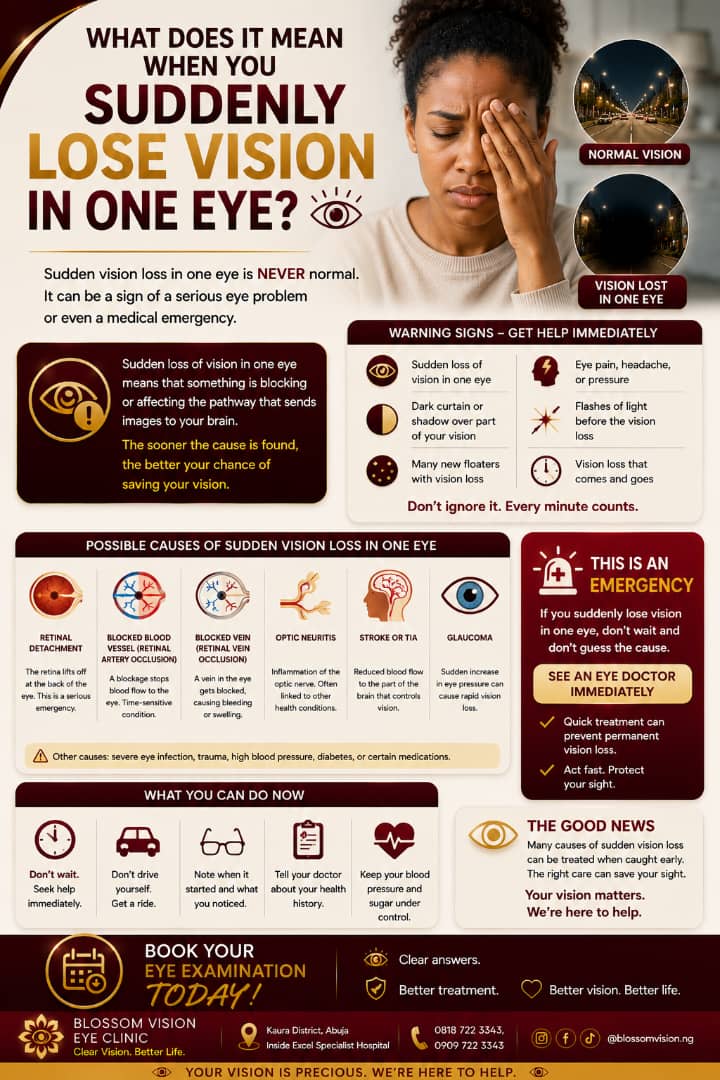
What Does It Mean When You Suddenly Lose Vision in One Eye?
What Does It Mean When You Suddenly Lose Vision in One Eye?
You close one eye.
Then open it again.
And something is wrong.
Maybe everything has suddenly become dark.
Maybe you can only see shapes.
Maybe half of your vision has disappeared.
Maybe it feels as though a curtain has come across your eye.
Or perhaps the eye has suddenly become extremely blurry.
If this happens:
Do not wait to see if it gets better.
Sudden significant loss of vision in one eye should be treated as a medical emergency until the cause has been identified.
Some causes can permanently damage vision.
Others may be related to problems affecting blood circulation that also increase the risk of stroke.
And some treatments are most useful when assessment happens quickly.
If you have suddenly lost vision in one eye right now, go to the nearest emergency department or emergency ophthalmic service immediately. Do not wait for a routine eye appointment.
Quick Answer: What Does Sudden Vision Loss in One Eye Mean?
Sudden vision loss in one eye can happen because something has affected:
- The retina
- The blood vessels supplying the retina
- The optic nerve
- The clear gel inside the eye
- The cornea or other eye structures
- Occasionally the nervous system
Important causes include:
- Retinal detachment
- Retinal artery occlusion, sometimes called an eye stroke
- Retinal vein occlusion
- Vitreous haemorrhage
- Optic-nerve disease
- Severe eye-pressure emergencies
- Eye injury
- Certain neurological or vascular conditions
The important thing is:
You cannot safely work out the cause at home.
Book Appointment
Is Sudden Vision Loss in One Eye Really an Emergency?
Yes.
Especially when the loss is:
sudden
new
and
significant.
Some people delay because the eye does not hurt.
That is dangerous thinking.
Several serious causes of sudden monocular vision loss are painless.
For example, central retinal artery occlusion typically causes sudden, painless and often severe loss of vision in one eye. It requires emergency evaluation.
So:
“It doesn't hurt”
does not mean:
“It isn't serious.”
1. Could It Be a Retinal Detachment?
Yes.
The retina is the light-sensitive tissue lining the back of your eye.
Think of it like the sensor inside a digital camera.
If the retina separates from its normal position, it cannot function normally.
Possible warning symptoms include:
- A sudden increase in floaters
- Flashes of light
- A dark curtain
- A shadow across part of your vision
- Loss of side vision
- Sudden blurry or reduced vision
The National Eye Institute describes retinal detachment as a medical emergency and advises immediate assessment because delay increases the risk of permanent vision loss.
What Does the Curtain From Retinal Detachment Feel Like?
Patients describe it in different ways:
“Something dark came from the side.”
“It looks like a curtain is closing.”
“Half of what I'm looking at has disappeared.”
“There is a shadow that doesn't go away.”
That is very different from an ordinary floater drifting around.
If you suddenly see a curtain or shadow:
seek emergency eye care immediately.
If you have new floaters or flashes but have not lost vision, read Why Do I See Black Spots Floating in My Vision?.
2. What Is an Eye Stroke?
This is one of the most important additions to this article.
A central retinal artery occlusion, or CRAO, happens when blood flow through the main artery supplying the retina becomes blocked.
In simple language:
blood suddenly stops reaching part of the retina properly.
This can cause:
- Sudden vision loss
- Usually in one eye
- Often without pain
- Sometimes very severe loss of vision
CRAO is considered a form of acute ischemic stroke and requires rapid emergency evaluation.
So if somebody tells you:
“My sight suddenly disappeared in one eye and there is no pain,”
do not simply send them for a new glasses prescription.
They need emergency assessment.
What Causes an Eye Stroke?
A retinal artery may become blocked by material travelling through the circulation or by other vascular problems.
Risk factors may overlap with those for cardiovascular and cerebrovascular disease.
These include conditions such as:
- High blood pressure
- High cholesterol
- Diabetes
- Smoking
- Carotid-artery disease
- Certain heart problems
But a person does not need to know their risk factors before seeking help.
The sudden vision loss itself is enough reason to go.
Once your High Blood Pressure article is published, link it naturally from this section using its exact URL.
3. Can a Blocked Retinal Vein Cause Sudden Blurry Vision?
Yes.
A central retinal vein occlusion, or CRVO, occurs when the main vein draining blood from the retina becomes blocked.
It usually affects one eye.
People may experience:
- Sudden blurry vision
- Reduced vision
- Sometimes substantial vision loss
The National Eye Institute lists blurry vision and sudden vision loss among CRVO symptoms.
A retinal vein occlusion is different from a retinal artery occlusion, but sudden visual loss still needs urgent assessment so the cause can be identified and appropriate management arranged.
4. Can Diabetes Suddenly Affect My Vision?
Yes.
Diabetes can cause several eye complications.
One important cause of sudden visual deterioration is bleeding into the vitreous, the clear gel inside the eye.
This is called a vitreous haemorrhage.
A person might suddenly notice:
- Many dark floaters
- Cobwebs
- Hazy vision
- A smoky appearance
- A reddish tint
- Significant reduction in vision
Vitreous haemorrhage often causes rapid, painless loss or haze of vision and can occur with diabetic retinal disease, retinal tears and other conditions.
If you have diabetes, read Can Diabetes Affect My Eyes Even If I Can See Clearly?.
But if your sight has suddenly disappeared or dramatically reduced, do not stop to read multiple articles first.
Get assessed urgently.
5. What Is a Vitreous Haemorrhage?
The inside of your eye is filled with clear vitreous gel.
If blood enters this clear space, light can no longer pass through normally.
Imagine dropping red ink into a clear bottle of water.
Depending on how much bleeding occurs, the patient may see:
a few new floaters
or:
almost nothing clearly.
Possible causes include:
- Diabetic retinal disease
- Retinal tears
- Retinal vascular problems
- Trauma
- Other retinal conditions
The bleeding itself is important.
But even more important is finding why it happened.
6. Can an Optic-Nerve Problem Cause Sudden Vision Loss?
Yes.
The optic nerve carries visual information from your eye toward your brain.
If the optic nerve becomes inflamed, loses blood supply or is otherwise damaged, vision may decrease.
One example is optic neuritis.
Typical optic neuritis may cause:
- Reduced vision in one eye
- Colours appearing washed out
- Pain around the eye
- Pain that becomes worse when moving the eye
Optic neuritis commonly causes acute unilateral loss of vision with reduced colour vision and pain on eye movement.
This requires proper medical assessment because optic-nerve disease has several possible causes.
Does Pain When I Move My Eye Matter?
Yes.
Tell the doctor if:
“The vision is blurry and it hurts when I move the eye.”
That pattern can provide an important clue.
But do not use the absence of pain to rule out serious disease.
Many vascular and retinal causes of sudden visual loss are painless.
7. What If I Am Over 50 and Suddenly Lose Vision?
There is an additional emergency that becomes particularly important in older adults.
It is called giant cell arteritis, sometimes called temporal arteritis.
This is inflammation involving certain arteries.
It can affect the blood supply to the optic nerve and cause severe permanent vision loss.
Warning symptoms may include sudden visual loss together with:
- A new headache
- Tenderness of the scalp
- Pain or tiredness in the jaw while chewing
- Double vision
- Muscle aches
- Feeling generally unwell
Giant cell arteritis is an ophthalmic emergency because the second eye can also become affected if treatment is delayed.
So a person over 50 with new visual loss plus these symptoms needs immediate medical assessment.
8. Can Glaucoma Suddenly Take Away My Vision?
The common form of glaucoma, open-angle glaucoma, usually does not suddenly make one eye go blind.
It tends to progress gradually and can have no noticeable early symptoms.
However, acute angle-closure glaucoma is different.
It can cause:
- Severe eye pain
- Red eye
- Blurry or hazy vision
- Halos around lights
- Headache
- Nausea
- Vomiting
This is an emergency because very high eye pressure can rapidly damage the optic nerve.
So:
sudden loss of vision + severe painful red eye
needs immediate assessment.
If you are asking about ordinary glaucoma risk rather than an emergency, read How Do I Know If I Have Glaucoma?.
9. Can an Eye Injury Suddenly Reduce Vision?
Yes.
Any significant injury can damage:
- Cornea
- Lens
- Retina
- Optic nerve
- Blood vessels
- Other structures inside the eye
If vision falls suddenly after:
- Being punched
- A fall
- A car accident
- Sports injury
- A sharp object
- Something striking the eye
seek urgent eye care.
Do not assume:
“There isn't much blood outside, so the inside must be fine.”
Serious internal injuries can exist without dramatic external appearance.
What About a Chemical Splash?
If a chemical enters your eye:
start rinsing immediately.
Use plenty of clean running water or appropriate irrigation fluid.
Do not wait until you reach the clinic before beginning irrigation.
Then seek urgent medical assessment.
10. Can a Stroke in the Brain Affect My Vision?
Yes.
Vision is not produced by the eyeball alone.
The brain plays a major role.
Stroke affecting visual pathways in the brain may cause sudden visual-field loss.
Patients sometimes believe:
“Only one eye has gone blind,”
when careful testing shows that the same side of the visual field is missing from both eyes.
That distinction may not be obvious to the patient.
If sudden vision change happens together with:
- Facial weakness
- Arm or leg weakness
- Difficulty speaking
- Confusion
- Severe loss of balance
- Other new neurological symptoms
call for emergency medical care immediately.
Book Appointment
What If My Vision Comes Back After Five Minutes?
Still seek urgent medical assessment.
Do not assume the danger has passed.
Temporary loss of vision in one eye is sometimes called transient monocular vision loss or amaurosis fugax.
Some episodes are caused by temporarily reduced blood flow to the retina or optic nerve.
Ischemic transient monocular vision loss can act as a warning of vascular disease and possible stroke risk, so urgent assessment is important even if the sight returns completely.
This is one of the biggest improvements I would make to your article.
The patient must understand:
Vision returning does not automatically mean everything is safe.
What Does Temporary Vision Loss Feel Like?
Patients may describe:
“A curtain came down and then disappeared.”
“Everything went grey for two minutes.”
“My right eye completely blacked out, then came back.”
“It looked like a shade came across my eye.”
That history is extremely important.
Tell the medical team:
- Which eye
- Exactly what you saw
- How quickly it began
- How long it lasted
- Whether vision completely returned
- Whether there were other symptoms
Could Temporary Vision Loss Just Be Migraine?
Migraine can cause visual symptoms.
But be very careful here.
Do not diagnose a first episode of sudden monocular vision loss as:
“just migraine.”
Retinal migraine is a diagnosis of exclusion, meaning more serious vascular and ocular causes of transient monocular loss should first be considered.
Typical migraine aura also commonly affects visual processing involving both eyes, even though the patient may initially think it is one eye.
If you suddenly lose sight in one eye for the first time:
get assessed.
Is Sudden Blurry Vision the Same as Sudden Vision Loss?
Not necessarily.
Vision loss can range from:
slightly reduced
to:
completely black.
Someone may still technically see but say:
“Everything suddenly became foggy.”
That can still represent a serious change.
The urgency depends on:
- How sudden it was
- How much vision changed
- Whether it is one eye or both
- Associated symptoms
- Medical history
If your vision has gradually been different between the two eyes rather than suddenly changing, read Why Is One Eye Blurrier Than the Other?.
But sudden new reduction is different.
What If There Is No Pain?
Still go.
This point deserves repetition.
Some of the most serious eye emergencies can be painless.
Examples include:
- Retinal artery occlusion
- Retinal detachment
- Vitreous haemorrhage
- Some retinal vein occlusions
- Ischemic optic-nerve disease
Pain does not determine whether vision loss is serious.
What If I Only Lose Side Vision?
That is still vision loss.
Do not think:
“I can still read, so everything is okay.”
Loss of peripheral vision can occur with retinal detachment, retinal vascular disease, neurological disease and other conditions.
A new curtain, shadow or missing section of vision requires urgent assessment.
What If I Suddenly See Lots of Black Spots Before Losing Vision?
New floaters, particularly a sudden shower of them, may accompany:
- Posterior vitreous detachment
- Retinal tear
- Retinal detachment
- Vitreous bleeding
If you have:
many new floaters + flashes + a shadow or curtain
go for emergency eye assessment.
Read Why Do I See Black Spots Floating in My Vision? for more explanation, but do not delay emergency care to finish reading if these symptoms are happening now.
Can High Blood Pressure Cause Sudden Vision Loss?
High blood pressure can increase the risk of retinal vascular problems and can damage retinal circulation over time.
Severe hypertension can also cause serious eye and systemic complications.
But sudden vision loss should not simply be labelled:
“It must be my blood pressure.”
The underlying cause needs to be identified urgently.
Once your High Blood Pressure article is published, link it here using its actual URL.
Can Diabetes Cause Sudden Vision Loss?
Yes, but through several different possible complications.
Diabetes can increase the risk of:
- Diabetic retinal disease
- Vitreous haemorrhage
- Retinal vascular problems
- Other vision-threatening complications
Again, the important issue is not simply knowing that someone has diabetes.
It is determining what has happened inside the eye.
What Should I Do Right Now If I Suddenly Lose Vision?
If this is happening now:
- Do not wait until tomorrow.
- Do not drive yourself if your vision is significantly affected.
- Do not spend hours searching Google for the diagnosis.
- Do not keep changing glasses or buying eye drops.
- Go to the nearest emergency department or emergency ophthalmic service immediately.
- Tell them exactly what time the vision loss started.
That last point can be medically important because some vascular emergencies are time-sensitive.
For suspected central retinal artery occlusion, the American Heart Association recommends rapid triage to an emergency department and stroke-style evaluation.
Should I Put Eye Drops in the Eye?
Not as a substitute for emergency assessment.
Ordinary lubricating, antibiotic or redness-relief drops cannot treat:
- Retinal detachment
- Retinal artery occlusion
- Optic-nerve ischemia
- Stroke
- Vitreous haemorrhage
Do not lose valuable time experimenting with drops.
Should I Cover the Eye and Sleep?
No.
If vision has suddenly significantly decreased:
do not sleep on it to see what happens in the morning.
Some eye and vascular emergencies are time-sensitive.
What Will the Emergency Team Check?
Assessment will depend on the suspected cause.
It may include:
- Visual acuity
- Pupillary reactions
- Eye movements
- Visual field
- Eye pressure
- Slit-lamp examination
- Dilated retinal examination
- Optic-nerve assessment
- Retinal imaging
- Ultrasound if the retina cannot be seen
- Blood-pressure measurement
- Blood tests
- Brain or vascular imaging where needed
- Stroke evaluation where indicated
No single test identifies every possible cause.
Can an Ordinary Glasses Test Rule Out an Emergency?
No.
Someone can have:
retinal detachment
retinal artery occlusion
or:
optic-nerve disease
without the problem being solved by refraction.
That is why sudden vision loss should never be handled as:
“Let's just check whether you need stronger glasses.”
What Happens if I Come to Blossom Vision With Sudden Vision Loss?
At Blossom Vision Eye Clinic in Games Village, Abuja, sudden vision loss should be treated as an urgent triage problem, not an ordinary glasses appointment.
If someone presents with sudden significant vision loss, the priority is to:
- Identify emergency warning signs
- Assess the eye as appropriate
- Determine whether immediate ophthalmology, emergency-department or stroke evaluation is required
- Arrange or direct urgent referral without unnecessary delay
But if you are currently at home experiencing sudden major vision loss, do not delay emergency care because you are waiting for a routine Blossom Vision appointment.
Go directly to an appropriate emergency service.
After emergency treatment, Blossom Vision can support ongoing eye-care follow-up where appropriate.
Frequently Asked Questions
Is sudden vision loss in one eye an emergency?
Yes. Sudden significant monocular vision loss should be urgently assessed because causes include retinal detachment, retinal artery occlusion and optic-nerve disease.
What does an eye stroke feel like?
A central retinal artery occlusion classically causes sudden, painless and often severe loss of vision in one eye.
Can an eye stroke happen without pain?
Yes. Retinal artery occlusion is typically painless.
Can vision return after suddenly disappearing?
Sometimes. But temporary monocular loss can still indicate retinal or vascular ischemia and warrants urgent medical assessment.
What does a retinal detachment look like?
People may notice sudden floaters, flashes and a curtain or shadow over part of their vision.
What if I see lots of new floaters and flashes?
Seek urgent eye assessment, particularly if there is also a curtain, shadow or vision loss.
Can high blood pressure cause sudden vision loss?
Hypertension can contribute to retinal vascular disease, but sudden vision loss requires urgent assessment to identify the exact cause.
Can diabetes cause sudden vision loss?
Diabetes can contribute to conditions such as vitreous haemorrhage and diabetic retinal complications that may suddenly reduce vision.
What if my vision loss is painless?
Still seek emergency care. Several serious causes of sudden vision loss are painless.
Can migraine cause temporary loss of vision?
Migraine can cause visual disturbances, but new sudden loss of vision in one eye should not automatically be diagnosed as migraine before serious vascular and ocular causes are considered.
What if I'm over 50 and suddenly lose vision?
Seek emergency care, especially if you also have a new headache, scalp tenderness or jaw pain when chewing because giant cell arteritis is one important emergency that must be considered.
Should I wait until morning?
No.
Should I drive myself to hospital?
If your vision is significantly affected, arrange for someone else to take you or use appropriate emergency transport.
If Your Vision Suddenly Disappears, Time Matters
This is not the article where I would end with:
“Book your comprehensive eye examination today.”
I would end with this instead:
Sudden Vision Loss Should Not Wait
If vision in one eye suddenly becomes dark, severely blurry, partially missing or covered by a curtain or shadow:
seek emergency medical or ophthalmic care immediately.
Even if there is no pain.
Even if you are young.
Even if you think you only need new glasses.
And even if the vision comes back.
Some causes of sudden monocular vision loss can permanently damage sight, while retinal artery occlusion can also signal serious vascular disease requiring stroke evaluation.
Do not wait for a routine appointment. Go to the nearest appropriate emergency service now.
After emergency assessment and treatment, Blossom Vision Eye Clinic in Abuja can support ongoing eye care and monitoring where appropriate.