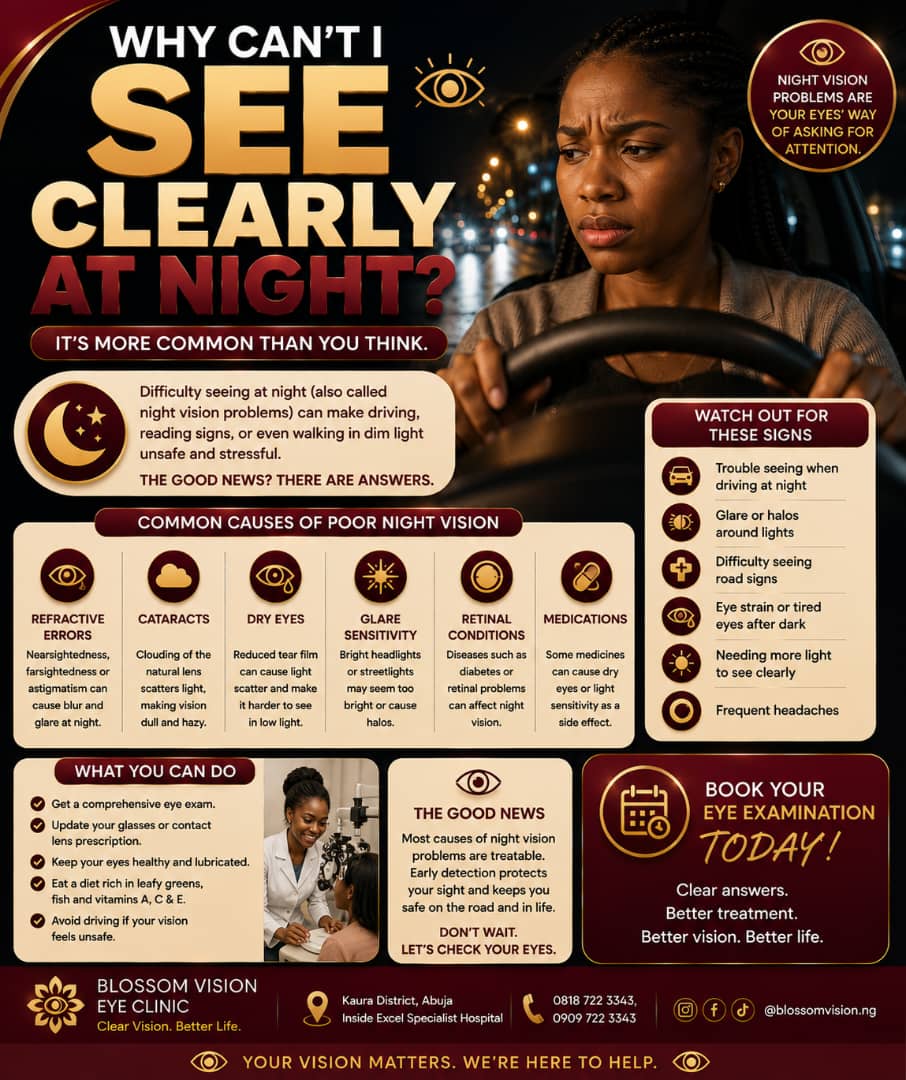
Why Can't I See Clearly at Night?
Why Can't I See Clearly at Night?
During the day, everything seems fine.
You can:
- Read road signs
- Recognise faces
- Work
- Watch television
- Drive comfortably
Then the sun goes down.
Suddenly:
Road signs become harder to read.
Headlights seem painfully bright.
People are harder to see.
The road looks less clear.
Maybe you have even started saying:
“I don't like driving at night anymore.”
or:
“My eyesight is fine during the day. Why can't I see properly once it gets dark?”
There are several possible reasons.
Some are relatively simple, such as:
- An outdated glasses prescription
- Astigmatism
- Dry-eye or tear-film problems
Others include:
- Cataracts
- Retinal conditions
- Certain inherited eye diseases
- Less commonly, nutritional or other medical problems
So difficulty seeing at night should not automatically be dismissed as:
“I'm just getting older.”
The first step is understanding what kind of night-vision problem you actually have.
Quick Answer: Why Can I See During the Day but Not at Night?
Nighttime places different demands on your visual system.
You have:
- Less light available
- Lower contrast
- Larger pupils
- Bright headlights surrounded by darkness
- More difficulty seeing small details
Problems that seem minor during the day may therefore become much more noticeable after dark.
Common possibilities include:
- Astigmatism or another refractive error
- A glasses prescription that has changed
- Cataract
- Dry or unstable tear film
- Corneal problems
- Certain retinal conditions
Cataracts, for example, can cause poor night vision, excessive brightness from headlights and halos around lights.
Book Appointment
Is Poor Night Vision the Same as Night Blindness?
Not always.
People often use the phrase night blindness to describe any difficulty driving after sunset.
Clinically, night blindness, also called nyctalopia, generally means an abnormal difficulty seeing or adapting in low-light conditions.
Someone with true night-vision impairment may struggle to:
- Move around in a dark room
- Walk outside in dim lighting
- Adjust after leaving a brightly lit area
- See objects that others can see in low light
But someone who says:
“I can see the road, but every headlight blinds me”
may actually have a glare problem rather than true night blindness.
And someone who says:
“Every streetlight has a circle around it”
may primarily be experiencing halos.
Those are related complaints, but they are not exactly the same problem.
Why Is Seeing at Night Harder Than Seeing During the Day?
Your eyes have to work with much less light after dark.
Your pupils become larger to allow more light into the eye.
Your retina also contains specialised light-sensitive cells that are important for seeing in low-light conditions.
That means problems involving:
- How light enters the eye
- How clearly it is focused
- How transparent the lens is
- How healthy the retina is
can become more obvious at night.
This is why somebody may genuinely have good daytime vision but notice significant difficulties after sunset.
1. Could I Simply Need New Glasses?
Yes.
This is one of the first things worth checking.
A refractive error means light is not being focused properly by the eye.
Examples include:
- Short-sightedness
- Long-sightedness
- Astigmatism
Refractive errors can cause blurred or hazy vision, glare and halos around bright lights.
During bright daytime conditions, you may cope reasonably well.
At night, the problem may become more noticeable.
You might say:
“My glasses still work during the day, but nighttime isn't as clear anymore.”
That is worth checking.
Can Astigmatism Make Night Driving Difficult?
Yes.
Astigmatism can make light appear:
- Blurry
- Stretched
- Star-shaped
- Surrounded by glare or halos
It may become particularly noticeable around:
- Headlights
- Streetlights
- Traffic lights
If your prescription has not been checked recently, an eye examination can determine whether astigmatism or another refractive error is contributing.
What If My Glasses Used to Work Fine?
Prescriptions can change.
If you previously drove comfortably at night but now notice:
- Blurry signs
- Increasing glare
- Squinting
- Headaches
- Halos
have the prescription checked rather than simply assuming nighttime itself has become the problem.
Read Why Do I Keep Changing My Glasses Prescription?.
2. Can Cataracts Make It Hard to See at Night?
Yes.
Cataracts are an important cause of worsening night vision, particularly as people get older.
A cataract means the natural lens inside your eye becomes cloudy.
Instead of light passing cleanly through the lens, some of it becomes scattered.
You may notice:
- Cloudy or blurry vision
- Poor night vision
- Headlights appearing excessively bright
- Halos around lights
- Colours becoming less vivid
- Frequent prescription changes
These are recognised symptoms of cataract.
Can Cataracts Affect Night Vision Before Daytime Vision?
They can.
Some people first realise something is wrong because:
“Driving at night has become terrible.”
They may still function reasonably well during daylight.
Nighttime glare, low contrast and bright headlights can reveal the problem earlier.
That does not automatically mean every person with poor night vision has cataracts.
But cataract assessment should be part of the examination when appropriate.
Do I Just Need Stronger Glasses for Cataracts?
Not necessarily.
Early cataract-related vision changes can sometimes be improved temporarily by updating the prescription.
But if the clouding of the natural lens becomes the main reason you cannot see clearly, stronger glasses cannot make that cloudy lens transparent again.
An ophthalmologist can assess when cataract surgery becomes appropriate.
3. Can Dry Eyes Affect My Night Vision?
Yes.
Your tear film forms the first smooth optical surface that light passes through.
If the tear film becomes unstable, vision may fluctuate.
You may experience:
- Blur
- Glare
- Burning
- Watering
- Grittiness
- Difficulty keeping lights sharp
A useful clue is:
You blink and things briefly become clearer.
Then they become fuzzy again.
If this happens, dry eye may be contributing.
Why Might Dry Eye Be Worse at Night?
By evening, you may already have spent hours:
- Using a computer
- Looking at your phone
- Sitting in air conditioning
- Driving
- Blinking less during concentrated work
Your eye surface may be less comfortable by the end of the day.
That can make nighttime visual problems more noticeable.
If your eyes also feel sandy, gritty, burning or watery, your dry-eye article should link naturally here.
4. Why Do Headlights Look So Bright?
Sometimes the problem is not that you cannot see in darkness.
It is that bright lights interfere with what you can see around them.
Possible contributors include:
- Cataract
- Astigmatism
- Prescription problems
- Tear-film instability
- Dirty glasses
- Scratched lenses
- Windscreen glare
- Headlight design and brightness
If the main thing you say is:
“Every car looks like it is using full beam,”
read Why Do Headlights Blind Me at Night?.
That is a slightly different problem from true difficulty seeing in dim environments.
5. Why Do I See Rings Around Lights at Night?
Those circles are commonly described as halos.
Possible causes include:
- Astigmatism
- Cataract
- Dry-eye or tear-film problems
- Corneal irregularity
- Prescription problems
If your main symptom is:
“Every streetlight has a glowing circle around it,”
your [Why Do I See Halos Around Lights at Night?] article should be linked here using its exact published URL.
That page should remain separate from this one.
6. Can Retinal Problems Cause Poor Night Vision?
Yes.
Your retina contains specialised cells that help you see in low-light conditions.
Some diseases affecting the retina can therefore interfere significantly with night vision.
One important example is retinitis pigmentosa, or RP.
The National Eye Institute identifies loss of night vision as a common early symptom of retinitis pigmentosa, often alongside progressive loss of peripheral vision.
RP is uncommon, so we should not frighten every person struggling with night driving by suggesting they have an inherited retinal disease.
But it becomes more relevant if someone reports:
- Significant difficulty moving in darkness
- Very slow adaptation from light to dark
- Loss of peripheral vision
- Symptoms beginning relatively young
- Similar problems in family members
That deserves proper retinal assessment.
What Is Retinitis Pigmentosa?
Retinitis pigmentosa is a group of inherited conditions that gradually damage cells in the retina.
A person may initially notice:
“I can't see where everybody else can see at night.”
Later, side vision may also become affected.
Diagnosis may require specialised retinal testing beyond a routine glasses check.
If examination raises suspicion, appropriate specialist referral is important.
7. Can Diabetes Affect Night Vision?
Diabetes can affect the eyes in several ways.
It can be associated with:
- Fluctuating vision
- Cataract
- Diabetic retinopathy
- Other retinal complications
Diabetic retinopathy can eventually cause significant visual impairment.
But I would not tell every diabetic patient with poor night vision that diabetic retinopathy is the cause.
The retina needs to be examined.
If you have diabetes, even good daytime vision does not prove the retina is healthy.
Read Can Diabetes Affect My Eyes Even If I Can See Clearly?.
8. Can Glaucoma Cause Poor Night Vision?
This requires careful explanation.
The common form, open-angle glaucoma, usually develops slowly without obvious symptoms at first.
As it progresses, peripheral or side vision can be lost.
Significant peripheral vision loss can make:
- Navigating dark environments
- Seeing obstacles
- Driving
more difficult.
But I would not present glaucoma as a common explanation for someone whose only complaint is blurry night vision.
If glaucoma risk is a concern, it should be assessed based on:
- Optic nerve
- Eye pressure
- Visual field
- Family history
- Age
- Other risk factors
rather than diagnosing it from night-driving difficulty.
9. Can Vitamin A Deficiency Cause Night Blindness?
Yes.
Vitamin A is important for the retinal processes that allow vision in low light.
Severe deficiency can cause night blindness.
But this is where online advice becomes dangerous.
If you struggle to see at night, do not simply start taking high doses of vitamin A.
Poor night vision has many possible causes.
And excessive vitamin A can itself be harmful.
The correct approach is:
Find the reason first.
Nutritional treatment is appropriate only when deficiency is actually relevant.
10. Does Getting Older Make Night Vision Worse?
Certain normal age-related changes can make low-light vision more challenging.
For example:
- Less light may reach the retina
- The natural lens changes
- Cataracts become more common
- Adaptation to different lighting conditions may become slower
But ageing by itself should not be used to dismiss significant visual difficulty.
The National Eye Institute specifically notes that ageing itself does not simply cause low vision, although eye diseases that cause visual impairment become more common with age.
So:
“You're getting old, just manage it”
is not a diagnosis.
Book Appointment
Why Does It Take My Eyes So Long to Adjust When I Enter a Dark Room?
Imagine leaving a bright Abuja afternoon and walking into a dim cinema.
For a short time, the room may look extremely dark.
Your visual system then adjusts.
Some adaptation time is normal.
But if other people begin navigating comfortably while you are still unable to see much at all, and this repeatedly happens, mention it during your eye examination.
Significantly impaired dark adaptation can be an important symptom of retinal disease.
Why Can't I Recognise Faces at Night?
Low lighting reduces contrast and makes fine detail harder to see.
If you already have:
- Refractive error
- Cataract
- Reduced contrast sensitivity
- Retinal disease
recognising faces can become particularly difficult.
People may say:
“I know someone is standing there, but I can't tell who it is until they come closer.”
That is useful information to give your optometrist.
Why Are Road Signs Blurry at Night?
Possible reasons include:
- Short-sightedness
- Astigmatism
- Outdated prescription
- Cataract
- Tear-film problems
If your road signs become clear when you move closer, refractive error deserves particular consideration.
An eye examination can determine whether an updated prescription improves the problem.
Why Do I See Better During the Day Without Glasses?
Bright light makes your pupil smaller.
A smaller pupil can sometimes reduce the effect of certain optical imperfections and make vision seem sharper.
At night, the pupil becomes larger.
That may expose blur that you barely noticed during daylight.
This is one reason a mild refractive problem may become much more obvious after dark.
Do I Need Special Night-Driving Glasses?
Do not start with the product.
Start with the problem.
There is no single pair of “night-driving glasses” that fixes every cause of poor night vision.
If the cause is:
Astigmatism: correct the astigmatism.
Wrong prescription: correct the prescription.
Dry eye: manage the eye surface.
Cataract: assess the cataract.
Retinal disease: manage or refer appropriately.
Buying tinted or heavily marketed glasses without knowing the cause can waste money and may not make driving safer.
What About Yellow Night-Driving Glasses?
Be cautious.
Any tinted lens reduces some of the light reaching your eyes.
At night, you already have less light available.
So yellow or dark “night-driving” lenses should not automatically be recommended as a solution for poor night vision.
If night driving has become difficult, the priority is finding the reason.
Can Anti-Reflective Coating Help?
A good anti-reflective coating can reduce reflections from the surfaces of spectacle lenses.
Some patients find this makes night driving more comfortable.
But it cannot cure:
- Cataract
- Retinal disease
- Dry eye
- An incorrect prescription
- Glaucoma
It is an optical feature, not a treatment for every night-vision problem.
Can Blue Light Glasses Improve Night Vision?
Do not rely on blue-light filtering glasses to treat poor night vision.
They do not correct:
- Cataracts
- Retinal disease
- Astigmatism
- Poor dark adaptation
- Dry eye
If someone cannot see properly at night, adding a blue-light filter without investigating the reason misses the real problem.
What Can I Do Before Driving at Night?
First, make sure the simple things are right.
- Keep your spectacle lenses clean
- Keep your windscreen clean inside and outside
- Wear your correct prescription
- Avoid driving when extremely tired
- Make sure headlights and windscreens are properly maintained
- Have persistent visual symptoms assessed
But do not let these simple steps become an excuse to avoid an examination when your vision has genuinely changed.
Is It Safe for Me to Keep Driving at Night?
Ask yourself a more important question:
Can I still drive safely?
Are you struggling to:
- See pedestrians?
- Identify motorcycles?
- Read road signs?
- See lane markings?
- Judge distances?
- Recover after oncoming headlights?
- See objects at the side of the road?
If yes, do not force yourself to keep driving at night just because:
“I've always driven at night.”
Avoid night driving until the problem has been assessed if you cannot see road hazards reliably.
Can My Night Vision Be Improved?
Sometimes dramatically.
It depends entirely on the cause.
For example:
Prescription problem: appropriate glasses may help.
Dry eye: treating the tear film may improve visual quality.
Cataract: cataract treatment may substantially improve vision when clinically appropriate.
Retinal disease: treatment, monitoring, referral or visual rehabilitation depends on the condition.
So the answer is not:
“Yes, everybody can be cured.”
It is:
“Let's first find out why you aren't seeing properly.”
When Should I Book an Eye Examination?
Arrange an eye examination if:
- Your night vision has noticeably worsened
- You have stopped driving at night because of your vision
- Road signs are becoming harder to read
- Headlights increasingly interfere with your vision
- Your glasses no longer provide clear nighttime vision
- You see halos or starbursts
- One eye is worse than the other
- You take unusually long to adjust to darkness
- Your peripheral vision seems reduced
You can see our current guide to eye test costs in Abuja.
When Is a Change in Night Vision Urgent?
Poor night vision that has developed gradually is different from sudden vision loss.
Seek urgent eye or medical assessment if you develop:
- Sudden significant reduction in vision
- A curtain or shadow over your vision
- Sudden flashes with many new floaters
- Sudden loss of side vision
- Severe eye pain
- A very red painful eye
- Sudden double vision
- New neurological symptoms
If you suddenly see new black spots or floaters, read Why Do I See Black Spots Floating in My Vision?.
What Happens During an Eye Examination for Poor Night Vision?
At Blossom Vision Eye Clinic in Games Village, Abuja, we do not simply say:
“You're getting older.”
We need to determine why nighttime vision has changed.
Depending on your symptoms, your examination may assess:
- Visual acuity
- Current glasses
- Refraction and astigmatism
- Tear film and eye surface
- Cornea
- Natural lens and possible cataract
- Eye pressure
- Retina
- Optic nerve
- Visual field where clinically appropriate
- Other tests or referral where necessary
We may also ask:
- Can you see clearly during the day?
- Is the problem mainly blur, glare or darkness?
- Do you see halos?
- Do headlights look star-shaped?
- Is one eye worse?
- How quickly do you adapt to darkness?
- Have you stopped driving at night?
- Do you have diabetes?
- Do you have a family history of retinal disease?
- Has your peripheral vision changed?
Those answers can help separate very different causes.
Frequently Asked Questions
Why can I see clearly during the day but not at night?
Low-light conditions make some refractive, lens and retinal problems more noticeable. Possible causes include prescription errors, astigmatism, cataract, tear-film problems and certain retinal conditions.
Is poor night vision the same as night blindness?
Not necessarily. Night blindness, or nyctalopia, more specifically refers to abnormal difficulty seeing in dim light. Night-driving difficulty may instead be caused by glare, halos, cataracts or refractive problems.
Can cataracts affect night vision?
Yes. Cataracts can cause poor night vision, blurry vision, glare, bright headlights and halos.
Can glasses improve night vision?
Yes, when refractive error or an outdated prescription is contributing. Glasses cannot make a cloudy cataract lens clear or treat retinal disease.
Can astigmatism make night driving difficult?
Yes. Refractive errors can produce blur, glare or halos around lights.
Can dry eyes make my night vision blurry?
An unstable tear film can cause fluctuating vision and glare, particularly if symptoms worsen after a long day.
Can glaucoma cause poor night vision?
Advanced glaucoma can reduce peripheral vision and make navigation more difficult, but common open-angle glaucoma usually develops without obvious early symptoms and should not be diagnosed simply from nighttime blur.
What retinal disease can cause night blindness?
Retinitis pigmentosa is one important example. Loss of night vision is commonly one of its early symptoms.
Can vitamin A deficiency cause night blindness?
Yes, severe vitamin A deficiency can impair the retinal processes required for low-light vision. Do not self-treat unexplained night vision problems with high-dose supplements.
Do yellow glasses improve night driving?
Tinted lenses are not a universal treatment for poor night vision and reduce some incoming light. The underlying cause should be identified first.
Should I stop driving at night?
If you cannot reliably see pedestrians, road signs, lane markings or other hazards, avoid night driving until your vision has been assessed.
Where can I get poor night vision checked in Abuja?
Blossom Vision Eye Clinic provides comprehensive eye examinations in the Games Village/Kaura District area of Abuja.
Don't Simply Accept Poor Night Vision as Ageing
If you have reached the point where you say:
“I don't drive at night anymore because I can't see properly,”
that is valuable information.
The problem might be as simple as an outdated prescription.
It might be dry eye.
It could be cataract.
Or there may be another eye condition that deserves investigation.
At Blossom Vision Eye Clinic in Games Village, Abuja, we can assess your prescription, cornea, natural lens, retina and overall eye health to determine what is making nighttime vision difficult.
If you see well during the day but struggle after sunset, book a comprehensive eye examination and find out why.