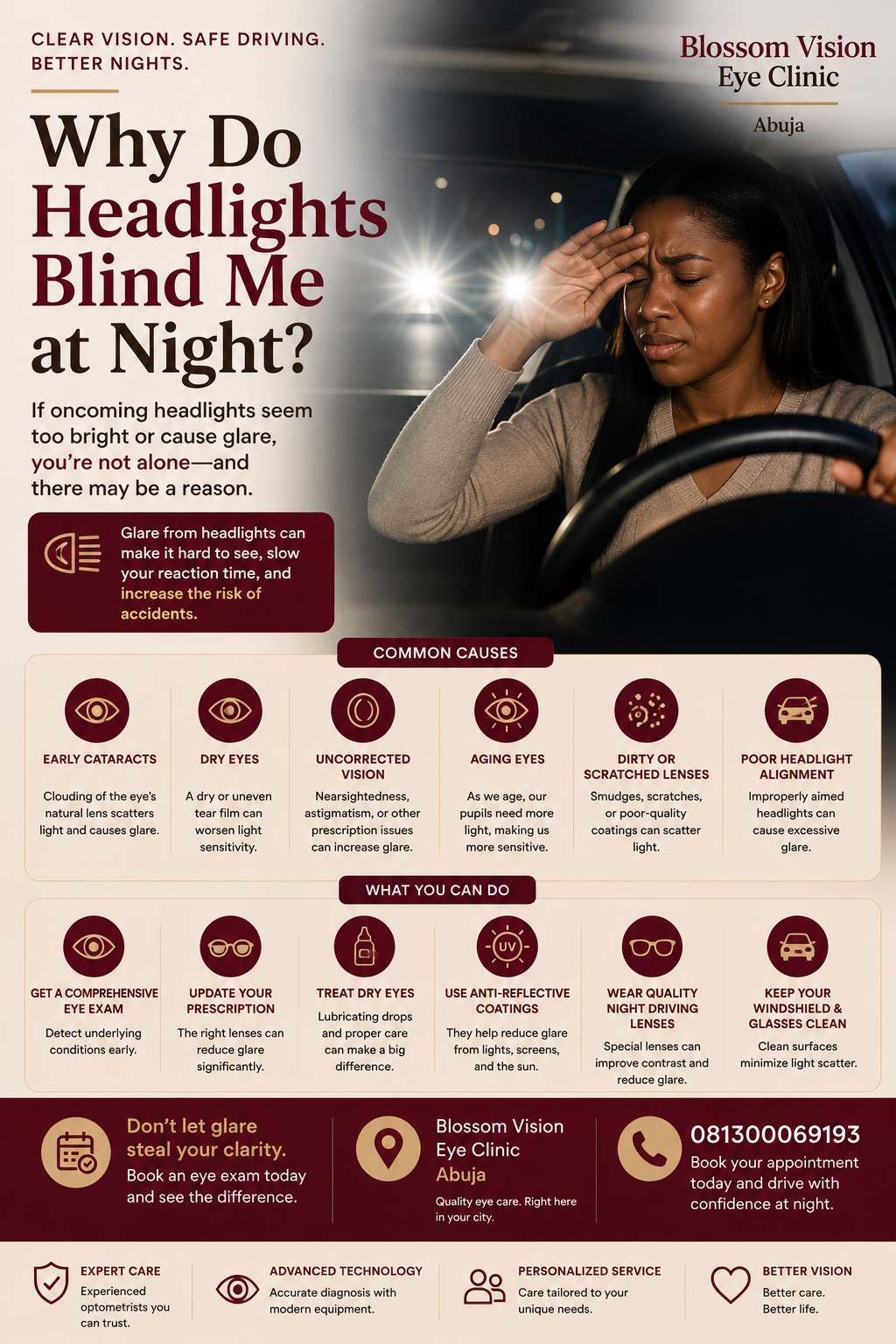
Why Do Headlights Blind Me at Night in Abuja?
If headlights seem unusually bright, blurry, or painful at night, it may not be the headlights, it may be your eyes. Conditions such as astigmatism, dry eye disease, cataracts, outdated prescriptions, and other eye problems can cause glare, halos, starbursts, and poor night vision. A comprehensive eye examination can identify the cause and help improve visual comfort and safety.
Why Do Headlights Blind Me at Night?
You are driving at night.
An oncoming car approaches.
Suddenly the headlights seem to explode across your vision.
You may think:
“Why are headlights so bright for me?”
“Why do car lights look blurry at night?”
“Why do I see lines or starbursts around headlights?”
or simply:
“Why can't I see properly when another car is coming towards me?”
Some glare from bright headlights at night is normal.
Modern headlights can also be very bright.
But if headlights regularly make it difficult for you to see the road, create large halos or starbursts, or make you avoid driving at night altogether, your eyes may also be contributing.
Common possibilities include:
- Astigmatism
- An outdated glasses prescription
- Dry eye
- Cataract
- Corneal problems
- Dirty or scratched glasses
- Contact-lens problems
- Other eye conditions
An eye examination can help determine what is happening.
Quick Answer: Why Do Headlights Blind Me at Night?
Night driving is more difficult because your pupils become larger in the dark.
A larger pupil allows more light into the eye, but it can also make small focusing imperfections more noticeable.
If your eyes do not focus light cleanly, headlights may appear:
- Blurry
- Streaky
- Star-shaped
- Surrounded by halos
- Scattered
- Uncomfortably bright
The cause may be as simple as an uncorrected prescription.
But worsening night glare can also occur with dry eye, cataracts and other eye conditions.
Book Appointment
Why Do Headlights Look Blurry at Night?
Your eye works a little like a camera.
Light needs to pass smoothly through the tear film, cornea and natural lens before being focused onto the retina.
Anything that causes light to scatter or focus unevenly can make headlights look distorted.
That may include:
- Astigmatism
- Dry or irregular tear film
- Cataracts
- Corneal irregularities
- An incorrect prescription
Because your pupil becomes larger in darkness, some of these imperfections are more noticeable at night than during the day.
That explains why someone may say:
“I see perfectly fine during the day, but I struggle terribly at night.”
Why Do I See Starbursts Around Headlights?
A starburst looks like rays or spikes of light spreading outward from a headlight or streetlight.
People describe them as:
- Stars
- Long lines
- Spikes
- Light rays
- Exploding lights
Astigmatism is one possible cause because it changes how light is focused through the eye.
Dry eye, cataracts, corneal irregularities and some previous eye surgeries can also contribute to starbursts.
Starbursts are especially noticeable at night because the contrast between a bright headlight and the dark surroundings is so strong.
Why Do I See Halos Around Lights at Night?
Halos look more like glowing rings around a light.
They may appear around:
- Car headlights
- Streetlights
- Traffic lights
- Security lights
Several eye conditions can produce halos.
These include refractive errors, cataracts and corneal problems.
Occasional mild halos are not automatically dangerous.
But new halos accompanied by significant eye pain, redness, headache, nausea or sudden blurred vision need urgent assessment, because certain forms of acute glaucoma can cause this combination of symptoms.
Could Astigmatism Be Why Headlights Look Strange?
Yes.
Astigmatism is a common refractive error.
Instead of light focusing evenly, differences in the curvature of the cornea or lens cause light to focus in different directions.
You may notice:
- Blurry distance vision
- Headlight streaks
- Starbursts
- Halos
- Squinting
- Difficulty reading road signs
- Eye strain
Some people have relatively mild astigmatism and function well during the day.
Night driving exposes the problem because bright point sources such as headlights are much less forgiving.
Properly prescribed glasses can improve vision when uncorrected astigmatism is contributing.
Could My Glasses Prescription Be Outdated?
Yes.
Your prescription can change gradually.
Because the change is slow, you may adapt without immediately recognising that your vision has deteriorated.
Then you drive at night and suddenly notice:
“The road signs aren't as sharp anymore.”
or:
“Headlights look terrible.”
Signs your prescription may need checking include:
- Squinting while driving
- Blurry road signs
- Headaches
- Difficulty recognising objects at distance
- Increasing night glare
- Your current glasses no longer feeling sharp
If this keeps happening, read Why Do I Keep Changing My Glasses Prescription?.
Can Dry Eyes Make Headlights Look Brighter?
Yes.
The tear film is the very first optical surface light passes through when it enters your eye.
A healthy tear film creates a smooth surface.
When it becomes unstable, light can scatter irregularly.
You may notice:
- Vision that changes after blinking
- Glare
- Starbursts
- Burning
- Grittiness
- Watering
- Heavy eyes
One clue is vision that temporarily improves after a good blink.
If your eyesight repeatedly becomes blurry and then clears, read our guide on why vision may go blurry and then clear again.
Can Harmattan Make Night Driving Glare Worse?
For some people, yes.
Abuja's harmattan season brings:
- Dry air
- Dust
- Wind
- Increased eye-surface irritation
If your tear film is already unstable, these conditions may worsen dryness and make vision fluctuate.
Your windshield may also collect dust, which can scatter oncoming light and make glare worse.
So during harmattan, think about both:
your eyes
and
the surfaces you are looking through.
If harmattan also makes your eyes itchy, watery or dry, read Why Do My Eyes Itch and Water During Harmattan?.
Can Cataracts Make Headlights Look Too Bright?
Yes.
A cataract is clouding of the natural lens inside the eye.
Instead of light passing cleanly through the lens, some of it becomes scattered.
One of the complaints people with cataracts can develop is increasing difficulty with:
- Headlight glare
- Night driving
- Halos
- Reduced contrast
- Blurry or hazy vision
The American Academy of Ophthalmology specifically lists extra sensitivity to oncoming headlights and difficulty seeing well at night among possible cataract symptoms.
You do not have to wait until daytime vision becomes extremely poor before mentioning night-driving problems during an eye examination.
Does Night Glare Mean I Have Cataracts?
No.
This is important.
Night glare has many possible causes.
A young person with astigmatism may experience significant headlight glare without having cataracts.
Someone else may have:
- Dry eye
- An outdated prescription
- Corneal irregularity
- Dirty glasses
- Poorly fitting contact lenses
The symptom tells us something needs investigating.
It does not tell us the diagnosis.
Can Keratoconus Cause Headlight Starbursts?
Yes.
Keratoconus changes the shape of the cornea.
Instead of maintaining a regular curved surface, the cornea becomes increasingly irregular.
This can cause:
- Distorted vision
- Ghost images
- Starbursts
- Glare
- Frequent prescription changes
- Difficulty achieving clear vision with ordinary glasses
Keratoconus is not the most likely explanation for everyone with night glare.
But if your prescription changes frequently or your vision remains distorted even with glasses, the cornea may need closer assessment.
Why Can't I See Clearly at Night Even With My Glasses?
Wearing glasses does not automatically mean your night vision will be perfect.
Possible reasons include:
- Your prescription has changed
- Astigmatism is not fully corrected
- Your lenses are scratched
- The lenses are dirty
- Reflections from the lens surface are distracting
- Dry eye is affecting vision
- Cataract or another eye condition is present
If your glasses no longer give you clear vision generally, read Why Can't I See Clearly Even With My Glasses?.
Can Dirty Glasses Make Headlight Glare Worse?
Absolutely.
Before assuming something serious is wrong with your eyes, inspect your glasses.
Grease, fingerprints, scratches and damaged lens coatings can scatter light.
At night, that can make headlights appear much worse.
Clean your lenses properly and inspect them under good lighting.
If glare remains after the lenses are clean, investigate further.
Can a Dirty Windshield Make Headlights Look Worse?
Yes.
This is often overlooked.
A dirty windshield can spread bright oncoming light across the glass.
Pay particular attention to:
- Dust
- Grease
- Smears
- Fine scratches
- Condensation
Clean both the inside and outside of the windshield.
In Abuja's dusty conditions, this simple step can make a noticeable difference.
But if everybody else in the car sees comfortably while you still struggle badly, your own vision deserves checking.
Do Anti-Reflective Glasses Help With Night Driving?
An appropriate anti-reflective coating can reduce reflections from spectacle lenses and may improve visual comfort for some glasses wearers.
But it is not a cure for every night-driving problem.
If your underlying issue is:
- Cataract
- Significant dry eye
- Keratoconus
- An incorrect prescription
a coating alone will not fix the cause.
The prescription and eye health need to be right first.
What About Yellow Night-Driving Glasses?
Be cautious.
Products marketed as “night-driving glasses” often use yellow or tinted lenses.
A tint reduces the amount of light entering your eyes.
That may make lights feel subjectively different, but reducing available light at night is not automatically helpful for safe driving.
If night glare is significant, identifying and treating the actual cause is more useful than simply buying a coloured lens marketed for night driving.
Why Is Driving at Night Harder as I Get Older?
Several normal and abnormal changes can make night vision more challenging with age.
For example:
- Pupillary responses change
- More light scatter may occur inside the eye
- Cataracts become more common
- Dry eye becomes more common
- Prescription needs may change
But you should not simply dismiss significant deterioration with:
“I am getting old.”
If night driving has become substantially harder, have your eyes examined.
Are Headlights Actually Getting Brighter?
Some modern vehicle headlights genuinely can feel more intense than older lighting systems.
LED headlights produce a different, often whiter light than traditional halogen bulbs, and headlight design, positioning and vehicle height can all influence glare.
So if you think modern headlights feel harsher, the answer is not simply:
“It's all your eyes.”
But there is another useful question:
Do these headlights bother you much more than they bother other people?
If the answer is yes, particularly if night driving has gradually worsened, checking your eyes still makes sense.
Why Does My Vision Get Worse Only at Night?
Low-light vision is more demanding.
Your pupil enlarges in darkness, and the visual system has less contrast to work with.
Small problems that are barely noticeable during the day can therefore become obvious at night.
You may first notice:
- Blurry road signs
- Difficulty identifying pedestrians
- Headlight glare
- Halos
- Starbursts
- Reduced confidence driving
Night driving can therefore reveal a vision problem before you notice much difficulty during the day.
Should I Stop Driving at Night?
If glare is severe enough that you cannot see pedestrians, lane markings, vehicles or road hazards safely, do not force yourself to drive simply because you used to manage it.
Your safety and the safety of other road users come first.
Arrange an eye assessment and determine what is causing the difficulty.
Depending on the cause, improving:
- Your prescription
- Dry-eye control
- Lens condition
- Windshield cleanliness
- Cataract management
may improve night-driving performance.
Book Appointment
When Should Headlight Glare Be Checked?
Arrange an eye examination if:
- Headlights have become increasingly difficult to tolerate
- You avoid driving at night
- Road signs look blurry
- You see large starbursts
- You see halos around lights
- One eye is worse than the other
- Your glasses no longer seem clear
- Your vision fluctuates
- You struggle to identify objects on dark roads
If you are also noticing other visual symptoms, review our guide on signs you may need an eye test.
When Are Halos or Glare an Emergency?
Most gradual night-driving glare is not an emergency.
But seek urgent eye or medical assessment if you suddenly develop:
- Severe eye pain
- A very red painful eye
- Sudden major blurred vision
- Rainbow-like halos with severe eye pain
- Nausea or vomiting with eye pain
- Sudden loss of vision
- New neurological symptoms
Sudden halos with pain and redness can occur with serious eye conditions and should not wait for a routine appointment.
What Happens During an Eye Examination for Night Glare?
At Blossom Vision Eye Clinic in Games Village, Abuja, we want to know exactly what you see.
We may ask:
- Are the headlights blurry?
- Do you see rings?
- Do you see starbursts?
- Is one eye worse?
- Does blinking improve the problem?
- Is your daytime vision also blurry?
- Do you wear glasses or contact lenses?
- Has your prescription recently changed?
- How long has night driving been difficult?
Depending on your needs, your examination may assess:
- Visual acuity
- Glasses prescription
- Astigmatism
- Tear film and dry eye
- Cornea
- Natural lens and cataract
- Eye pressure
- Retina
- Other eye-health findings
The goal is not simply to sell you “night-driving glasses.”
The goal is to identify why night driving has become difficult.
How Much Does an Eye Test Cost in Abuja?
The cost depends on the examination and whether additional tests are required.
You can see our guide to the cost of an eye test in Abuja and what the examination includes.
Frequently Asked Questions
Why do headlights blind me at night?
Some glare from bright headlights is normal, but severe night glare may be worsened by astigmatism, an outdated prescription, dry eye, cataracts, corneal problems or other visual issues.
Why do headlights look blurry at night?
Blur can occur when light is not focused cleanly through the eye. Refractive errors, tear-film problems and cataracts are among the possible causes.
Why do I see starbursts around headlights?
Astigmatism, dry eye, cataracts, corneal irregularities and other optical problems can cause light to appear as rays or starbursts.
Why do I see halos around headlights?
Halos can occur with refractive errors, cataracts, corneal problems and other conditions. Sudden halos associated with significant pain or redness require urgent assessment.
Does astigmatism make headlights look worse?
It can. Astigmatism causes light to focus unevenly and can make nighttime point sources such as headlights appear streaky, blurry or star-shaped.
Can dry eyes cause night-driving glare?
Yes. An unstable tear film can scatter light and cause fluctuating vision, glare or starbursts.
Can cataracts make headlights too bright?
Yes. Cataracts scatter light within the eye and commonly cause increased glare and difficulty with night driving.
Can glasses improve night driving?
If an uncorrected prescription or astigmatism is contributing, correctly prescribed glasses may improve clarity. The benefit depends on the actual cause.
Should I buy night-driving glasses?
Do not assume a tinted “night-driving” lens will fix the problem. Have your prescription and eye health checked if glare is significant.
Should I get an eye test if headlights suddenly seem much worse?
Yes, particularly if the problem is persistent, getting worse or affecting safe driving.
Don't Just Stop Driving at Night. Find Out Why It Has Become Difficult.
If you find yourself saying:
“I hate driving at night now.”
“I can't see when another car approaches.”
or:
“Every headlight looks like a giant star.”
do not automatically assume you simply have to live with it.
The headlights may genuinely be bright.
But your prescription, tear film, cornea or natural lens may also be making the glare worse.
At Blossom Vision Eye Clinic in Games Village, Abuja, we can examine your vision and eye health to determine what may be affecting your night driving.
If headlights are making it difficult for you to drive safely at night, book a comprehensive eye examination.