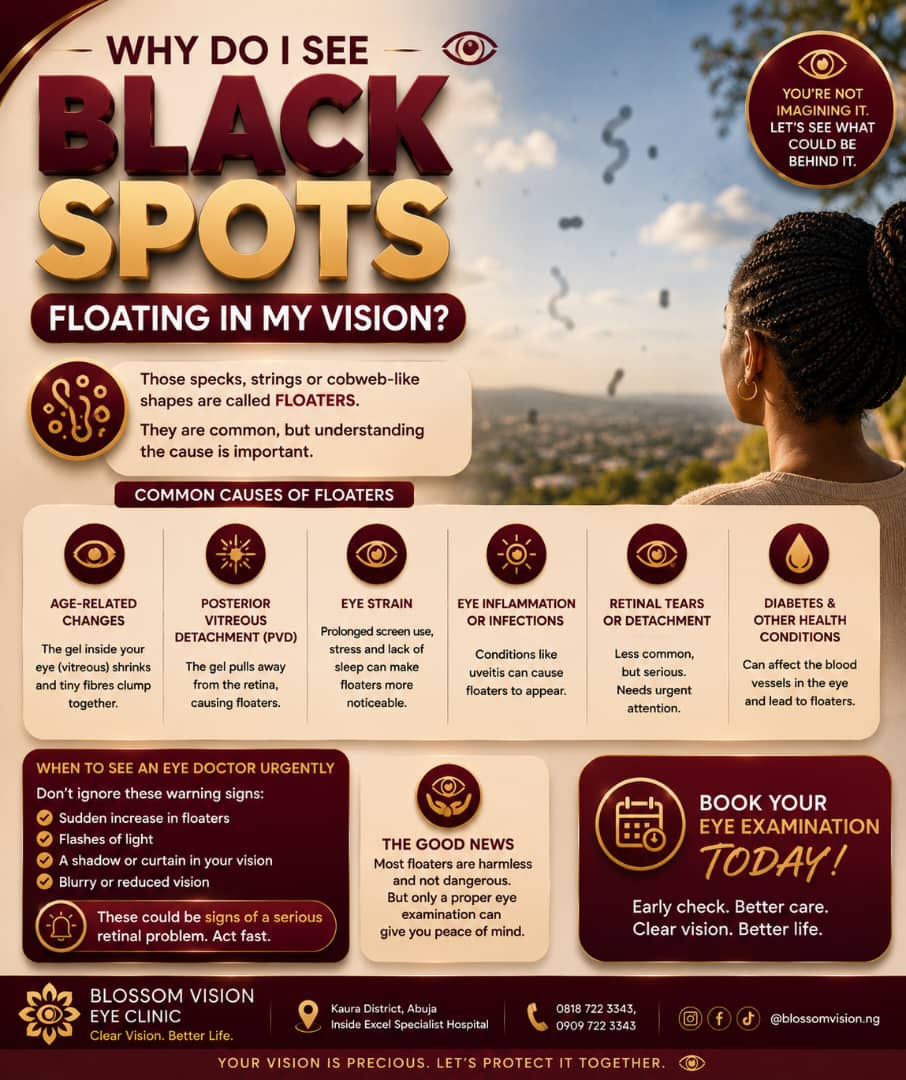
Why Do I See Black Spots Floating in My Vision?
Seeing black spots, cobwebs or floating specks in your vision is usually caused by eye floaters. They are common, especially as we get older, and are often harmless. However, if you suddenly notice many new floaters, flashes of light or a curtain over your vision, seek urgent eye care immediately, as these could be signs of a retinal tear or retinal detachment.
Why Do I See Black Spots Floating in My Vision?
These moving spots are often called eye floaters.
Floaters are very common, particularly as the eye changes with age.
Many are not dangerous.
But there is one rule I want you to remember:
A sudden appearance of many new floaters should never simply be ignored.
Especially if you also notice:
- Flashes of light
- A dark curtain
- A shadow in your vision
- Sudden loss of part of your vision
Those symptoms can occur with a retinal tear or retinal detachment and require urgent eye assessment.
Quick Answer: Why Do I See Black Spots Moving in My Vision?
Those black spots, threads, cobwebs or moving shadows may be eye floaters.
They are usually shadows created by tiny structures inside the clear gel that fills your eye.
You may notice them particularly when looking at:
- White walls
- White paper
- A bright computer screen
- A clear sky
- Other bright plain backgrounds
Floaters often move when your eyes move and continue drifting slightly after your eye stops.
Many floaters result from normal changes inside the eye.
But new floaters can sometimes occur because of:
- Vitreous detachment
- Bleeding inside the eye
- Inflammation
- Eye injury
- Retinal tear
- Retinal detachment
So the important question is not simply:
“Do I have floaters?”
It is:
“Are these ordinary floaters, or is something happening to my retina?”
Book Appointment
What Exactly Is an Eye Floater?
The inside of your eye contains a clear gel-like substance called the vitreous.
Imagine a clear bowl filled with transparent jelly.
The vitreous fills much of the inside of your eye.
As you get older, the vitreous gradually changes.
Tiny strands or clumps can form inside it.
Light enters your eye and passes through the vitreous.
Those small strands can cast shadows onto your retina, the light-sensitive tissue at the back of your eye.
Your brain sees those shadows as:
- Black dots
- Grey spots
- Threads
- Cobwebs
- Rings
- Squiggly lines
- Moving shadows
So the floater usually is not sitting on the surface of your eye.
It is being created by something inside the eye casting a shadow on the retina.
Why Does the Black Spot Move When I Move My Eyes?
This is one of the classic features of a floater.
You see the spot.
You try to look directly at it.
It seems to move.
That happens because the material creating the floater is suspended within the vitreous.
When your eye moves, the vitreous moves too.
When your eye stops, the floater may continue drifting for a moment.
That is why patients often say:
“It keeps running away whenever I try to look at it.”
What Do Eye Floaters Look Like?
There is no single appearance.
Patients describe them as:
“A black dot.”
“Something like hair.”
“A spider web.”
“A transparent worm.”
“Tiny flies.”
“Smoke.”
“A string.”
“A small ring.”
All of those descriptions can occur with floaters.
Some people see one.
Others see several.
Why Can I See Floaters Better Against a White Wall or the Sky?
Because a bright, plain background makes the shadows easier to notice.
You may hardly notice your floater in a dark or complicated environment.
Then you look at:
- White paper
- A bright screen
- A white ceiling
- The blue sky
and suddenly it becomes obvious.
This is a typical feature of floaters.
Why Have I Suddenly Started Seeing Floaters?
There are several possibilities.
Age-Related Changes Inside the Eye
This is very common.
As we get older, the vitreous gradually changes consistency.
Small strands may clump together and become visible as floaters.
Almost everyone becomes more likely to experience them as they age.
But age-related changes can also lead to another condition called posterior vitreous detachment.
What Is Posterior Vitreous Detachment?
This sounds frightening, but it is common as people get older.
The vitreous contains tiny fibres that are attached to the retina.
As the vitreous changes with age, it can gradually separate from the retina.
This is called posterior vitreous detachment, often shortened to PVD.
The most common symptom can be a sudden increase in floaters.
Some people also experience flashes of light.
Most posterior vitreous detachments do not cause a serious problem.
But sometimes the vitreous pulls strongly enough to tear the retina.
That is why new sudden floaters deserve examination.
Can Short-Sightedness Cause Floaters?
People who are significantly short-sighted, or myopic, have an increased likelihood of developing floaters.
The National Eye Institute lists high myopia among factors associated with a greater likelihood of floaters.
Being short-sighted does not mean every floater is dangerous.
But new symptoms still deserve appropriate assessment.
Can Diabetes Cause Black Spots in My Vision?
Diabetes is relevant for several reasons.
People with diabetes can develop floaters like anyone else.
But advanced diabetic retinal disease can also cause bleeding inside the vitreous.
Blood within the vitreous may appear as:
- Dark spots
- Clouds
- Cobwebs
- Numerous new floaters
- Hazy vision
The National Eye Institute also identifies diabetes as a factor associated with an increased likelihood of floaters.
If you live with diabetes, do not assume a sudden shower of black spots is simply an ordinary age-related floater.
Read Can Diabetes Affect My Eyes Even If I Can See Clearly?.
Can an Eye Injury Cause Floaters?
Yes.
Trauma to the eye can affect the vitreous or retina.
If you develop new floaters after:
- Being hit in the eye
- A sporting injury
- A fall
- An accident
- Another significant eye trauma
have the eye assessed.
Eye trauma is also a recognised risk factor for retinal detachment.
Can Eye Surgery Cause Floaters?
Floaters may sometimes become noticeable after eye surgery.
People who have had cataract surgery also have a higher risk of retinal detachment than someone without that history.
That does not mean new floaters after surgery automatically mean something has gone wrong.
But tell your eye-care professional about the symptoms.
Can Inflammation Inside the Eye Cause Floaters?
Yes.
Inflammatory cells inside the eye can become visible as floaters.
One example is uveitis, which means inflammation involving tissues inside the eye.
The National Eye Institute lists uveitis, eye infection and bleeding among possible more serious causes of floaters.
This is another reason we should not diagnose every black moving spot as harmless age-related change without examining the eye.
When Are Floaters Dangerous?
This is the most important section of this article.
Suddenly Seeing Lots of New Floaters
If yesterday you saw nothing unusual and today you suddenly see:
dozens of dots
or
a shower of black specks
or
many new cobwebs
get your eyes assessed urgently.
A sudden increase in floaters can happen with posterior vitreous detachment and may sometimes accompany a retinal tear.
Floaters With Flashes of Light
This combination deserves particular attention.
Patients describe flashes as:
“Lightning at the side of my eye.”
“Someone keeps flashing a camera.”
“I see sparks.”
“A streak of light keeps appearing.”
Flashes can occur when the vitreous pulls on or stimulates the retina.
That traction may occur without a retinal tear.
But it may also tear the retina.
We cannot determine which one has happened simply from the patient's description.
A Curtain or Shadow Over Your Vision
This is an emergency warning sign.
Patients sometimes describe:
“A black curtain is coming across my eye.”
“Part of my side vision has disappeared.”
“There is a dark shadow that won't move.”
A curtain or shadow over the field of vision can occur with retinal detachment.
Do not:
- Sleep on it
- Wait several days
- Buy eye drops
- Assume it will disappear
Seek urgent eye care.
Sudden Loss of Vision
Floaters together with sudden significant reduction in vision also need urgent assessment.
Retinal detachment can cause permanent vision loss if not treated promptly.
What Is a Retinal Tear?
Your retina is the thin light-sensitive tissue lining the back of the eye.
Sometimes, as the vitreous separates from the retina, it pulls hard enough to create a tear.
A retinal tear matters because fluid can pass through the break and separate the retina from the back of the eye.
That can lead to a retinal detachment.
Prompt treatment of a retinal tear can reduce the chance of progression to detachment.
What Is a Retinal Detachment?
Imagine wallpaper beginning to peel away from the wall.
A retinal detachment happens when the retina separates from its normal position at the back of the eye.
It is a medical emergency.
Possible symptoms include:
- Sudden new floaters
- Flashes of light
- A dark curtain
- A shadow
- Missing peripheral vision
- Reduced vision
Prompt treatment can help protect vision.
Do All New Floaters Mean Retinal Detachment?
No.
This is equally important.
Do not panic simply because you noticed one floater.
Many floaters come from normal vitreous changes and do not need treatment.
But we cannot safely use:
“Most floaters are harmless”
as a reason to ignore sudden new symptoms.
The examination is what separates:
common vitreous changes
from
something involving the retina.
What Are Flashes of Light?
Flashes may appear as:
- Lightning streaks
- Camera flashes
- Sparks
- Brief arcs of light
- Flickering at the side of your vision
They can occur when the vitreous pulls on the retina.
Flashes have other possible causes too, including migraine-related visual symptoms.
So the pattern matters.
New flashes occurring with sudden floaters deserve prompt eye assessment.
Can Migraine Cause Spots or Flashing Lights?
Yes, migraine can cause visual symptoms.
Migraine-related visual disturbance may be described as:
- Zigzag lines
- Shimmering
- Flashing
- Heat-wave patterns
- Expanding areas of altered vision
These are not necessarily the same as vitreous floaters.
If you are unsure whether what you are seeing is migraine, flashes or floaters, describe exactly what you see and how long it lasts during your examination.
Can Stress Cause Floaters?
Stress is not considered a direct cause of ordinary vitreous floaters.
During stressful periods, you may become much more aware of things happening in your vision.
But stress should not be used to explain away a genuinely new floater.
If you suddenly develop floaters, assess the eye rather than saying:
“It must be stress.”
Can High Blood Pressure Cause Floaters?
High blood pressure is not the usual explanation for ordinary age-related floaters.
However, conditions that cause bleeding inside the eye can create dark spots or floaters.
So sudden new visual symptoms need proper assessment rather than being diagnosed simply from one medical condition.
Will Eye Floaters Go Away?
Sometimes they become much less noticeable.
The physical opacity may remain, but:
- It may move away from the central line of sight
- Your brain may learn to pay less attention to it
- Symptoms from vitreous detachment may become less noticeable over time
The NEI notes that many people with uncomplicated vitreous detachment notice the symptoms less after several months.
But not every floater disappears completely.
Can I Learn to Ignore Floaters?
Often, yes.
A stable, harmless floater can become much less noticeable over time.
You may suddenly realise:
“I haven't noticed that black dot all day.”
Then you look at a bright wall and there it is again.
That can happen because the brain becomes better at ignoring an unimportant visual disturbance.
The important thing is establishing that the symptom is not from a retinal problem first.
Can Eye Drops Remove Floaters?
No ordinary eye drop has been proven to dissolve common vitreous floaters.
The floater is inside the vitreous cavity.
Putting a drop onto the surface of the eye does not simply dissolve the structures suspended deep inside the eye.
Be very cautious about products promising:
“Remove floaters naturally in seven days.”
or:
“Drops that dissolve floaters permanently.”
Those claims deserve scepticism.
Can Vitamins Get Rid of Floaters?
There is no established vitamin supplement that simply dissolves ordinary vitreous floaters.
Eating well is important for general health.
But:
healthy nutrition
is not the same thing as
a proven treatment for an existing vitreous floater.
Do Floaters Need Treatment?
Most uncomplicated age-related floaters do not require treatment.
If another condition is causing the floaters, that underlying condition may require treatment.
For a small number of people whose floaters severely interfere with vision and daily activities, an ophthalmologist may discuss procedures such as vitrectomy.
But those treatments have potential risks.
They are not something every person with one harmless floater needs.
Should I Ignore a Floater I've Had for Years?
A small stable floater that has looked the same for years is generally less concerning than a sudden new shower of floaters.
But pay attention to change.
Seek assessment if you suddenly develop:
- More floaters
- Different floaters
- Flashes
- A shadow
- A curtain
- Reduced vision
Even if you already had one harmless floater before.
What If I Only See One Black Spot?
One floater may still be an ordinary vitreous floater.
But if that spot is:
- New
- Fixed rather than floating
- Associated with missing vision
- Associated with flashes
- Associated with reduced vision
have it assessed.
Not every “black spot” described by a patient is necessarily a vitreous floater.
What If the Black Spot Doesn't Move?
A true floater typically moves with eye movement.
A fixed dark area in your vision may represent something different.
If you notice a persistent stationary area of missing or darkened vision, especially if it is new, arrange assessment promptly.
Why Do I See Floaters in Only One Eye?
Floaters can occur in one eye or both.
The vitreous in each eye changes independently.
So one eye may develop symptoms before the other.
Do not assume that because only one eye is affected it must be harmless.
A sudden new floater in one eye still deserves appropriate assessment.
If one eye generally seems blurrier than the other, read Why Is One Eye Blurrier Than the Other?.
Why Do I Notice Floaters More at Night?
Typical floaters are often easier to see against bright, uniform backgrounds.
But some people notice visual phenomena more when:
- Looking at bright lights in darkness
- Moving their eyes in a dark room
- Paying close attention to their vision
If what you see is actually flashing rather than floating, explain that distinction during your examination.
Can Floaters Make My Vision Blurry?
A large or dense floater can temporarily interfere with part of your vision as it passes across your visual axis.
But persistent general blur may have another cause.
If your vision repeatedly goes blurry and then clear again, read Why Does My Vision Go Blurry Then Clear Again?.
When Should I Get New Floaters Checked?
A useful rule is:
Old and unchanged is different from sudden and new.
Arrange prompt assessment for:
- A new onset of floaters
- A sudden increase in existing floaters
- Floaters after eye trauma
- Floaters associated with flashes
- Floaters associated with blurry or reduced vision
Seek urgent assessment for:
- A shower of new floaters
- Flashes with new floaters
- A curtain or shadow
- Loss of peripheral vision
- Sudden significant vision reduction
The NEI advises urgent evaluation for symptoms suggestive of retinal tear or detachment.
Book Appointment
What Eye Test Do I Need for Floaters?
This is important.
Simply checking:
“Can you read the letters on the chart?”
is not enough to rule out a retinal tear.
Evaluation of new floaters often requires a dilated retinal examination so the retina can be assessed carefully. The National Eye Institute identifies dilated examination as the method used to assess floaters and retinal detachment.
Depending on the findings, additional examination or specialist retinal assessment may be required.
Why Might My Pupils Need to Be Dilated?
Dilating drops temporarily make the pupils larger.
This gives the examiner a wider view of the retina.
After dilation, you may temporarily notice:
- Increased light sensitivity
- Blurry near vision
The purpose is not simply to make the examination more complicated.
It is to make it easier to inspect the structures at the back of the eye.
What Happens When I Come to Blossom Vision With Floaters?
At Blossom Vision Eye Clinic in Games Village, Abuja, the first priority is understanding when the symptom began and whether there are retinal warning signs.
We may ask:
- When did you first see the floater?
- Is this the first time?
- Did many appear suddenly?
- Is it one eye or both?
- Are you seeing flashes?
- Is there a curtain or shadow?
- Has your vision changed?
- Are you very short-sighted?
- Have you had eye surgery?
- Have you had an eye injury?
- Do you have diabetes?
Your assessment may include:
- Visual acuity
- Examination of the front of the eye
- Eye pressure where appropriate
- Vitreous and retinal assessment
- Dilated retinal examination where clinically required
- Referral for specialist retinal assessment when necessary
If we cannot safely exclude a retinal problem or specialist treatment is required, referral should not be delayed.
Can Glasses Remove Floaters?
No.
Floaters are not caused by an ordinary glasses prescription.
A stronger spectacle lens does not make the vitreous opacity disappear.
However, you may have a floater and a glasses prescription problem at the same time.
That is why the whole eye should be assessed rather than assuming every visual complaint has one cause.
How Much Does It Cost to Get Floaters Checked in Abuja?
The assessment needed depends on your symptoms and examination findings.
You can see our current guide to eye test costs in Abuja and what is included.
But if you have a sudden shower of floaters, flashes or a curtain over your vision, do not delay urgent assessment simply because you are first comparing prices online.
Frequently Asked Questions
Why do I see black spots floating in my vision?
They are often eye floaters caused by tiny structures within the vitreous casting shadows on the retina.
What do eye floaters look like?
They may look like dots, cobwebs, threads, hairs, rings, squiggly lines or small moving shadows.
Why do the black spots move when I look at them?
Floaters are suspended within the vitreous, so they move as the eye and vitreous move.
Are eye floaters normal?
Floaters become increasingly common with age and many do not require treatment. Sudden new floaters, however, need appropriate assessment.
Can young people get floaters?
Yes. Floaters are not limited to older adults. Myopia, inflammation, trauma and other factors can also contribute.
Does short-sightedness increase the chance of floaters?
Yes. People who are very nearsighted are more likely to experience floaters.
Can diabetes cause floaters?
Diabetes is associated with a greater likelihood of floaters, and advanced diabetic retinal disease can also cause bleeding that creates dark visual spots.
Can stress cause eye floaters?
Stress is not considered a direct cause of ordinary vitreous floaters, although people may notice existing visual symptoms more when anxious or paying close attention to them.
Will eye drops remove floaters?
There are no ordinary eye drops proven to dissolve common vitreous floaters.
Will floaters eventually disappear?
Some become less noticeable with time, but they do not always disappear completely.
What are flashes of light?
Flashes can occur when the vitreous pulls on or stimulates the retina. New flashes, particularly with sudden floaters, should be assessed promptly.
When should I worry about floaters?
Be particularly concerned about a sudden shower of new floaters, flashes, a dark curtain or shadow, missing side vision or sudden vision reduction.
Are retinal detachments painful?
Retinal detachment commonly causes visual symptoms rather than eye pain. Do not assume that the absence of pain means everything is safe.
Where can I get floaters checked in Abuja?
Blossom Vision Eye Clinic provides comprehensive eye assessment in the Games Village/Kaura District area of Abuja and can arrange referral when specialist retinal care is required.
One New Floater and a Sudden Shower of Floaters Are Not the Same Thing
This is the message I would want the patient to remember.
You may have had the same small thread floating in your vision for years.
That is very different from waking up and suddenly seeing:
Twenty new black dots.
Flashes.
A curtain.
A shadow.
Those changes can be warnings from the retina.
At Blossom Vision Eye Clinic in Games Village, Abuja, we can assess your symptoms and eye health and determine whether further retinal assessment is required.
If you suddenly develop many new floaters, flashes of light, a curtain or shadow over your vision, do not wait for a routine appointment. Seek urgent eye care.