Why do I see rainbow circles around lights?
Seeing halos around lights, especially at night, isn't always normal. While dry eyes or an outdated glasses prescription can cause halos, they may also be an early sign of cataracts, glaucoma or other eye conditions. If halos are new or becoming worse, it's important to have a comprehensive eye examination.
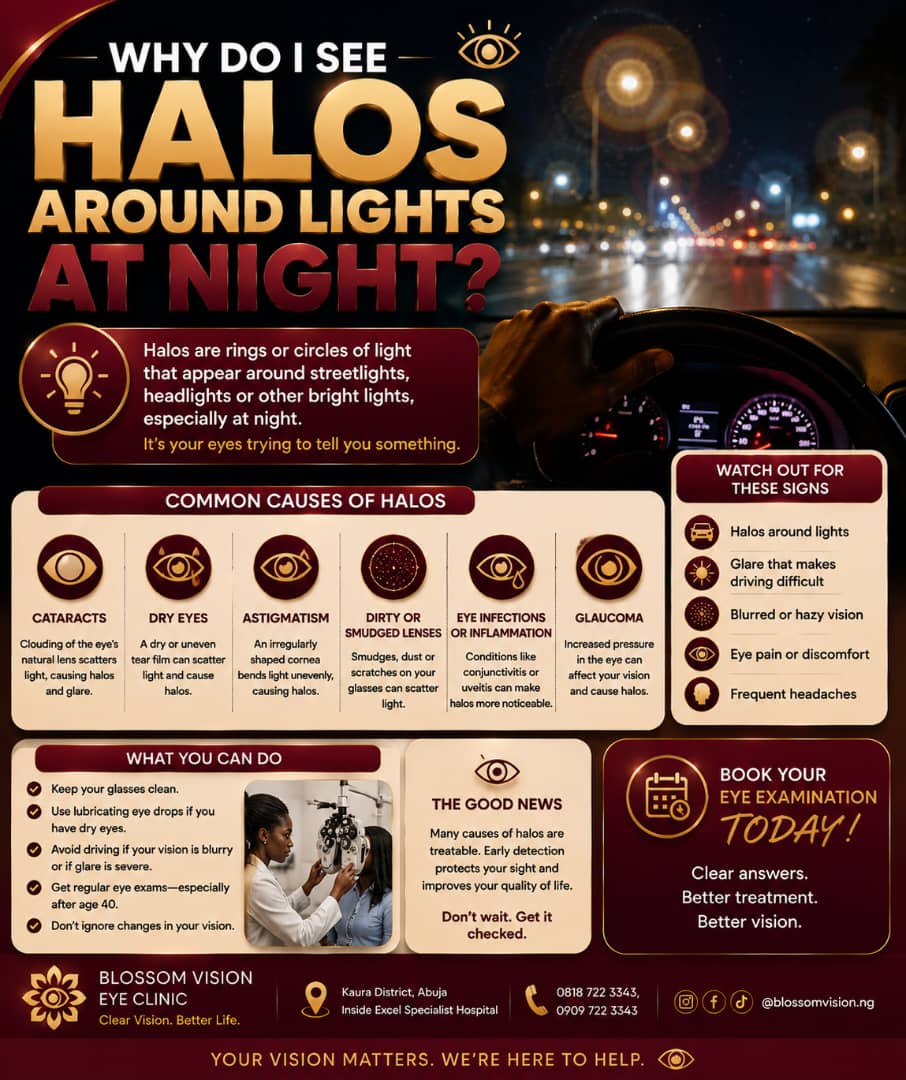
Why Do I See Halos Around Lights at Night?
Rainbow circles or Halos can happen for several reasons.
Sometimes the cause is relatively simple, such as:
- An uncorrected glasses prescription
- Astigmatism
- Dry or unstable tear film
- Dirty or scratched glasses
But halos can also occur with conditions such as:
- Cataracts
- Corneal problems
- Certain changes after eye surgery
- Less commonly, acute angle-closure glaucoma
The important question is not simply:
“Do I see halos?”
It is:
“Why am I seeing them?”
Quick Answer: Why Do I See Rings Around Lights at Night?
A halo is the appearance of a glowing ring around a light source.
You may notice it around:
- Headlights
- Streetlights
- Traffic lights
- Security lights
- Bright indoor lights
Halos are often easier to notice after dark.
Possible causes include:
- Astigmatism
- An outdated or incorrect prescription
- Dry-eye or tear-film problems
- Cataract
- Corneal irregularity
- Contact-lens problems
- Certain eye procedures or lenses
If the halos are new, worsening or affecting your ability to drive safely, have your eyes examined.
And if you suddenly develop:
halos + severe eye pain + red eye + blurred vision + nausea or vomiting
seek urgent eye care.
Book Appointment
What Exactly Is a Halo Around a Light?
Normally, light entering your eye should be focused in a way that produces a reasonably clear image.
If light is scattered or does not focus properly, a point of light can appear to spread.
Instead of:
one clear headlight
you may see:
a headlight surrounded by a glowing circle.
Patients may describe this as:
- A halo
- A ring
- A glow
- A rainbow
- A fuzzy circle
- A haze around lights
Different people may use different words for essentially the same visual problem.
Why Are Halos More Noticeable at Night?
At night, your pupils naturally become larger to allow more light into the eye.
That can make certain optical imperfections more noticeable.
There is also much more contrast.
Imagine:
bright white headlight
against
dark black road.
Any scattering or distortion of that light becomes much easier to notice.
This is why someone may say:
“My vision is fine during the day, but driving at night is becoming difficult.”
Are Halos Around Lights Normal?
Occasional glare or light spread does not automatically mean something serious is wrong.
For example, halos may temporarily occur:
- After pupil dilation
- Following certain eye procedures
- Because of dirty spectacle lenses
- Because of glare from the windscreen
But repeated or worsening halos deserve attention, especially when they are associated with:
- Blurry vision
- Increasing glare
- Poor night vision
- Frequent prescription changes
- Eye pain
- Redness
The pattern matters.
1. Can Astigmatism Cause Halos Around Lights?
Yes.
Astigmatism is a common type of refractive error.
It means the eye does not focus light evenly.
This may make lights appear:
- Blurry
- Stretched
- Star-shaped
- Surrounded by glare
- Surrounded by halos
The National Eye Institute lists glare or halos around bright lights among possible symptoms of refractive errors.
Astigmatism can affect people of any age.
And you may have mild astigmatism without realising it.
How Do I Know If Astigmatism Is Causing My Halos?
You cannot reliably diagnose it from halos alone.
Other clues may include:
- Blurry distance vision
- Blurry near vision
- Squinting
- Eye strain
- Headaches
- Difficulty seeing clearly at night
A refraction, which is the part of the eye examination that determines your glasses prescription, can show whether astigmatism is present.
2. Can an Old Glasses Prescription Cause Halos?
Yes.
If your prescription no longer focuses light accurately, nighttime visual problems may become more obvious.
You may notice:
- Fuzzy headlights
- Halos
- Starbursts
- Difficulty reading signs
- Headaches
- Squinting
If your glasses used to work well but your night vision has changed, it may be time to check the prescription.
Read Why Do I Keep Changing My Glasses Prescription?.
What If I See Halos Even With My Glasses On?
Then do not automatically assume you simply need stronger glasses.
Possible explanations include:
- Your prescription has changed
- Your lenses were not made or fitted correctly
- Your glasses are scratched or dirty
- Dry eye
- Cataract
- Corneal problems
- Another eye condition
If your vision remains unclear despite wearing glasses, read Why Can't I See Clearly Even With My Glasses?.
3. Can Dry Eyes Cause Halos?
Dry-eye and tear-film problems can make light look less crisp.
Your tear film forms the first smooth optical surface that light passes through before entering the eye.
If that layer becomes unstable, vision may fluctuate.
You may notice:
- Blur
- Glare
- Light spreading
- Burning
- Watering
- Grittiness
A useful clue is:
You blink and the vision briefly becomes clearer.
Then it becomes blurry again.
If that happens, the tear film may be contributing.
Why Do Halos Sometimes Improve After Blinking?
Blinking redistributes your tears across the front of the eye.
For a moment, this may create a smoother optical surface.
So you may notice:
halo → blink → clearer light → halo gradually returns.
That pattern is worth mentioning during your examination.
It does not prove dry eye is the cause, but it provides useful information.
4. Can Cataracts Cause Halos Around Lights?
Yes.
This is an important cause, particularly as people get older.
A cataract occurs when the natural lens inside the eye becomes cloudy.
Instead of light travelling cleanly through the lens, some of it becomes scattered.
You may notice:
- Halos around lights
- Increasing glare
- Cloudy or blurry vision
- Headlights appearing painfully bright
- Poor night vision
- Colours looking faded
- More frequent prescription changes
These are recognised symptoms of cataract.
Does Seeing Halos Mean I Have Cataracts?
No.
Halos alone do not diagnose cataracts.
Younger people can see halos because of:
- Astigmatism
- Dry eye
- Contact lenses
- Corneal problems
- Prescription issues
An eye examination is needed to determine whether the natural lens is actually becoming cloudy.
Why Do Cataracts Make Night Driving Difficult?
When the lens becomes cloudy, bright lights can scatter inside the eye.
At night, this may make:
- Headlights spread
- Glare increase
- Contrast decrease
- Road details harder to see
The National Eye Institute specifically identifies poor night vision, headlights appearing too bright and halos around lights as cataract symptoms.
If headlights are your main complaint, read Why Do Headlights Blind Me at Night?.
5. Can Contact Lenses Cause Halos?
They can contribute.
Possible reasons include:
- Dry lenses
- Poor lens fit
- Deposits on the lens
- Incorrect prescription
- Wearing lenses longer than recommended
- Corneal problems
If the halos disappear when you remove your contact lenses and wear glasses instead, mention this during your contact-lens assessment.
If you develop:
redness + pain + sensitivity to light + reduced vision
while wearing contact lenses, seek prompt eye care rather than assuming the lens is merely dry.
6. Can Corneal Problems Cause Halos?
Yes.
The cornea is the clear front surface of the eye.
For clear vision, the corneal surface needs to allow light to pass through smoothly.
If the cornea becomes:
- Swollen
- Irregular
- Injured
- Scarred
- Affected by another condition
light may scatter.
This can contribute to:
- Halos
- Glare
- Blurry vision
- Ghost images
That is one reason a proper eye examination looks beyond your spectacle prescription.
What About Keratoconus?
Keratoconus is a condition in which the cornea becomes progressively thinner and changes shape.
It can produce irregular astigmatism and symptoms such as:
- Distorted vision
- Ghosting
- Glare
- Night-vision problems
- Frequent prescription changes
Not everybody seeing halos has keratoconus.
But repeatedly changing glasses without achieving good vision may justify further assessment.
7. Can Glaucoma Cause Halos?
This needs very careful wording.
The common form of glaucoma, open-angle glaucoma, usually does not announce itself through ordinary nighttime halos.
It often develops without obvious symptoms.
However, acute angle-closure glaucoma is completely different.
A rapid rise in eye pressure can cause:
- Halos or rainbow rings around lights
- Severe eye pain
- Red eye
- Blurry or hazy vision
- Headache
- Nausea
- Vomiting
This requires emergency treatment.
So I would not tell someone:
“You see halos, therefore you might have glaucoma.”
I would say:
“Halos with severe pain, redness, blurry vision, headache or nausea are an emergency pattern that must not be ignored.”
If you are concerned about glaucoma generally, read How Do I Know If I Have Glaucoma?.
What Are Rainbow Halos Around Lights?
Some people describe halos as white.
Others describe:
- Blue
- Green
- Red
- Rainbow-coloured rings
A rainbow appearance does not automatically tell us the diagnosis.
But sudden rainbow halos occurring with:
- Severe eye pain
- Red eye
- Blurry vision
- Headache
- Nausea
deserve urgent assessment because acute angle closure must be considered.
8. Can Eye Surgery Cause Halos?
Yes.
Some people notice glare or halos after certain eye procedures.
For example, some intraocular lenses used during cataract surgery can produce glare or halos, particularly certain multifocal lens designs.
Symptoms may also occur temporarily while the eye heals from some procedures.
If halos appear after surgery, tell the surgeon who treated you.
Especially if they are:
- New
- Severe
- Getting worse
- Associated with pain
- Associated with reduced vision
Why Do I See Halos After My Pupils Are Dilated?
Dilating drops make your pupils larger.
A larger pupil allows more light into the eye.
For several hours after dilation, you may experience:
- Light sensitivity
- Glare
- Blurry near vision
- Halos
This usually improves as the medication wears off.
Your optometrist should explain what to expect when dilation is performed.
Book Appointment
Can Dirty Glasses Really Cause Halos?
Yes.
Before becoming frightened, check the simple things.
Your spectacle lenses may have:
- Fingerprints
- Oil
- Dust
- Scratches
- Coating damage
These can scatter light.
Clean your glasses properly.
Also clean your car windscreen inside and outside.
If the halos remain, investigate your eyes.
Can a Dirty Windscreen Make Headlights Look Worse?
Absolutely.
A greasy or dirty windscreen can scatter incoming headlight beams.
Small scratches or haze on the glass can also worsen glare.
This means some people have:
an eye problem + a windscreen problem
at the same time.
So clean both.
But if halos persist when you are not driving, the windscreen clearly is not the whole explanation.
What Is the Difference Between Halos, Glare and Starbursts?
Patients often use these words interchangeably.
Halo
A glowing ring around a light.
Glare
Light feels excessively bright or reduces visual comfort.
Starburst
Light appears to have rays or spikes spreading outward.
A person may experience more than one at the same time.
And the same condition can sometimes produce different descriptions.
The important thing is to tell your optometrist exactly what you see.
Why Do Headlights Look Like Stars?
Starbursts may occur when light does not focus cleanly.
Possible contributors include:
- Astigmatism
- Refractive error
- Tear-film problems
- Corneal irregularity
- Cataract
- Optical factors involving your glasses or contact lenses
If this happens only when driving at night, your headlight glare article explains it in more detail.
Why Do I See Halos but My Daytime Vision Is Fine?
Nighttime conditions can expose subtle optical problems that are much less noticeable during the day.
Your pupils are larger.
Contrast is lower.
Bright lights are surrounded by darkness.
So someone can genuinely say:
“I see perfectly during the day, but night driving is terrible.”
That does not mean you are imagining the problem.
It means nighttime places different demands on your visual system.
Can Young People See Halos Around Lights?
Yes.
Halos are not exclusively an older person's symptom.
Younger people may experience them because of:
- Astigmatism
- Myopia
- Dry eye
- Contact lenses
- Corneal irregularity
- An incorrect prescription
Cataracts become more common with age, but age alone cannot diagnose the cause.
Can Diabetes Cause Halos?
Diabetes itself should not automatically be blamed every time somebody sees halos.
But diabetes can affect vision in several ways.
For example, it may be associated with:
- Fluctuating prescription
- Cataract
- Diabetic retinal disease
- Other eye complications
If you live with diabetes and notice a new visual change, have it assessed rather than assuming it is simply your blood sugar.
Read Can Diabetes Affect My Eyes Even If I Can See Clearly?.
Do Blue Light Glasses Stop Halos?
Do not assume they will.
Blue-light filtering lenses are not a proven general treatment for:
- Halos
- Astigmatism
- Cataracts
- Dry eye
- Corneal disease
If your halos are caused by an incorrect prescription, the prescription needs correction.
If they are caused by cataract, the cataract needs appropriate assessment.
If dry eye contributes, the eye surface needs attention.
Treat the cause, not simply the appearance of the symptom.
Can Anti-Reflective Coating Help With Night Driving?
Anti-reflective coatings can reduce reflections from the surfaces of spectacle lenses.
Some people find good-quality anti-reflective lenses more comfortable for night driving.
But this is important:
An anti-reflective coating cannot cure cataract, dry eye, keratoconus, acute glaucoma or an incorrect prescription.
So if halos have recently developed, do not simply buy a new coating without having your eyes assessed.
Should I Stop Driving at Night?
If the halos are mild and you can still see the road clearly and safely, you may not necessarily need to stop.
But if you are struggling to:
- See pedestrians
- Read road signs
- Judge other vehicles
- See lane markings
- Recover after headlights pass
- Drive confidently
then do not force yourself to continue driving at night.
Your safety and the safety of other road users come first.
Arrange an eye examination.
When Should I Get Halos Checked?
Book an eye examination if:
- Halos are new
- They are increasing
- Night driving is becoming harder
- Your vision is blurry
- Your glasses no longer seem clear
- You see starbursts or ghost images
- One eye is significantly worse
- You are changing prescriptions frequently
- You have not been able to identify the cause
You can see our guide to eye test costs in Abuja.
When Are Halos an Emergency?
Seek urgent eye care if you suddenly develop halos together with:
- Severe eye pain
- A very red eye
- Sudden blurry or hazy vision
- Severe headache
- Nausea
- Vomiting
This combination can occur with acute angle-closure glaucoma and requires immediate treatment.
Do not wait until the next morning simply because:
“It's only circles around lights.”
The associated symptoms change the urgency.
What Happens During an Eye Examination for Halos?
At Blossom Vision Eye Clinic in Games Village, Abuja, we do not simply ask:
“Do you need stronger glasses?”
We need to understand why light is scattering.
Depending on your symptoms, your examination may assess:
- Visual acuity
- Current glasses
- Refraction
- Astigmatism
- Tear film
- Corneal health
- Slit-lamp findings
- Natural lens and possible cataract
- Eye pressure
- Retina and optic nerve where appropriate
- Other findings where clinically necessary
We may ask:
- When did the halos begin?
- Is it one eye or both?
- Are they only at night?
- Do you see halos or starbursts?
- Does blinking make them clearer?
- Do you wear contact lenses?
- Are your glasses scratched?
- Is your vision blurry during the day?
- Do you have pain?
- Is the eye red?
- Do you experience headaches or nausea?
- Have you had previous eye surgery?
Those details help narrow down the cause.
Frequently Asked Questions
Why do I see halos around lights at night?
Halos can occur when light is scattered or does not focus properly. Possible causes include refractive error, astigmatism, tear-film problems, cataract and corneal conditions.
Why do I see rings around headlights?
A ring around a headlight is commonly described as a halo. Astigmatism, prescription changes, cataracts and other optical problems may contribute.
Is it normal to see halos around lights?
Occasional halos may occur in some situations, such as after pupil dilation. New, persistent or worsening halos deserve assessment.
Can astigmatism cause halos?
Yes. Refractive errors including astigmatism can cause glare or halos around bright lights.
Can cataracts cause halos?
Yes. Cataracts can cause halos, glare, blurry vision, increased headlight sensitivity and difficulty seeing at night.
Can dry eyes cause halos?
Tear-film instability can make light appear less clear and may contribute to glare, blur or halo-like effects.
Can glaucoma cause halos?
Ordinary open-angle glaucoma usually does not present simply as nighttime halos. Sudden halos with severe eye pain, redness, blurry vision, headache, nausea or vomiting can occur with acute angle closure and require urgent treatment.
Why are halos worse at night?
Larger pupils and the strong contrast between bright lights and darkness can make optical imperfections more noticeable.
Can dirty glasses cause halos?
Dirty, greasy or scratched spectacle lenses can scatter light and worsen glare or halo-like effects.
Why do I see halos even with my glasses?
Your prescription may have changed, or another issue such as tear-film instability, cataract or corneal irregularity may be contributing.
Should I stop driving at night if I see halos?
If halos prevent you from seeing road hazards, pedestrians, lane markings or other vehicles safely, avoid night driving until your vision has been assessed.
When should I worry about halos?
Seek urgent care for sudden halos accompanied by severe eye pain, redness, significant blurred vision, headache, nausea or vomiting.
Where can I get halos around lights checked in Abuja?
Blossom Vision Eye Clinic provides comprehensive eye examinations in the Games Village/Kaura District area of Abuja.
Don't Just Blame the Headlights
Seeing rings around lights is a symptom.
The light itself may not be the entire problem.
Your eyes may be dealing with:
Astigmatism.
A prescription change.
Dry eye.
Cataract.
A corneal problem.
Or another issue that needs assessment.
At Blossom Vision Eye Clinic in Games Village, Abuja, we can examine your prescription, cornea, natural lens and overall eye health to help determine why lights no longer look clear.
If halos around lights are new, worsening or making night driving unsafe, book a comprehensive eye examination.