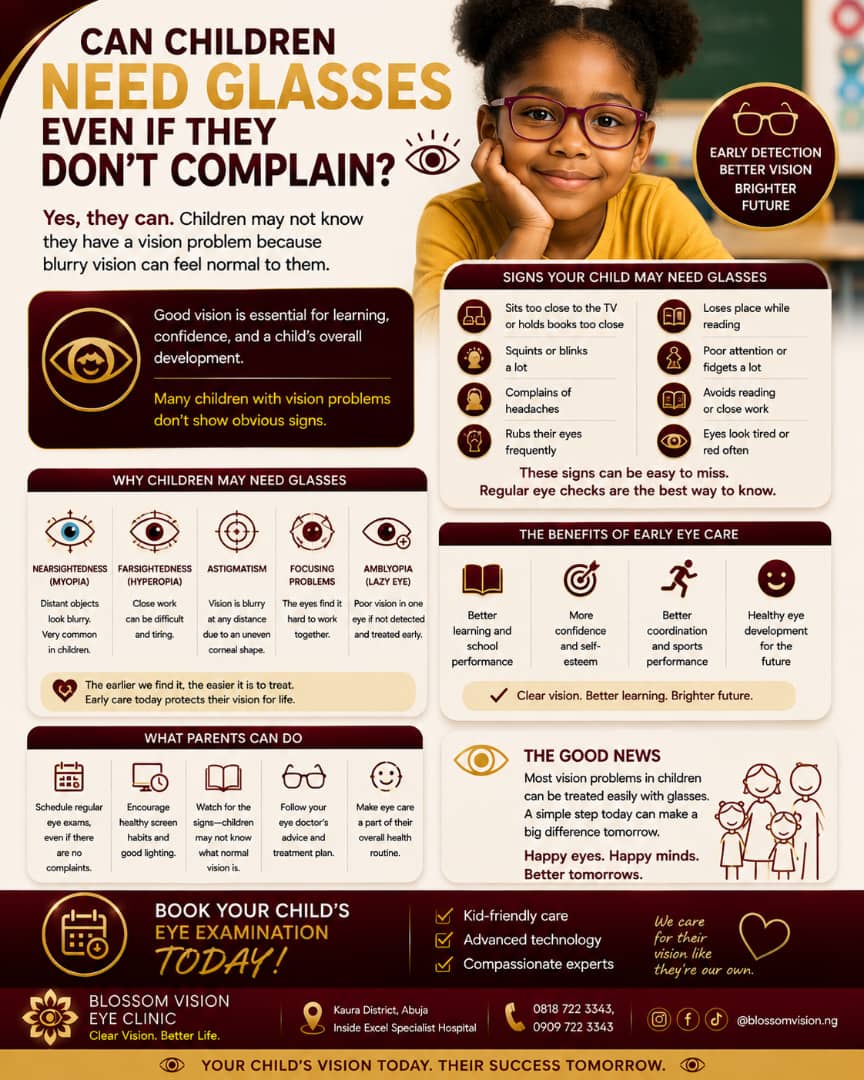
Can Children Need Glasses Even If They Don't Complain?
Can Children Need Glasses Even If They Don't Complain?
Yes.
A child can need glasses and still tell you:
“Mummy, I can see.”
They may play normally.
Watch television.
Use a phone.
Read books.
Run around with their friends.
And never once say:
“I can't see properly.”
This surprises many parents.
But children do not always know when their vision is different.
If a child has always seen the world slightly blurry, they may simply assume:
“This is how everybody sees.”
That is why parents should not wait for a child to complain before paying attention to their vision.
Quick Answer
Children can have short-sightedness, long-sightedness, astigmatism or a significant difference between the two eyes without clearly telling anyone that their vision is blurry.
Instead of complaining, a child may:
- Squint
- Move closer
- Sit close to the television
- Hold books or devices close
- Copy from classmates
- Tilt their head
- Close or cover one eye
- Avoid certain visual tasks
And sometimes:
there may be no obvious behaviour at all.
That is especially important when one eye sees much better than the other.
Book Appointment
Why Wouldn't My Child Know Their Vision Is Blurry?
Adults usually know what clear vision feels like.
You may remember seeing clearly through your old glasses.
Then when things become blurry, you notice:
“Something has changed.”
Children may not have that comparison.
If their vision has been blurry for years, they may genuinely believe that is normal.
Think of a child who has never seen leaves clearly on a distant tree.
They may not know that other people can see the individual leaves.
They simply see what they see.
That is why asking:
“Can you see?”
is not always enough.
The child may truthfully answer:
“Yes.”
The better question is:
How well does each eye actually see?
Can One Eye Be Blurry Without My Child Knowing?
Yes.
This is one of the most important reasons children may not complain.
Imagine:
Right eye: clear
Left eye: blurry
When both eyes are open, the child may rely mainly on the clearer right eye.
They can still:
- Walk around
- Watch television
- Recognise people
- Play
- Read
- Function normally
So neither the parent nor the child realises that one eye is significantly weaker.
This is why checking the eyes one at a time matters.
What Is Anisometropia?
Anisometropia simply means the two eyes have significantly different prescriptions.
For example:
One eye may have a small prescription.
The other may have a much stronger prescription.
The child may not notice because the brain relies more heavily on the clearer eye.
But during childhood, a large untreated difference between the eyes can interfere with normal visual development.
That can contribute to amblyopia.
What Is Amblyopia?
Amblyopia is sometimes called lazy eye, although that phrase can be misleading.
It means vision in one eye, or occasionally both eyes, has not developed as well as expected during childhood.
This may happen because of:
- A large difference between the prescriptions of the two eyes
- Significant uncorrected refractive error
- An eye that turns inward or outward
- Another problem preventing a clear image from reaching the developing visual system
The important point is:
A child with amblyopia may not complain.
If the other eye sees well, they may not realise there is a problem.
That is one reason early detection matters.
What Eye Problems Can Children Have Without Complaining?
Several.
1. Short-Sightedness
Short-sightedness is also called myopia.
A child with myopia sees things nearby more clearly than things far away.
They may not say:
“I can't see far.”
Instead, they may:
- Squint
- Move closer
- Sit near the television
- Ask to sit at the front of the classroom
- Struggle to recognise distant signs
You already have a detailed article about one common parent observation:
Why Does My Child Sit Too Close to the TV?
2. Long-Sightedness
Long-sightedness is also called hyperopia.
Children have powerful focusing ability.
That means some children can compensate for a degree of hyperopia without obvious blur.
Depending on the amount and the individual child, they may experience:
- Tired eyes
- Difficulty with prolonged near work
- Headaches
- Visual discomfort
But not every child with a small amount of hyperopia needs glasses.
The decision depends on things such as:
- The amount of prescription
- Age
- Symptoms
- Eye alignment
- Vision in each eye
- Other examination findings
3. Astigmatism
Astigmatism happens when light does not focus evenly inside the eye.
It can cause:
- Blurry vision
- Distorted vision
- Squinting
- Difficulty seeing details
It may affect:
- Distance vision
- Near vision
- Both
Again, a child may not know that the way they see is unusual.
4. A Significant Difference Between the Two Eyes
This deserves repetition because it can be easy to miss.
A child with one clear eye and one blurry eye may appear completely normal.
They may not bump into things.
They may not complain.
They may even perform well at school.
The problem may only be discovered when each eye is tested separately.
Can My Child Say They See Fine and Still Need Glasses?
Yes.
A child's description of their vision is useful.
But it should not be the only thing we rely on.
Children may say:
“I can see.”
because they genuinely can see something.
The real question is:
Can they see as clearly as they should with each eye?
There is a big difference between:
seeing something
and:
seeing it clearly.
What Behaviour Could Suggest a Hidden Vision Problem?
Parents can watch for changes such as:
- Frequent squinting
- Sitting unusually close to the television
- Holding books very close
- Bringing a phone very close to the face
- Moving closer to see distant objects
- Closing one eye
- Covering one eye
- Tilting the head
- Difficulty seeing the classroom board
- Complaints of blurry vision
- Repeated visual discomfort
But remember:
A child can still have a vision problem without showing these signs.
That is the central message of this article.
Does Sitting Close to the TV Mean My Child Definitely Needs Glasses?
No.
Children sometimes sit close because they simply like being close to the screen.
But if your child repeatedly sits very close and also:
- Squints at distant objects
- Moves closer to recognise people
- Cannot see the classroom board
- Holds other things close
then short-sightedness becomes more worth investigating.
Read Why Does My Child Sit Too Close to the TV? for the full explanation.
Does Holding a Phone Close Mean My Child Is Short-Sighted?
Not automatically.
Phones are naturally used at near distances.
The more important question is whether your child also struggles with distance vision.
For example:
Can they recognise a person across the room?
Can they see writing on the board?
Do they squint at the television?
Do they move unusually close to see things that other children can see comfortably?
Those patterns provide more useful clues.
Can My Child Have a Vision Problem Without Squinting?
Yes.
Not every child with refractive error squints.
That is why using one behaviour as the test can be misleading.
A child may have:
- Astigmatism
- Hyperopia
- Unequal prescriptions
- Amblyopia
without constantly squinting.
Can Vision Problems Affect Learning?
Clear vision is important for accessing visual information.
If a child cannot see the classroom board clearly, that can obviously make learning harder.
If near work is uncomfortable, reading or homework may also become more difficult.
But there is an important distinction.
We should not assume that every child who:
- Struggles at school
- Finds reading difficult
- Has poor concentration
- Is easily distracted
has an eye problem.
Learning difficulties can have many causes.
The purpose of an eye assessment is to make sure that poor vision is not one of the barriers affecting the child.
Can Poor Vision Make a Child Look Uninterested in School?
Sometimes.
Imagine being expected to copy information you cannot clearly see.
A child may:
- Stop trying
- Copy from another child
- Move closer
- Avoid looking at the board
An adult may interpret that as:
“This child isn't concentrating.”
But vision should be considered if there are other visual signs.
Again, not every school-performance problem is caused by the eyes.
Book Appointment
Can Children's Vision Change as They Grow?
Yes.
A child's eyes continue developing.
Their prescription may change during childhood and adolescence.
One important example is myopia progression.
A child who sees clearly today may develop increasing short-sightedness as they grow.
If your child is already short-sighted, read:
How Can I Stop My Child's Eyesight From Getting Worse?
That article explains myopia progression and management in more detail.
Does Screen Time Mean My Child Needs Glasses?
No.
Using a phone, tablet or computer does not automatically mean a child needs glasses.
But screens can make existing visual problems more noticeable.
Pay attention if your child:
- Brings screens unusually close
- Complains of recurring visual discomfort
- Squints frequently
- Struggles to shift attention from near to far
- Has difficulty seeing distant objects
An examination can determine whether a prescription is actually present.
Should Every Child Wear Blue-Light Glasses?
No.
A child does not automatically need blue-light-filtering glasses simply because they use screens.
First determine:
Does the child actually need a prescription?
If they do, the appropriate lens options can then be discussed based on their actual visual needs.
Do not start with:
“My child uses an iPad, therefore they need glasses.”
What About Headaches?
Headaches can have many causes.
They do not automatically mean a child needs glasses.
But recurrent headaches associated with:
- Reading
- Homework
- Prolonged near work
- Squinting
- Blurry vision
are worth discussing during an eye assessment.
An eye examination can determine whether an uncorrected prescription or another visual factor may be contributing.
What If My Child Rubs Their Eyes?
Eye rubbing alone does not mean a child needs glasses.
Frequent rubbing may occur because of:
- Allergy
- Dry-eye irritation
- Tiredness
- Habit
- Other irritation
But if eye rubbing occurs alongside other visual symptoms, mention it during the appointment.
What If My Child Covers One Eye?
Pay attention to this.
Children sometimes cover one eye because:
- One eye sees more clearly
- The eyes are not working comfortably together
- They are trying to avoid double vision
- Light bothers one eye
- Another visual issue is present
It does not tell us the diagnosis by itself.
But repeated covering or closing of one eye is worth assessing.
What If One Eye Turns Inward or Outward?
An eye that repeatedly turns inward or outward should be assessed.
Eye alignment problems can affect binocular vision and, in some children, normal visual development.
Do not wait for the child to complain.
A young child may have no idea that the eye movement is abnormal.
My Child Passed a School Vision Screening. Can They Still Need an Eye Examination?
School and community vision screenings are valuable.
They help identify children who may need further assessment.
A child who passes screening is less likely to have some detectable vision problems.
But screening is not the same thing as a complete eye examination.
Further assessment may still be appropriate when:
- A parent notices symptoms
- An eye turns
- One eye appears different
- The child repeatedly squints
- There is a significant family history
- A teacher raises a concern
- There are medical or developmental risk factors
- The child has previously had an eye problem
So I would not tell parents:
“A school screening is useless.”
It is useful.
But it has a different purpose from a comprehensive examination.
What If My Child Has Never Had Any Vision Problems?
That is reassuring.
Parents should still remain aware of their child's vision as they grow.
The appropriate frequency of professional eye examinations depends on factors such as:
- Age
- Symptoms
- Screening results
- Family history
- Previous findings
- Medical history
There is no need to frighten every parent into believing their child's eyes must secretly be abnormal.
The message is simpler:
Do not rely only on complaints.
Can Very Young Children Have Their Eyes Checked?
Yes.
A child does not necessarily need to know the alphabet before their vision can be assessed.
Age-appropriate methods can be used.
Depending on the child's age, this may involve:
- Pictures
- Symbols
- Matching tasks
- Observation of visual behaviour
- Objective prescription assessment
- Other child-friendly techniques
The assessment is adapted to the child.
What Happens During a Children's Eye Examination?
At Blossom Vision Eye Clinic in Games Village, Abuja, the examination can be adapted to your child's age and ability.
Depending on what is appropriate for the child, assessment may include:
- Visual acuity
- Checking each eye separately
- Prescription assessment
- Eye alignment
- Eye movements
- Focusing
- Binocular vision assessment where appropriate
- Examination of eye health
The purpose is not:
“Let's find glasses for every child.”
The purpose is:
“Let's find out how this child's eyes are actually seeing and developing.”
Sometimes the answer is:
“No glasses are needed.”
Sometimes:
“There is a prescription, but we should monitor it.”
And sometimes:
“Glasses are important.”
What If My Child Does Need Glasses?
Do not present the glasses as punishment.
Avoid saying:
“You spoiled your eyes with your phone.”
or:
“Your eyes are bad.”
Glasses are simply a tool used to help light focus properly for a child who needs them.
Explain it positively:
“These glasses will help you see more clearly.”
For younger children, acceptance often improves when parents treat glasses as normal rather than frightening.
Will Wearing Glasses Make My Child's Eyes Weaker?
No.
Correctly prescribed glasses do not make the eyes “lazy” or dependent simply because the child wears them.
If a child needs correction, refusing the prescribed glasses because:
“I don't want the eyes to get used to them”
is not a good strategy.
The appropriate plan depends on the child's prescription and clinical findings.
Will My Child Need Glasses Forever?
Not necessarily.
It depends on the type of prescription and how the eyes develop.
Some children's prescriptions change considerably.
Others continue needing correction into adulthood.
Myopia, for example, often progresses during the growing years.
The answer should come from follow-up measurements rather than guessing.
When Should I Arrange an Eye Assessment?
Consider assessment if:
- Your child repeatedly squints
- Your child sits unusually close to see distant objects
- Books or screens are consistently held very close
- One eye turns inward or outward
- Your child covers or closes one eye
- The child reports blurry or double vision
- A school or vision screening identifies a concern
- A teacher notices difficulty seeing
- There is a significant family history of childhood eye problems
- You are simply concerned that the child's two eyes may not see equally
You do not have to wait for:
“Mummy, I can't see.”
When Is a Child's Eye Problem More Urgent?
Seek prompt assessment if your child develops:
- Sudden significant vision loss
- Severe eye pain
- Significant eye injury
- Chemical exposure
- A very red painful eye with reduced vision
- New severe light sensitivity
- Sudden double vision
- Sudden neurological symptoms
These are different from an ordinary glasses question and should not wait for a routine appointment.
Frequently Asked Questions
Can my child need glasses even if they don't complain?
Yes. Children may not realise their vision is blurry, particularly if the problem has been present for a long time or one eye sees better than the other.
Why wouldn't my child know they can't see clearly?
They may have nothing to compare their vision with. If they have always seen that way, they may think it is normal.
Can one eye be blurry without my child noticing?
Yes. The child may rely mainly on the better-seeing eye.
What are common signs that a child may need glasses?
Possible signs include squinting, moving closer, difficulty seeing distant objects, holding material unusually close or covering one eye. But some children have no obvious symptoms.
Does sitting close to the TV mean my child needs glasses?
Not automatically. But persistent close viewing together with poor distance vision or squinting deserves assessment. Read Why Does My Child Sit Too Close to the TV?.
Can children have astigmatism?
Yes. Children can have myopia, hyperopia, astigmatism and differences between the prescriptions of the two eyes.
What is amblyopia?
Amblyopia is reduced visual development in one or both eyes during childhood. It can occur when the brain does not receive a sufficiently clear or properly aligned image from an eye during development.
Can my child pass school screening and still need further assessment?
Yes, particularly if there are symptoms, abnormal eye alignment, significant risk factors or another specific concern.
Does screen time automatically mean my child needs glasses?
No.
Will glasses make my child's eyes weaker?
Correctly prescribed glasses do not weaken the eyes simply because they are worn.
Can young children have their eyes checked before they can read?
Yes. Age-appropriate methods can be used to assess young children's vision.
What if my child is already becoming more short-sighted?
Read How Can I Stop My Child's Eyesight From Getting Worse? for information about childhood myopia progression.
Where can I have my child's eyes checked in Abuja?
Blossom Vision Eye Clinic provides children's eye assessments in the Games Village/Kaura District area of Abuja.
Don't Wait for “Mummy, I Can't See”
That sentence may never come.
Your child may:
see through one good eye
move closer
squint
adapt
or simply:
believe that blurry vision is normal.
That is why children's vision should not be judged only by whether they complain.
At Blossom Vision Eye Clinic in Games Village, Abuja, we can assess how clearly each eye sees, check for a glasses prescription and examine how the eyes are working together.
If your child does not need glasses, we will tell you.
If they do, identifying the problem gives you the opportunity to address it appropriately.
If you have noticed unusual visual behaviour or are concerned about your child's eyesight, book a children's eye assessment.