Why Does My Child Sit So Close to the TV? | Abuja Eye Clinic
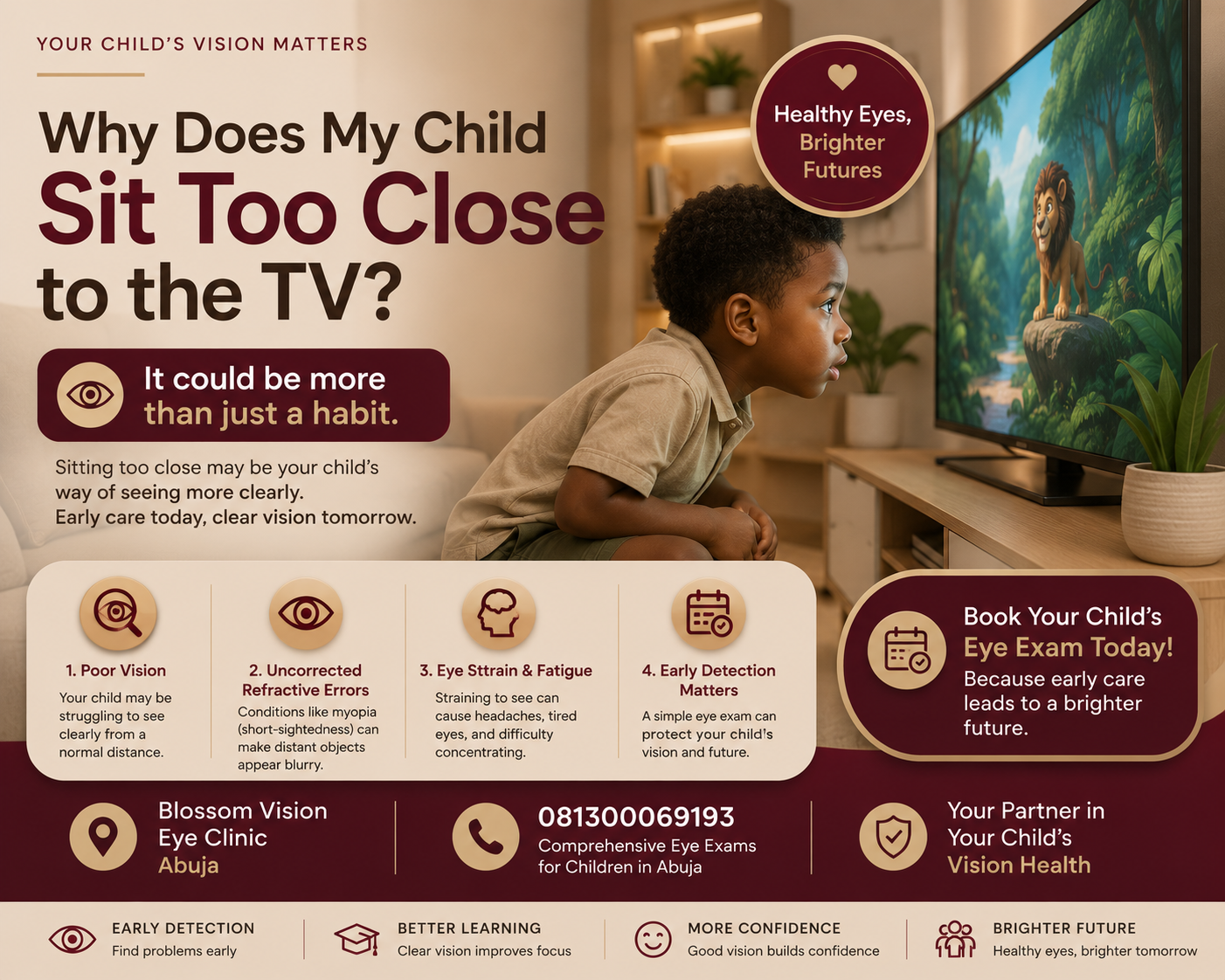
Why Does My Child Sit So Close to the TV?
You tell your child:
“Move back from the television.”
Five minutes later, they are sitting close again.
Many parents immediately wonder:
“Is something wrong with my child's eyes?”
Sometimes, a child simply likes sitting close because the picture appears bigger and more interesting.
But repeatedly sitting very close to the TV can also be one of the behaviours seen in children who do not see clearly at a distance, particularly children with myopia, or short-sightedness.
The important question is therefore not:
“Will sitting close to the TV spoil my child's eyes?”
The better question is:
“Why does my child keep needing or wanting to sit so close?”
Quick Answer
Sitting close to the TV does not by itself damage your child's eyes.
And sitting close does not automatically mean your child needs glasses.
However, book an eye examination if your child sits close and also:
- Squints to see distant objects
- Says the classroom board is blurry
- Moves unusually close to other distant objects
- Holds phones or tablets extremely close
- Complains of headaches during visual tasks
- Closes or covers one eye
- Has one eye turning in or out
- Complains of blurry distance vision
The combination of signs matters more than sitting close on its own.
Book Appointment
Is Sitting Too Close to the TV Bad for My Child's Eyes?
This is probably the biggest concern parents have.
The answer is:
Sitting close to the television does not itself cause permanent eye damage.
Children have strong focusing ability and may comfortably sit closer to screens than adults would choose to.
Some simply enjoy having the picture fill more of their field of view.
But there is an important difference between:
A child who likes sitting close
and
A child who needs to sit close because they cannot see clearly from farther away.
That is what parents need to watch for.
Does Sitting Close to the TV Mean My Child Needs Glasses?
Not necessarily.
Sitting close alone cannot tell us whether a child needs glasses.
But if your child consistently moves close to the television and struggles with distance vision elsewhere, glasses may be needed.
For example, ask:
- Can my child see the classroom board clearly?
- Do they recognise people from across the room?
- Do they squint at television subtitles?
- Do they move closer to signs or displays?
- Can they see things their siblings see easily?
If several of these seem difficult, arrange an eye examination.
For a broader checklist, read How Do I Know If My Child Needs Glasses?.
Why Does My Child Sit Close to the TV?
There are several possibilities.
1. Your Child May Simply Prefer Sitting Close
This is especially common in younger children.
A large television image becomes even larger and more immersive when they sit close.
Young eyes also have a strong ability to focus at short distances.
So a child who sits close but:
- Does not squint
- Sees the classroom board clearly
- Has no difficulty recognising distant objects
- Has no other vision complaints
may simply prefer that viewing position.
Sitting close alone does not diagnose an eye problem.
2. Your Child May Be Short-Sighted
This is the vision problem parents particularly need to watch for.
Myopia, also called short-sightedness or near-sightedness, means near objects are clearer while distant objects appear blurry.
A child with myopia may therefore move closer to the television because the picture becomes easier to see.
Other signs of myopia can include:
- Squinting at distant objects
- Difficulty seeing the classroom board
- Moving closer to screens
- Holding objects unusually close
- Sitting near the front of the classroom
- Complaining that things far away look blurry
If these behaviours occur together, arrange an eye examination.
If your child has already been diagnosed with myopia, read our guide on myopia control in Abuja and how childhood short-sightedness can be managed.
Why Does My Child Hold the Phone So Close to Their Face?
This is another common parent question.
Young children can focus at much closer distances than adults, so holding a device close does not automatically mean something is wrong.
But again, look at the pattern.
Be more concerned if your child:
- Holds everything close
- Cannot comfortably see things farther away
- Squints at distant objects
- Struggles to see the board
- Has recently started moving much closer than before
If your child sees perfectly well at distance and simply brings a phone close while watching cartoons, it may be habit rather than poor eyesight.
Why Does My Child Squint When Watching TV?
Squinting deserves more attention than sitting close by itself.
When someone squints, narrowing the eyelids can temporarily make some blurred images appear clearer.
A child may therefore squint if they are having difficulty seeing distant detail.
Repeated squinting when watching television, looking at the classroom board or recognising distant objects is a good reason to have their vision checked.
My Child Sits Close to the TV but Says They Can See Fine. Should I Believe Them?
Listen to your child, but do not rely only on what they tell you.
Children may not realise their vision is blurry.
If they have always seen that way, they may think everyone sees the same thing.
This is why behaviour can sometimes tell us more than the child's complaint.
A child may adapt by:
- Moving closer
- Squinting
- Copying from another child's book
- Sitting at the front of class
- Avoiding tasks they cannot see comfortably
They may never actually say:
“My vision is blurry.”
Can My Child Be Short-Sighted Without Knowing It?
Yes.
A child can have myopia and assume their vision is normal.
This becomes especially easy to miss when myopia develops gradually.
Parents may first notice that the child:
- Starts sitting closer
- Squints at distance
- Cannot recognise people far away
- Says the classroom board is unclear
The eye examination is what tells us whether the problem is actually myopia.
Why Can't My Child See the Board at School?
If your child can comfortably read a book but struggles to see what the teacher writes on the board, distance vision should be checked.
That pattern is particularly suggestive of myopia.
Your child may say:
“I can only see the board when I sit in front.”
or:
“The writing is blurry from the back.”
That deserves an eye examination.
Do not simply tell the child to keep moving to the front of the classroom without investigating why.
Can Vision Problems Affect Schoolwork?
They can.
A child needs clear and comfortable vision for activities such as:
- Reading the board
- Reading books
- Copying notes
- Looking between a book and the board
- Using classroom screens
- Completing visually demanding tasks
An uncorrected vision problem can make some of these activities harder.
But we should be careful here.
Poor grades, short attention span or difficulty learning do not automatically mean the child has an eye problem.
Those difficulties can have many causes.
The eye examination simply helps determine whether vision is one part of the problem.
Does Sitting Close to the TV Cause Myopia?
We should separate two different things.
Sitting close to the television itself is not considered the simple cause of myopia.
However, childhood myopia is associated with a wider combination of genetic and environmental factors.
Research has particularly focused on:
- Family history
- Large amounts of near work
- Time spent indoors
- Limited outdoor time
So instead of repeatedly shouting:
“Move away from the TV or you'll spoil your eyes!”
a better family approach is:
- Encourage regular breaks from prolonged near work
- Encourage outdoor activity
- Avoid hours of uninterrupted screen use
- Watch for changes in distance vision
- Have concerning symptoms assessed
Does Too Much Screen Time Damage Children's Eyes?
Long periods of screen use can contribute to temporary problems such as:
- Eye strain
- Tired eyes
- Dryness
- Headaches
- Temporary blurred vision
But that is different from saying that ordinary screen viewing directly burns or permanently damages children's eyes.
The bigger issue is balance.
Children should not spend nearly every waking hour doing close work indoors.
Breaks, comfortable viewing habits and outdoor activity matter.
Should I Keep Moving My Child Away From the TV?
You can encourage a comfortable viewing distance.
But if your child repeatedly returns to the front of the television, do more than keep correcting them.
Ask:
Can this child actually see clearly from where I want them to sit?
If you have never checked, an eye examination can answer that question.
What Other Signs Mean My Child's Eyes Should Be Checked?
Pay particular attention if sitting close happens together with:
- Squinting
- Complaints of blurry vision
- Difficulty seeing the classroom board
- Holding books or devices unusually close
- Closing one eye
- An eye turning inward or outward
- Frequent headaches during visual tasks
- Moving very close to recognise distant objects
- A noticeable change from how the child used to behave
Read our full guide on how to know if your child may need glasses for more signs.
Book Appointment
What If My Child Already Wears Glasses but Has Started Sitting Close Again?
That is worth checking.
A child's prescription can change as they grow, especially with myopia.
If your child previously watched television comfortably from farther away and has gradually started moving closer again, their prescription may need review.
Do not simply order another pair using an old prescription.
Have the child's vision reassessed.
Can My Child's Short-Sightedness Get Worse?
Yes.
Myopia commonly begins during childhood and can progress while the eyes are growing.
This is why a child with myopia should not only receive glasses and then disappear from eye care for several years.
Their prescription and progression should be monitored.
For children whose myopia is progressing, different approaches may be considered to slow progression.
Read more in our guide to myopia control for children in Abuja.
Can a Child Pass a School Eye Test and Still Have a Vision Problem?
Yes.
A school screening can be useful, but it is not always the same as a comprehensive children's eye examination.
Depending on how the screening is performed, it may mainly check distance vision.
A fuller eye examination can assess additional areas such as:
- Vision in each eye separately
- Glasses prescription
- Eye alignment
- Focusing
- Eye movements
- Binocular vision
- Eye health
So if you keep noticing something concerning at home, do not ignore it simply because your child previously passed a screening.
What Happens During a Children's Eye Test?
At Blossom Vision Eye Clinic in Games Village, Abuja, children's eye examinations are adjusted to the child's age and ability.
A child does not necessarily need to know the alphabet before their vision can be assessed.
Depending on the child's age and needs, the examination may assess:
- Distance vision
- Near vision
- Each eye separately
- Glasses prescription
- Eye alignment
- Eye movements
- Focusing
- Binocular vision
- Eye health
We also ask parents what they have noticed at home and what teachers may have observed at school.
Does My Child Need Glasses?
Only an appropriate eye examination can answer that reliably.
Some children who sit close need glasses.
Others do not.
That is why we should not prescribe glasses based purely on one behaviour.
If your child does need glasses, the examination tells us:
- What type of vision problem is present
- How much prescription is needed
- Whether both eyes see equally
- How the glasses should be used
- Whether the prescription needs closer monitoring
How Much Is a Children's Eye Test in Abuja?
The cost depends on the type of examination and whether additional testing is needed.
You can see our guide to the cost of an eye test in Abuja and what the examination includes.
Where Can I Get My Child's Eyes Checked in Abuja?
Blossom Vision Eye Clinic provides children's eye examinations in the Games Village/Kaura District area of Abuja.
Parents commonly bring children for concerns such as:
- Sitting close to the television
- Squinting
- Difficulty seeing the board
- Headaches during visual work
- Eye turns
- Blurry vision
- Changing glasses prescriptions
- Myopia
Frequently Asked Questions
Why does my child sit so close to the TV?
Sometimes children simply enjoy sitting close because the picture looks larger. In other cases, repeatedly sitting close can be a clue that distance vision is blurry, particularly if the child also squints or struggles to see the classroom board.
Is sitting too close to the TV bad for my child's eyes?
Sitting close itself does not cause permanent eye damage. The more useful question is why your child prefers or needs to sit close.
Does sitting close to the TV mean my child needs glasses?
Not necessarily. Sitting close alone cannot diagnose a glasses prescription. It becomes more concerning when accompanied by squinting, blurred distance vision or difficulty seeing at school.
Why does my toddler sit close to the TV?
Young children commonly enjoy sitting close and can focus comfortably at short distances. If your toddler also shows unusual visual behaviour, eye misalignment or difficulty seeing things farther away, have their eyes assessed.
Why does my child hold the phone close to their face?
It may simply be comfortable for them. But if they hold everything close and appear unable to see clearly at distance, an eye examination is appropriate.
Can my child be short-sighted without knowing?
Yes. Children may assume the way they see is normal because they have nothing to compare it with.
Why does my child squint at the television?
Squinting can temporarily improve the appearance of some blurred images. Persistent squinting at distant objects should be assessed.
Does sitting close to the TV cause short-sightedness?
Sitting close itself should not be described as the direct cause of myopia. Childhood myopia has a combination of genetic and environmental risk factors.
Should I stop my child from sitting close to the television?
Encourage a comfortable viewing distance, but if the child repeatedly returns close to the screen, investigate whether they actually see clearly from farther away.
When should I book an eye examination?
Book an examination if sitting close occurs repeatedly alongside squinting, difficulty seeing the board, blurry vision, an eye turn, covering one eye or other visual concerns.
Don't Just Move Your Child Back. Find Out Why They Move Forward.
If your child repeatedly sits close to the television, the answer is not always:
“Stop sitting there.”
Sometimes the better question is:
“Can you actually see properly from the sofa?”
Most children who enjoy being close to a screen will have perfectly normal vision.
But if your child also squints, struggles to see the classroom board or consistently moves closer to see distant things, it is worth checking.
At Blossom Vision Eye Clinic in Games Village, Abuja, we provide children's eye examinations to determine how clearly each eye sees and whether glasses, monitoring or other care is needed.
If you are wondering why your child keeps sitting close to the TV, book a children's eye examination and let the examination answer the question.