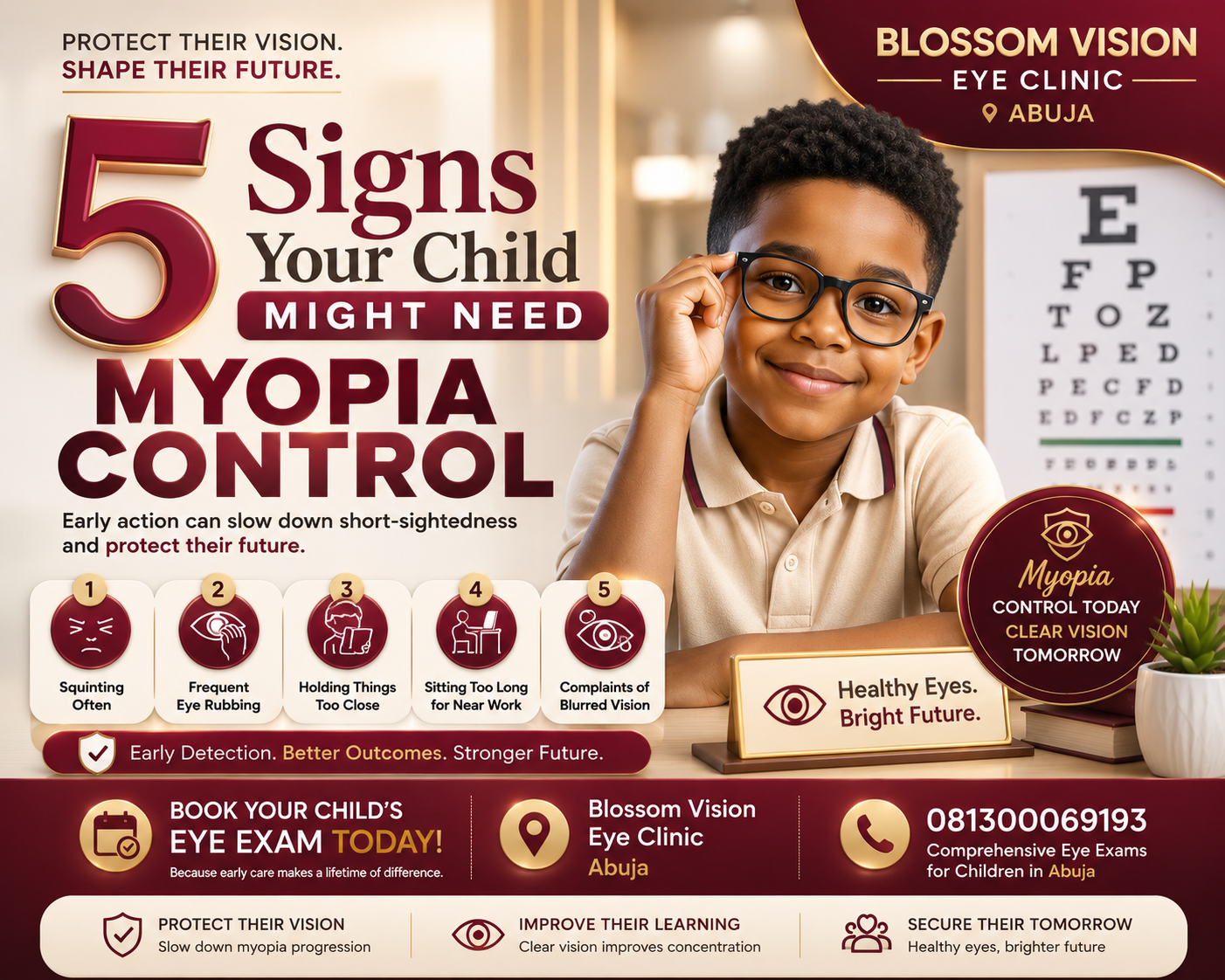
Myopia Control Abuja: How to Slow Down Your Child's Short-Sightedness
Myopia (short-sightedness) is becoming increasingly common among children in Abuja and around the world.Contrary to popular belief, the goal is not just to prescribe stronger glasses every year. Modern myopia management focuses on slowing down the progression of myopia through outdoor activity, regular monitoring, and evidence-based treatment strategies. Early intervention can reduce the risk of serious eye diseases later in life.
Myopia can be slowed down.
Many parents believe that once a child starts wearing glasses, stronger prescriptions every year are inevitable.
That is no longer true.
Modern eye care focuses not only on helping children see clearly today but also on reducing how quickly their eyesight worsens over time.
The earlier myopia is identified, the more opportunities we have to manage it effectively.
What Is Myopia?
Myopia, also known as short-sightedness, is a condition where distant objects appear blurry while nearby objects remain clear.
Children with myopia often:
- Sit close to the TV
- Squint frequently
- Struggle to see the classroom board
- Hold devices close to their face
- Need frequent prescription updates
The condition develops because the eye grows too long from front to back.
When this happens, light focuses in front of the retina instead of directly on it.
The result is blurry distance vision.
Why Are More Children Becoming Short-Sighted?
This is one of the biggest questions parents ask.
The answer surprises many people.
The problem isn't simply screens.
The bigger issue is that children are spending less time outdoors.
Today's children often move between:
- School
- Homework
- Lesson classes
- Television
- Phones
- Tablets
- Sleep
Many spend very little time outside.
Research increasingly shows that outdoor light plays an important role in healthy eye development.
The Balloon and Brake Pedal Explanation
This is how we explain myopia to children in clinic.
Imagine your child's eye is a balloon.
As the balloon stretches longer, distant objects become blurry.
Now imagine the eye has a brake pedal.
That brake pedal is activated by outdoor light.
When children spend time outdoors, natural light stimulates dopamine release inside the retina.
Dopamine helps regulate eye growth.
It tells the eye:
"Slow down."
Without enough outdoor exposure, that signal becomes weaker.
The eye may continue growing longer than it should.
And the prescription keeps increasing.
This is why outdoor activity is now considered one of the most important protective habits for children's vision.
Why Myopia Matters Beyond Glasses
Many parents think:
"So what if my child needs glasses?"
The concern isn't just today's prescription.
The concern is where that prescription may lead.
Higher levels of myopia increase the risk of:
- • Retinal detachment
- • Glaucoma
- • Myopic macular degeneration
- • Early cataracts
In other words:
The goal is not simply clear vision.
The goal is healthier eyes for life.
Signs Your Child May Have Myopia
Watch for:
- Sitting too close to the TV
- Squinting
- Complaints of blurry distance vision
- Difficulty seeing the board at school
- Frequent prescription changes
- Holding books very close
- Reduced interest in outdoor activities
Learn more:
Why Does My Child Sit Too Close to the TV?
and
Child Vision Problems in Abuja: 7 Signs Parents Often Miss
How Can Myopia Progression Be Slowed?
1. Increase Outdoor Time
This is one of the simplest and most effective strategies.
Current research suggests children should spend approximately 90–120 minutes outdoors daily.
Outdoor activity is not about exercise alone.
It is about exposure to natural light.
2. Regular Eye Examinations
Children's eyes change rapidly.
Regular examinations help monitor progression and allow early intervention when necessary.
3. Appropriate Optical Correction
Accurate prescriptions remain important.
Undercorrecting vision does not stop myopia.
Children should see clearly.
4. Early Intervention
The younger the child when myopia begins, the more important early management becomes.
This is why routine eye examinations are critical.
Common Myopia Myths
Myth: Screens directly cause myopia.
Reality: Research suggests that reduced outdoor time plays a major role.
Myth: Myopia can be outgrown.
Reality: Myopia usually progresses throughout childhood before stabilizing in adulthood.
Myth: Stronger glasses make the eyes weaker.
Reality: Glasses do not weaken the eyes.
They simply correct blurred vision.
Why Abuja Parents Should Pay Attention
We are seeing more children with myopia than ever before.
Many parents only discover the problem when:
- School performance drops
- The teacher complains
- The child fails a vision screening
By then, the condition may have already progressed significantly.
Early detection creates more opportunities for successful management.
Frequently Asked Questions
What is myopia?
Myopia is short-sightedness, a condition where distant objects appear blurry.
Can myopia be cured?
There is currently no cure, but progression can often be slowed through proper management.
At what age does myopia start?
It commonly develops during childhood and school-age years.
Does screen time cause myopia?
The relationship is complex. Reduced outdoor exposure appears to play a significant role.
How much outdoor time does my child need?
Research generally supports approximately 90–120 minutes of outdoor activity daily.
If your child's glasses prescription seems to be increasing every year, don't assume it's something they simply have to live with.
Early myopia management can make a significant difference to your child's long-term eye health.
Schedule a comprehensive children's eye examination at Blossom Vision Eye Clinic Abuja today.
📍 Blossom Vision Eye Clinic Abuja
📞 081300069193