Can Children Outgrow Poor Eyesight? | Blossom Vision Eye Clinic Abuja
Can Children Outgrow Poor Eyesight?
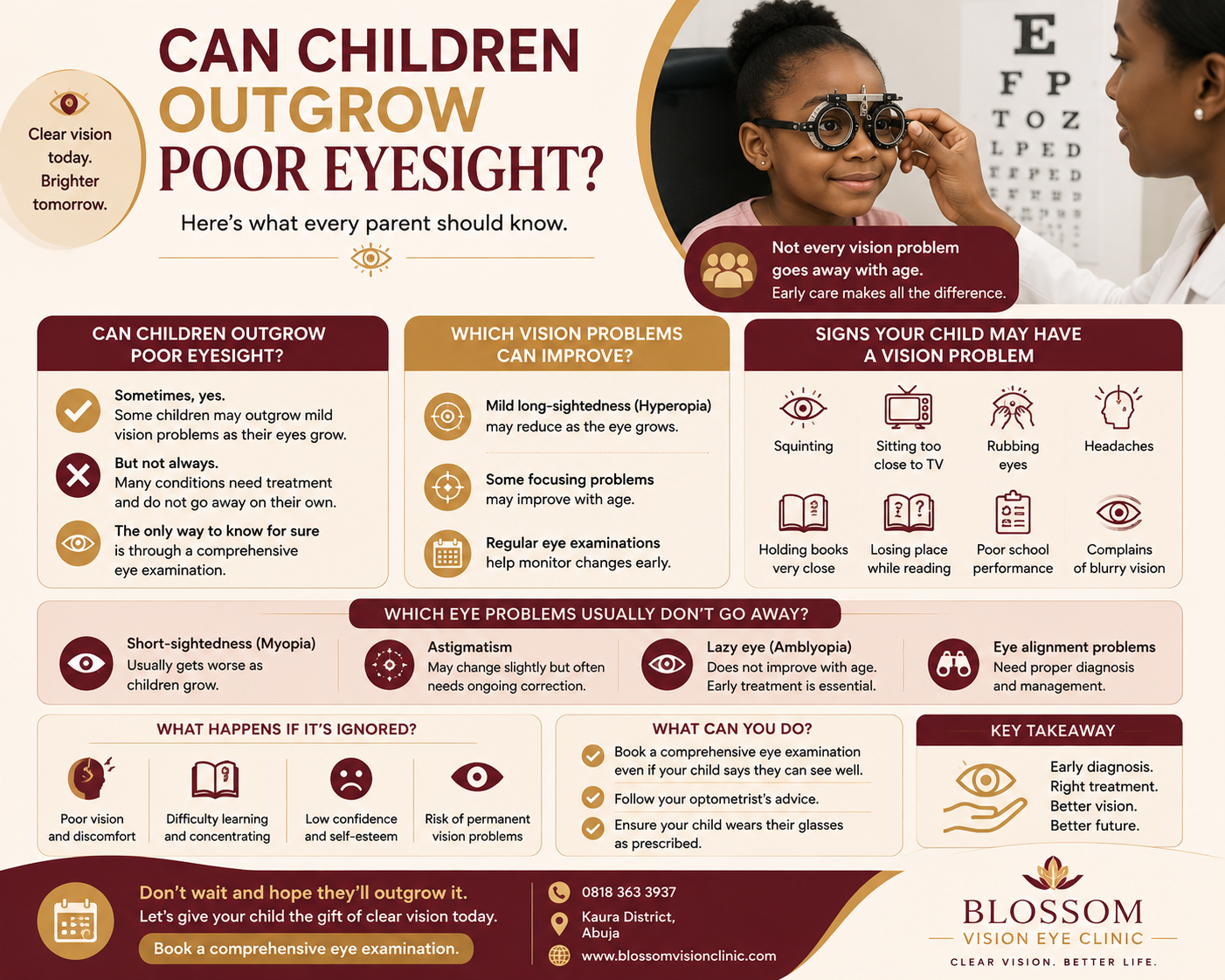
“Doctor, will she have to wear glasses forever?”
It is one of the first questions many parents ask when their child is prescribed glasses.
Sometimes the question sounds like:
“Won't his eyes correct themselves as he grows?”
Or:
“Can we wait for her to outgrow it?”
The answer is:
It depends on why your child cannot see clearly.
Some childhood prescriptions may become smaller as the eyes grow.
Others may remain.
Some, such as childhood myopia, often become stronger during the growing years rather than disappearing.
And some childhood vision problems need treatment while the visual system is still developing.
So instead of asking only:
“Will my child outgrow glasses?”
the better question is:
“What type of vision problem does my child actually have?”
That tells us much more about what may happen as the child grows.
Quick Answer: Can Children Outgrow Glasses?
Sometimes.
A young child with a small amount of hyperopia, or long-sightedness, may need less correction as the eyes develop.
But a child with myopia, or short-sightedness, will usually not simply outgrow it. Myopia commonly starts during childhood and may increase through the school years and into the teenage or young-adult years.
Astigmatism can also change as a child grows, but it cannot be assumed that it will disappear.
And amblyopia, sometimes called lazy eye, should not be left untreated in the hope that age will fix it. Early treatment generally gives children the best opportunity for good visual development.
Book Appointment
First, What Does “Poor Eyesight” Actually Mean?
Parents often use the words:
“poor eyesight”
to describe any child who needs glasses.
But there are several different reasons a child may not see clearly.
The main refractive errors are:
- Myopia
- Hyperopia
- Astigmatism
- Anisometropia, where the two eyes need significantly different prescriptions
Children can also have:
- Amblyopia
- Eye alignment problems
- Focusing or binocular-vision problems
- Eye disease
These are not the same thing.
And they do not all behave the same way as a child grows.
1. Can Children Outgrow Long-Sightedness?
Sometimes.
Long-sightedness is called hyperopia.
Young children's eyes are naturally smaller than adult eyes, so some amount of hyperopia is common in early childhood.
A child with a small amount may still see clearly because children have strong focusing ability.
As the eye grows, the prescription may change.
AAPOS notes that small amounts of hyperopia are common in young children and often do not require treatment, while larger amounts may require glasses, particularly if vision is blurry or the eyes turn inward.
So yes:
some children may need less plus power as they grow.
But that does not mean every long-sighted child should be left without glasses.
When Does Hyperopia Need Glasses?
That depends on things such as:
- How much hyperopia is present
- The child's age
- Vision in each eye
- Whether the eyes are straight
- Whether amblyopia is developing
- Symptoms
- How effectively the child can focus
A child with significant hyperopia may need glasses to provide clear vision during an important period of visual development.
So if glasses have been prescribed, do not stop them simply because:
“I heard children can outgrow long-sightedness.”
The child's actual prescription and vision need to be monitored.
2. Can Children Outgrow Myopia?
Usually, no.
Myopia means short-sightedness.
A child with myopia usually sees nearby things more clearly but distant objects appear blurry.
For example:
phone → clear
classroom board → blurry.
Childhood myopia commonly progresses as the eye grows and often continues changing into the late teenage or early adult years.
So a child who is:
-1.00 today
may later become:
-1.75
or:
-2.50
depending on how their myopia progresses.
That does not happen because the glasses damaged the eyes.
It happens because the underlying myopia is changing.
Can Myopia Ever Get Better by Itself?
Small fluctuations in measurements can occur.
But parents should not expect established childhood myopia to simply disappear as the child becomes taller or older.
That is why myopia deserves monitoring.
If your child is already short-sighted, read How Can I Stop My Child's Eyesight From Getting Worse?.
That article explains childhood myopia progression and the options used to manage it.
What If My Child Keeps Needing Stronger Glasses?
That can happen with progressive myopia.
Do not automatically conclude:
“The glasses are making the eyes weaker.”
The glasses are correcting the myopia that is already present.
If the underlying eye continues growing in a way that increases myopia, the prescription may need updating.
The important question becomes:
How quickly is the myopia progressing?
That helps determine whether myopia-management options should be discussed.
3. Can Children Outgrow Astigmatism?
Astigmatism can change during childhood.
Some children have relatively small amounts.
Others have significant astigmatism that continues to require correction.
Astigmatism happens when light does not focus evenly in the eye, producing blurry or distorted vision. It is common in children and can be corrected with appropriately prescribed lenses.
I would therefore not tell a parent:
“Your child will definitely outgrow astigmatism.”
And I would not say:
“Once a child has astigmatism, it can never change.”
Both statements are too absolute.
We monitor the actual prescription over time.
Why Does Significant Astigmatism Matter in Young Children?
Because clear visual input matters while the brain is learning how to see.
If one or both eyes remain significantly blurry during early childhood, visual development can be affected.
Uncorrected refractive errors can contribute to amblyopia.
That is why sometimes the glasses are doing more than making the classroom board clearer.
They are helping provide the brain with a clearer image during visual development.
4. Can a Child Outgrow Different Prescriptions in the Two Eyes?
Sometimes prescriptions change.
But a large difference between the eyes deserves attention.
This is called anisometropia.
For example:
Right eye: +1.00
Left eye: +4.00
The child may function surprisingly well because the brain relies more heavily on the clearer eye.
They may never complain.
But significant unequal refractive error can contribute to amblyopia if the brain begins favouring one eye.
This is one reason parents should not judge vision only by:
“My child says she can see.”
Can Children Have Poor Vision Without Complaining?
Absolutely.
Children often do not know that their vision is abnormal.
Especially if one eye sees well.
They may assume:
“This is how everyone sees.”
If your main concern is that your child seems fine and has never complained, your separate article Can Children Need Glasses Even If They Don't Complain? covers that question specifically.
And for the broader signs parents should watch for, read How Do I Know If My Child Needs Glasses?.
5. Can a Child Outgrow Amblyopia?
This question needs careful wording.
Amblyopia is not simply a glasses prescription.
It is a problem with visual development.
It happens when the brain receives poorer visual input from one eye, or sometimes both eyes, during childhood and begins relying more heavily on the better visual information.
Possible causes include:
- Significant difference between the two eyes
- Uncorrected refractive error
- Eye misalignment
- Childhood cataract
- Other conditions interfering with clear visual development
Amblyopia should not simply be left for the child to outgrow.
Early treatment works well for many children and helps prevent long-term visual impairment.
Can Amblyopia Improve?
Yes.
This is an important distinction.
Saying:
“Children don't outgrow amblyopia”
does not mean:
“Nothing can be done.”
Quite the opposite.
Amblyopia can often improve with appropriate treatment.
Depending on the cause and child, treatment may involve:
- Correct prescription glasses
- Patching the stronger eye
- Atropine treatment in selected cases
- Treating an underlying eye problem
The goal is to encourage the brain to use the weaker eye more effectively.
NEI notes that treatment works best when started early, although some older children can also benefit.
Why Does Age Matter With Amblyopia?
Because the visual system develops during childhood.
Think of it like learning a language.
It is much easier for the brain to build certain visual pathways while it is still developing.
That does not mean treatment suddenly becomes impossible after one exact birthday.
But it does mean:
waiting years unnecessarily is not a good strategy.
If amblyopia is suspected, proper assessment and treatment should not be delayed because:
“Maybe the eye will catch up later.”
6. Can a Child Outgrow an Eye Turn?
Sometimes the appearance or pattern of an eye turn can change.
But parents should not simply wait for persistent eye misalignment to disappear.
An eye turning:
- Inward
- Outward
- Upward
- Downward
may be related to strabismus.
Some forms can be associated with refractive error and amblyopia.
The treatment depends on the type and cause.
So:
persistent eye turning deserves assessment.
It should not be managed with:
“Let's wait until secondary school.”
7. Will Wearing Glasses Make My Child's Eyes Worse?
No.
This myth causes unnecessary problems.
Prescription glasses do not weaken a child's eyes.
They correct the way light is focused.
Think about a child with myopia.
Without glasses:
the classroom board is blurry.
With glasses:
the board becomes clear.
The glasses did not create the myopia.
They corrected the blur caused by it.
Eyeglasses are one of the standard and safest ways to correct refractive errors in children.
Why Does My Child Seem More Dependent on Glasses After Wearing Them?
Parents sometimes say:
“Before we bought glasses, she managed without them. Now she can't do anything without them.”
Usually, the glasses have not damaged the eyes.
The child has simply discovered:
what clear vision actually looks like.
Imagine watching television in standard definition for years.
Then someone gives you a sharp high-definition picture.
Once you know the difference, going back to blur becomes much more obvious.
That does not mean the clear television damaged you.
Book Appointment
Does Wearing Glasses Make Myopia Progress Faster?
Ordinary prescription glasses correct the blur from myopia.
They are not the reason the child's eye becomes more myopic.
Childhood myopia commonly progresses because of the way the eye grows.
The appropriate response to increasing myopia is therefore not:
“Stop the glasses.”
It is:
“Let's measure how the myopia is progressing and decide how best to manage it.”
What Happens If My Child Doesn't Wear Their Glasses?
That depends on why the glasses were prescribed.
This distinction matters.
If the Glasses Are Mainly for Myopia
The child may struggle to see:
- Classroom board
- Television
- Road signs
- Faces at a distance
Not wearing the glasses does not magically exercise the eyes until myopia disappears.
It simply leaves the child blurry at the distances where correction is needed.
If the Glasses Are Important for Amblyopia Treatment
This can be more significant.
If clear visual input is needed for normal visual development, failure to wear prescribed correction can interfere with treatment.
Refractive errors that remain uncorrected in childhood can contribute to amblyopia.
If the Glasses Help Eye Alignment
Some children with significant hyperopia may have an inward eye turn that improves with the appropriate glasses.
In that situation, wearing the prescribed correction may be particularly important.
So the answer should never simply be:
“Children must wear every pair of glasses all day forever.”
The better question is:
“Why were these glasses prescribed, and when did the optometrist ask the child to wear them?”
What If My Child Refuses to Wear Their Glasses?
First find out why.
The problem may be:
- Frame uncomfortable
- Glasses slipping
- Glasses too tight
- Lens scratched
- Prescription changed
- Child being teased
- Child does not understand why they need them
- Glasses not being worn as prescribed
Do not immediately conclude:
“He refuses them because he doesn't really need them.”
A child can reject something useful simply because it is uncomfortable or unfamiliar.
Can Poor Eyesight Affect School?
Poor distance vision can clearly make it difficult for a child to see information on the board.
Other visual problems may make certain tasks uncomfortable.
But we should not tell parents that every:
- Reading difficulty
- Attention problem
- Poor grade
- Concentration problem
is caused by eyesight.
Learning difficulties can have many causes.
Our job is to make sure that poor vision is not creating an unnecessary barrier.
What Signs Should Parents Watch For?
Possible signs include:
- Squinting
- Sitting close to the television
- Moving closer to see distant objects
- Holding books unusually close
- Closing or covering one eye
- Tilting the head
- Difficulty seeing the classroom board
- Repeated complaints of blur
- An eye turning inward or outward
But remember:
some children show no obvious signs.
If you are wondering whether your child needs glasses at all, read How Do I Know If My Child Needs Glasses?.
Does Sitting Close to the TV Mean My Child's Eyes Are Getting Worse?
Not necessarily.
Some children simply like sitting close.
But persistent close viewing combined with:
- Squinting
- Difficulty seeing the board
- Moving close to see people or objects
- Poor distance vision
can raise suspicion of myopia.
Your dedicated article Why Does My Child Sit Too Close to the TV? explains this in more detail.
Should I Stop My Child's Glasses to See Whether the Eyes Have Improved?
No.
Do not run your own experiment by stopping prescribed glasses for several months.
If you want to know whether the prescription has reduced, the proper way is:
re-examine the eyes.
If the child genuinely needs less correction, the new measurements will show it.
Then the prescription can be changed appropriately.
How Do We Know if My Child Has Outgrown Their Glasses?
Not by guessing.
Not by asking:
“Can you still see without them?”
And not simply because:
“She doesn't complain anymore.”
We compare:
- Vision in each eye
- Current prescription
- Previous prescription
- Eye alignment
- Visual development
- Symptoms
- Overall eye health
Then we can see whether the prescription has:
reduced
remained stable
or:
increased.
Why Do Children's Prescriptions Change?
Because children's eyes are still developing.
The physical dimensions and focusing system of the eye change as a child grows.
Different refractive errors respond differently to that growth.
That is why two children can start wearing glasses at the same age and have completely different experiences.
One may require less correction later.
Another may require stronger myopia correction.
A third may need glasses primarily to support visual development.
There is no single rule.
Does Every Child Who Gets Glasses Need Them Forever?
No.
That is one of the main messages of this article.
A prescription at age five does not automatically mean lifelong glasses.
But neither does childhood mean:
“They will definitely outgrow it.”
The answer depends on the diagnosis.
What Happens During a Children's Eye Examination?
At Blossom Vision Eye Clinic in Games Village, Abuja, we need to understand more than:
“Can the child read the bottom line?”
Depending on the child's age and needs, assessment may include:
- Visual acuity in each eye
- Prescription assessment
- Eye alignment
- Eye movements
- Focusing
- Binocular vision where appropriate
- Examination of eye health
The important thing is comparing the child's current results with previous findings.
That helps us answer:
Is this prescription improving?
Is it stable?
Is it progressing?
Is visual development normal?
How Often Should a Child Who Wears Glasses Be Reviewed?
I would not give every child one universal timetable.
The appropriate review interval depends on:
- Age
- Type of prescription
- How quickly it has been changing
- Myopia progression
- Amblyopia risk
- Eye alignment
- Symptoms
- Previous findings
- Treatment being used
A child undergoing active amblyopia or myopia management may need closer follow-up than a child with a stable prescription.
Follow the schedule recommended for the individual child.
What About Children Who Don't Wear Glasses Yet?
Childhood vision screening is important because some children do not complain even when one eye sees poorly.
The National Eye Institute recommends that children have vision screening at least once between ages 3 and 5 to help detect amblyopia and other problems early.
If screening identifies a concern, or if parents, teachers or healthcare professionals notice suspicious signs, a more complete eye assessment may be needed.
Frequently Asked Questions
Can children outgrow glasses?
Some can eventually need less correction or no correction, particularly with certain types of childhood hyperopia. Others continue needing glasses.
Can a child outgrow long-sightedness?
Small amounts of hyperopia in young children may reduce as the eye develops. Significant hyperopia may continue to need correction.
Can children outgrow myopia?
Established childhood myopia usually does not simply disappear. It commonly progresses through the growing years.
Can astigmatism disappear as a child grows?
Astigmatism can change during childhood, but you should not assume significant astigmatism will disappear. Its progression needs to be measured.
Can a child outgrow amblyopia?
Amblyopia should not be left untreated in the hope that age will fix it. Appropriate treatment during childhood can improve vision, and earlier treatment generally gives the best opportunity for visual development.
Will glasses make my child's eyes weaker?
No. Correctly prescribed glasses correct refractive error; they do not weaken the eyes.
Why does my child's glasses prescription keep getting stronger?
One possible reason is progressive myopia. If your child is short-sighted, read How Can I Stop My Child's Eyesight From Getting Worse?.
Should I stop my child's glasses to test whether the eyes have improved?
No. Have the prescription reassessed professionally rather than deliberately leaving the child without prescribed correction.
What happens if my child doesn't wear their glasses?
It depends on the reason they were prescribed. Some children will mainly experience blur; for others, particularly children being treated for amblyopia or certain alignment problems, consistent prescribed correction can be important for visual development.
Can my child need glasses without complaining?
Yes. Children often do not recognise that their vision is abnormal, particularly when one eye sees better than the other.
How do I know if my child needs glasses?
Possible signs include squinting, moving closer and difficulty seeing distant objects, but some children have no obvious symptoms. Read How Do I Know If My Child Needs Glasses?.
Why does my child sit so close to the TV?
It does not automatically mean poor eyesight, but it can be associated with difficulty seeing farther away. Read Why Does My Child Sit Too Close to the TV?.
Where can I have my child's prescription checked in Abuja?
Blossom Vision Eye Clinic provides children's optometric eye assessments in the Games Village/Kaura District area of Abuja.
Don't Wait for Your Child to “Grow Out of It”
When parents hear:
“Your child needs glasses,”
it is natural to hope:
“Maybe this will disappear.”
Sometimes the prescription really does reduce as the child develops.
But sometimes it does not.
A child with myopia may become more short-sighted as they grow.
A child with amblyopia may lose valuable treatment time if everyone simply waits.
And a child with significant unequal prescriptions may not even realise that one eye is seeing poorly.
So rather than guessing:
measure.
At Blossom Vision Eye Clinic in Games Village, Abuja, we can assess your child's vision, compare both eyes and monitor how the prescription changes over time.
If your child already wears glasses and you are wondering whether they still need them, bring:
- Their current glasses
- Any previous glasses
- Previous prescription if available
That allows us to compare what has changed.
If you would like to understand our examination charges first, see our guide to eye test costs in Abuja and what is included.
Your child may need less correction one day. They may need more. The important thing is not to guess which one.