How Do I Know If My Child Needs Glasses? | Eye Test Abuja
How Do I Know If My Child Needs Glasses?
One of the hardest things about children's vision problems is that your child may never tell you they cannot see properly.
They may not know anything is wrong.
If the classroom board has always looked slightly blurry, your child may simply assume that is how everybody sees it.
Instead of saying:
“Mummy, I think I am short-sighted.”
you may notice something completely different.
Your child may:
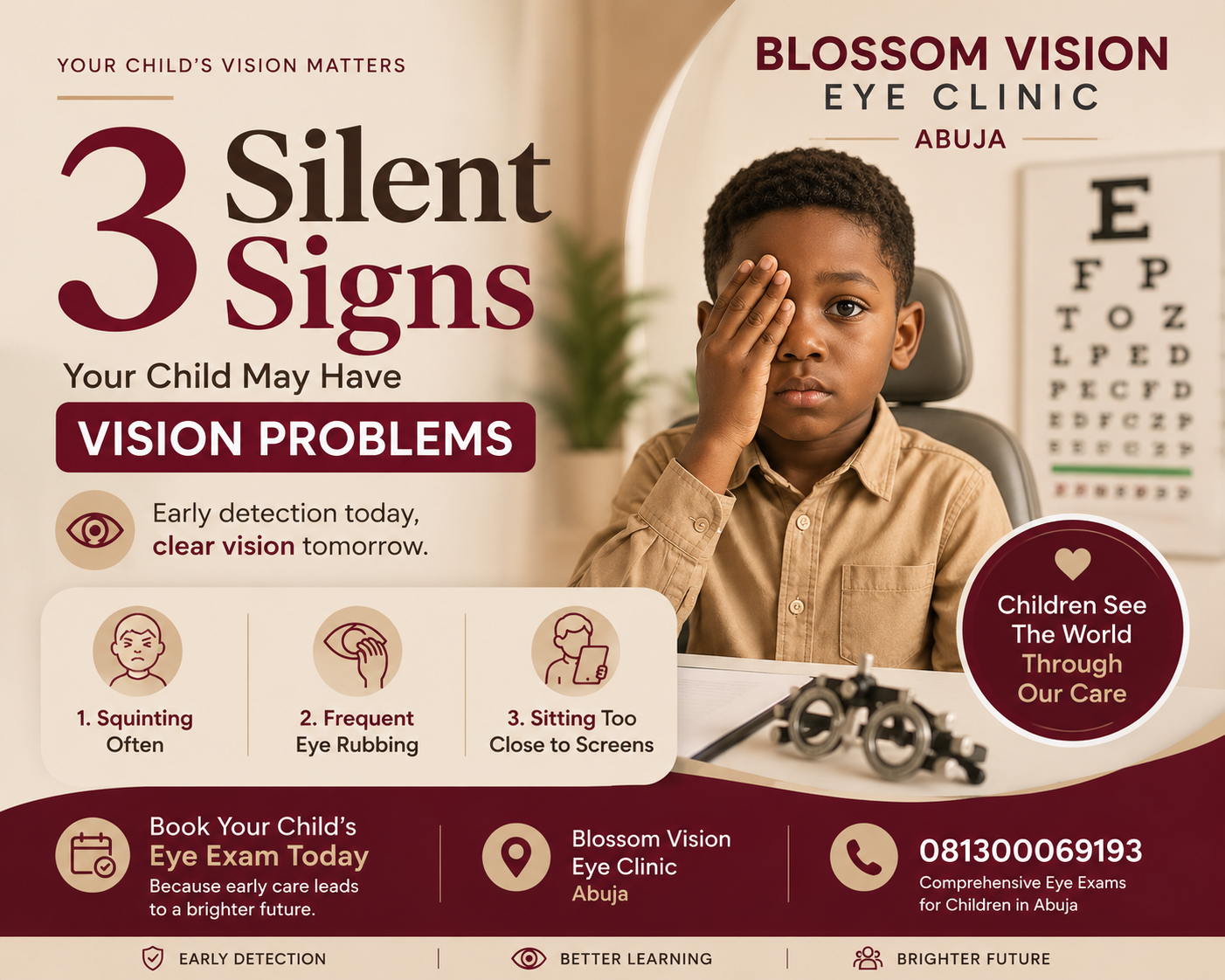
- Sit close to the television
- Squint when looking into the distance
- Hold a phone or tablet very close
- Complain of headaches
- Rub their eyes frequently
- Struggle to see the classroom board
- Lose interest in reading
- Close or cover one eye
- Move closer to objects they want to see
These behaviours do not automatically mean your child needs glasses.
But when they happen repeatedly, they are worth investigating.
Quick Answer: How Do I Know If My Child Needs Glasses?
Your child may need an eye examination if you notice:
- Frequent squinting
- Sitting unusually close to the TV
- Holding books or devices very close
- Difficulty seeing the classroom board
- Frequent headaches during visual tasks
- Closing or covering one eye
- One eye turning in or out
- Repeated complaints of blurry vision
- Difficulty recognising things at a distance
- Unusual difficulty with reading or visual schoolwork
The only way to know whether glasses are actually needed is to examine each eye properly.
Why Doesn't My Child Tell Me Their Vision Is Blurry?
Adults usually know what clear vision should look like.
If your vision suddenly becomes blurry, you notice the difference.
Children may not have that comparison.
If a child has been short-sighted for years, blurred distance vision may simply feel normal.
Instead of complaining, children often adapt.
They may:
- Move closer
- Squint
- Ask to sit near the front of the classroom
- Copy information from a friend
- Avoid activities requiring clear distance vision
- Hold objects closer
This is one reason parents and teachers play such an important role in noticing changes.
1. Why Does My Child Sit So Close to the TV?
This is one of the most common questions parents ask.
Sitting close to the television does not automatically mean your child's eyes are being damaged.
Some children simply like being close to the screen.
However, consistently moving close to see television, tablets or distant objects can sometimes happen because the child sees more clearly at close range than far away.
That can occur with myopia, also called short-sightedness.
Research-oriented child-eye guidance also notes that sitting close by itself may be normal behaviour, but it becomes more meaningful when combined with signs such as squinting, headaches or difficulty seeing at distance.
If this is the main thing you have noticed, read our detailed guide on why your child may sit too close to the TV.
2. Why Does My Child Squint to See?
Squinting can temporarily make some blurred images appear slightly clearer.
Your child may squint when trying to see:
- The classroom board
- Television
- Road signs
- People at a distance
- Details across a room
Frequent squinting can occur with refractive errors such as:
- Myopia
- Astigmatism
- Hyperopia
A refractive error simply means the eye is not focusing light clearly enough and may need glasses.
Occasional squinting does not prove a prescription is needed.
Persistent squinting deserves an eye examination.
3. Why Does My Child Hold the Phone or Book So Close?
Some children naturally prefer holding things close.
But if your child consistently puts a tablet, phone or book very near the face, ask yourself another question:
Can they see comfortably farther away?
A child who is short-sighted may prefer near objects because those objects appear clearer.
Watch for this behaviour together with:
- Sitting close to the TV
- Squinting
- Difficulty seeing the board
- Moving closer to recognise faces or objects
The pattern matters more than one isolated behaviour.
4. Why Can't My Child See the Board at School?
Difficulty seeing the classroom board is one of the clearer signs that distance vision may need checking.
A child may say:
- “The writing is blurry.”
- “I can't see from the back.”
- “I need to sit in front.”
- “I can see my book but not the board.”
That pattern can occur with myopia.
Children sometimes cope by copying what another child has written rather than telling the teacher they cannot see properly.
If your child repeatedly moves to the front of the class or complains about the board, arrange an eye examination.
5. Can Poor Eyesight Cause Headaches in Children?
Vision can contribute to headaches in some children, particularly during visually demanding activities.
You may notice headaches:
- After school
- After reading
- During homework
- After prolonged screen use
Possible vision-related contributors include:
- Uncorrected glasses prescription
- Focusing problems
- Eye coordination problems
- Visual strain
But headaches have many causes.
A headache does not automatically mean your child needs glasses.
An eye examination helps determine whether vision may be contributing.
6. Can Poor Eyesight Affect My Child's School Performance?
Vision plays an important role in many classroom activities.
Children need to see:
- The board
- Books
- Worksheets
- Computer screens
- Diagrams
- Teachers' demonstrations
An uncorrected vision problem can make some of these tasks harder.
A child struggling visually may:
- Take longer to copy from the board
- Lose their place while reading
- Avoid certain visual tasks
- Become frustrated
- Appear distracted
- Make avoidable copying errors
But an important warning:
Poor school performance should never automatically be blamed on eyesight.
Learning difficulties, attention problems and school performance have many possible causes.
An eye examination can rule out or identify a visual problem that may be contributing.
7. Why Does My Child Keep Rubbing Their Eyes?
Children rub their eyes for many reasons.
These can include:
- Tiredness
- Allergy
- Dryness
- Irritation
- Eye strain
- Habit
Eye rubbing alone does not mean your child needs glasses.
But frequent rubbing combined with headaches, squinting, blurry vision or difficulty with visual tasks deserves attention.
8. Why Does My Child Close or Cover One Eye?
This behaviour deserves particular attention.
A child may sometimes close or cover one eye when:
- Reading
- Watching television
- Looking at something far away
This can happen when the two eyes are not giving equally clear or comfortable vision.
Possible reasons include:
- One eye seeing much better than the other
- Eye alignment problems
- Double vision
- Other binocular vision problems
If your child regularly covers one eye to see, book an eye examination.
9. What If One of My Child's Eyes Turns In or Out?
An eye that regularly turns inward or outward should be assessed.
This is called strabismus, which simply means the eyes are not consistently pointing in the same direction.
Sometimes the eye turn is obvious.
Sometimes it only happens when the child is:
- Tired
- Daydreaming
- Looking at certain distances
- Unwell
Eye alignment problems in childhood can sometimes affect how vision develops.
Do not simply wait for the child to “grow out of it” without professional assessment.
Can My Child Have Poor Vision in Only One Eye?
Yes.
And this can be particularly easy to miss.
If one eye sees clearly and the other does not, the stronger eye can compensate.
Your child may:
- Read normally
- Watch television normally
- Play normally
- Never complain
This is one reason testing each eye separately is important.
If vision in one eye does not develop normally during childhood, amblyopia, commonly called a lazy eye, can occur.
Earlier detection generally gives the visual system a better opportunity for appropriate treatment.
How Do I Know If My Child Is Short-Sighted?
Short-sightedness, or myopia, means near objects are usually clearer than things farther away.
Possible signs include:
- Squinting at distant objects
- Sitting close to television
- Holding screens close
- Difficulty seeing the classroom board
- Moving closer to recognise people
- Complaining that distant writing is blurry
Myopia commonly begins during childhood and may progress while the eyes are growing.
If your child is already short-sighted, read our guide on myopia control in Abuja and ways to slow the progression of childhood myopia.
Why Is Childhood Myopia Important?
Myopia is not simply about changing glasses every year.
Higher levels of myopia later in life are associated with increased risk of certain eye conditions.
That is why modern children's eye care increasingly looks not only at:
“Does this child need glasses?”
but also:
“Is the myopia getting worse, and can we slow its progression?”
This is called myopia management or myopia control.
The appropriate approach depends on the child's age, prescription, eye measurements, progression and individual circumstances.
Does Too Much Phone or Tablet Use Cause Myopia?
The relationship is more complicated than simply saying:
“Phones cause bad eyes.”
Research has linked greater amounts of near work and less outdoor time with childhood myopia, while time outdoors appears to have a protective effect against developing myopia.
That does not mean every child who uses a tablet becomes short-sighted.
A more sensible approach is:
- Avoid extremely long uninterrupted periods of near work
- Encourage regular breaks
- Encourage outdoor activity
- Maintain a comfortable viewing distance
- Have the child's vision assessed when there are warning signs
The objective is not to make parents afraid of screens.
It is to create healthier visual habits.
Does Sitting Close to the TV Damage My Child's Eyes?
No.
Sitting close to the television itself does not mean the television is damaging the child's eyes.
The more useful question is:
Why does my child prefer sitting close?
If your child sits close but sees clearly elsewhere and has no other concerning signs, it may simply be preference.
If sitting close happens together with:
- Squinting
- Difficulty seeing the board
- Complaints of blurry distance vision
- Holding everything close
then an eye examination makes sense.
Can a Child Pass a School Vision Screening and Still Have an Eye Problem?
Yes.
School vision screenings can be useful for identifying some children who may need further assessment.
But a screening is not necessarily the same as a comprehensive eye examination.
A basic screening may focus mainly on how clearly the child sees at a particular distance.
A comprehensive children's eye examination can assess other areas depending on the child's needs, including:
- Vision in each eye
- Glasses prescription
- Eye alignment
- Focusing
- Eye movements
- Binocular vision
- Eye health
So if your child has persistent symptoms despite passing a school screening, do not ignore what you are seeing at home.
At What Age Should My Child Have an Eye Test?
There is no need to wait until a child can read letters before their eyes can be examined.
Children's vision can be assessed using age-appropriate methods.
The exact timing of examinations depends on the child's:
- Age
- Symptoms
- Family history
- Development
- Previous findings
- Medical history
- School or visual demands
A child with symptoms or risk factors should be assessed rather than waiting for a particular birthday.
Does My Child Need an Eye Test If They Are Not Complaining?
Sometimes, yes.
Children are not always reliable reporters of visual problems because they may not know what normal clear vision should look like.
This is especially important if you notice:
- Squinting
- Sitting unusually close
- Difficulty seeing distance
- One eye turning
- Closing one eye
- Repeated headaches during visual work
- A family history of significant childhood eye problems
If you are unsure what an eye examination involves generally, read our guide on signs you may need an eye test.
What Happens During a Children's Eye Examination?
A children's eye examination is not simply:
“Can you read this line?”
At Blossom Vision Eye Clinic in Games Village, Abuja, the examination is adjusted to the child's age and ability.
Depending on the child's needs, we may assess:
- Distance vision
- Near vision
- Each eye separately
- Glasses prescription
- Eye alignment
- Eye movements
- Focusing
- Binocular vision
- Eye health
We also listen to what the parent has noticed at home and what the teacher may have observed at school.
The aim is to answer a simple question:
Is this child's vision developing and functioning as it should?
Does My Child Definitely Need Glasses If One of These Signs Is Present?
No.
This is important.
A child who rubs their eyes does not automatically need glasses.
A child who sits close to the television does not automatically have myopia.
A child with headaches does not automatically have an eye problem.
These are clues, not diagnoses.
The examination tells us what is actually happening.
What If My Child Really Does Need Glasses?
If your child's examination shows that glasses are needed, the prescription depends on the type and amount of refractive error.
Glasses may help your child:
- See the classroom board more clearly
- Read more comfortably
- Reduce some vision-related strain
- Use both eyes more effectively in certain situations
- Participate more comfortably in visual activities
Some children need glasses all day.
Others may need them for particular activities.
Your optometrist should explain how the glasses should be used.
How Much Is a Children's Eye Test in Abuja?
The cost depends on the type of examination and any additional testing that is required.
You can read our current guide to eye test costs in Abuja and what the examination includes.
The most important thing is making sure the child receives the assessment appropriate for their age and symptoms.
Where Can I Get My Child's Eyes Checked in Abuja?
Blossom Vision Eye Clinic provides children's eye examinations in the Games Village/Kaura District area of Abuja.
Parents visit us when they notice concerns such as:
- Sitting close to television
- Squinting
- Headaches
- Difficulty seeing the board
- Eye turning
- Reading discomfort
- Changing glasses prescription
- Myopia
You can learn more about our location and services on our Eye Clinic in Games Village Abuja page.
Frequently Asked Questions
How do I know if my child needs glasses?
Common clues include squinting, difficulty seeing the board, repeatedly sitting close to screens, holding objects very close or complaining of blurred vision. An eye examination is needed to determine whether glasses are actually required.
Why does my child sit close to the TV?
Sometimes it is simply preference. In other children it may be because distance vision is blurry, particularly with myopia. Look for other signs such as squinting or difficulty seeing the board.
Why does my child squint?
Squinting can temporarily make a blurred image seem clearer. Persistent squinting is a reason to have the child's vision assessed.
Can my child need glasses even if they never complain?
Yes. Children may not realise that their vision is abnormal because they have nothing else to compare it with.
Can bad eyesight affect schoolwork?
A vision problem can make visually demanding classroom activities more difficult, but not every academic difficulty is caused by eyesight.
Does sitting close to the TV damage children's eyes?
No. Sitting close itself does not damage the eyes. However, repeatedly choosing to sit close can sometimes be a sign that distance vision is blurry.
Can my child pass a school eye screening and still have a vision problem?
Yes. Screenings are useful but are not always equivalent to a comprehensive eye examination.
At what age can a child have an eye examination?
Children can be examined before they can read. Eye-care professionals use different methods depending on the child's age and abilities.
Can children's eyesight change quickly?
Yes. Children's prescriptions can change as they grow, particularly with myopia. Children with progressing myopia may need closer monitoring.
Where can I get a children's eye test in Abuja?
Blossom Vision Eye Clinic provides children's eye examinations in the Games Village/Kaura District area of Abuja.
Your Child May Not Know Their Vision Is Blurry
This is the most important message for parents:
Do not wait for your child to say, “I cannot see.”
Watch what they do.
If your child repeatedly squints, sits unusually close to the television, struggles to see the classroom board, covers one eye or seems to have difficulty with visual tasks, let an eye examination tell you what is actually happening.
At Blossom Vision Eye Clinic in Games Village, Abuja, we provide comprehensive children's eye examinations designed to identify vision problems early and explain the findings clearly to parents.
If you are wondering whether your child needs glasses, book a children's eye examination today.