Should I See an Optometrist or an Ophthalmologist in Abuja?
Should I See an Optometrist or an Ophthalmologist?
You know you need an eye doctor.
But then comes the confusing part:
“Should I see an optometrist or an ophthalmologist?”
For many people, both simply mean “eye doctor.”
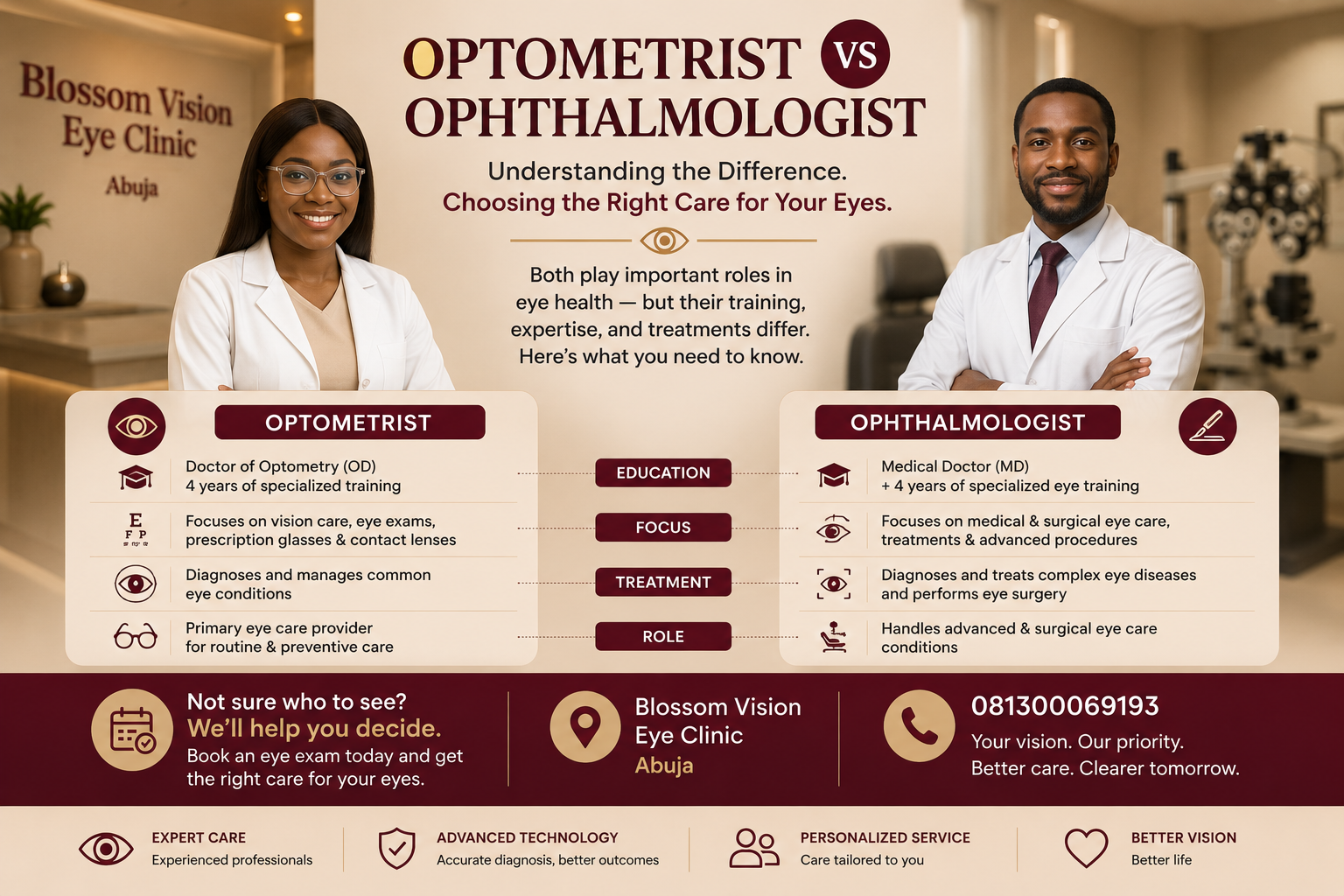
They are both eye-care professionals, but their training and roles are different.
Here is the simplest way to understand it:
If you need a routine eye examination, glasses, contact lenses or assessment of a common vision problem, an optometrist is often an appropriate place to start.
If you already know that you need eye surgery or highly specialised medical treatment, you may need an ophthalmologist.
And sometimes you need both.
Good eye care is not about deciding which profession is “better.”
It is about seeing the right professional for the problem you have.
Quick Answer: Optometrist or Ophthalmologist?
Consider seeing an optometrist for:
- Routine eye examinations
- Blurry vision
- Glasses prescriptions
- Contact lenses
- Children's vision concerns
- Eye strain
- Dry-eye symptoms
- Changes in your prescription
- Glaucoma risk assessment and screening
- Diabetic eye assessment
- Many other common eye and vision concerns
You may need an ophthalmologist when you require:
- Cataract surgery
- Retinal surgery
- Glaucoma surgery
- Corneal surgery
- Eye injections
- Laser procedures
- Management of complex or advanced eye disease
- Specialist hospital-based ophthalmic care
But these categories overlap.
An ophthalmologist can also perform routine examinations and prescribe glasses.
And an optometrist can identify eye disease and refer you when specialist medical or surgical care is necessary.
Book Appointment
Who Is an Optometrist?
An optometrist is an eye-care professional trained in examining vision and eye health.
In Nigeria, optometrists qualify as Doctors of Optometry, usually written as OD.
They are regulated by the Optometrists and Dispensing Opticians Registration Board of Nigeria.
An optometrist commonly helps patients with:
- Comprehensive eye examinations
- Vision testing
- Glasses prescriptions
- Contact lenses
- Children's vision
- Binocular vision problems
- Eye-health assessment
- Detection of abnormal eye findings
- Monitoring and referral where appropriate
So when someone says:
“I just need to check my eyes.”
or
“My glasses aren't working anymore.”
or
“My vision has become blurry.”
an optometrist is often a very appropriate professional to see.
Is an Optometrist a Doctor?
Yes, but there is an important distinction.
An optometrist is a Doctor of Optometry.
An ophthalmologist is a medical doctor who specialises in eye care and ophthalmic surgery.
They are different healthcare professions.
So saying:
“An optometrist isn't an eye doctor”
would be incorrect.
But saying:
“An optometrist is a medical doctor”
would also be incorrect.
An optometrist is a doctor of optometry.
An ophthalmologist is a medically trained eye specialist.
What Does an Optometrist Do During an Eye Examination?
An eye examination involves much more than asking you to read letters from a wall.
Depending on your symptoms and needs, an optometrist may assess:
- How clearly each eye sees
- Your glasses prescription
- Near vision
- Eye pressure
- Eye alignment
- Focusing
- The front of the eye
- Retina
- Optic nerve
- Peripheral vision
- Other areas where clinically appropriate
The purpose is to understand both:
How well are you seeing?
and
Is there anything about your eye health that needs attention?
If you want to understand what an examination costs before booking, read our guide to the cost of an eye test in Abuja.
Who Is an Ophthalmologist?
An ophthalmologist is a medical doctor who specialises in diseases and surgery of the eye.
Ophthalmologists can diagnose and medically treat eye disease, prescribe medicines and perform eye surgery.
They may also specialise further in areas such as:
- Retina
- Glaucoma
- Cornea
- Cataract
- Children's ophthalmology
- Oculoplastic surgery
- Neuro-ophthalmology
So if your condition requires surgery, injections, laser treatment or highly specialised medical eye care, an ophthalmologist may become an important part of your treatment team.
Can an Ophthalmologist Also Prescribe Glasses?
Yes.
Ophthalmologists can assess vision and prescribe glasses.
The difference is not:
“Optometrists do glasses while ophthalmologists do eyes.”
Both deal with the eyes.
The difference is mainly in their training and scope of practice.
Routine vision care and prescription work are commonly handled by optometrists, while ophthalmologists also provide medical and surgical treatment for eye disease.
Should I See an Optometrist or Ophthalmologist for Blurry Vision?
For ordinary or gradually developing blurry vision, an optometrist is often an appropriate starting point.
Blurred vision may be caused by something relatively straightforward such as:
- Short-sightedness
- Long-sightedness
- Astigmatism
- Presbyopia
- Dry eye
- A changing prescription
But blur can also occur with eye disease.
An examination helps determine the cause.
If the optometrist finds something requiring specialist medical or surgical care, referral to an ophthalmologist can then be arranged.
However, sudden severe loss of vision is different.
If you suddenly lose vision, develop severe eye pain, new neurological symptoms or another major acute change, seek urgent medical or ophthalmic care rather than waiting for a routine appointment.
If one eye is more blurry than the other, read our guide on why one eye may be blurrier than the other.
Who Should I See If I Need Glasses?
An optometrist is a very appropriate professional to see.
Your optometrist can determine:
- Whether you actually need glasses
- The prescription for each eye
- Whether your current glasses are still suitable
- Whether you need distance, reading or multifocal correction
- How your prescription relates to your work and lifestyle
Simply copying an old prescription is not always enough because vision can change over time.
Who Should I See for Contact Lenses?
An optometrist commonly provides contact-lens assessment and fitting.
Contact lenses sit directly on the eye, so there is more involved than simply choosing the same number as your glasses prescription.
The examination may consider:
- Your prescription
- Corneal shape
- Eye surface
- Tear film
- Type of lens
- Fit
- Wearing schedule
- Safe handling
If complications develop that require specialist medical care, onward referral may be required.
Who Should I See for Glaucoma?
This depends on your situation.
If you are asking:
“Do I have glaucoma?”
or
“I have a family history of glaucoma. Should I be checked?”
an optometrist can perform an initial assessment and glaucoma-related testing.
Depending on the findings, this may include:
- Eye-pressure measurement
- Optic-nerve examination
- Visual-field testing
- Retinal or optic-nerve imaging
- Additional investigations where appropriate
If glaucoma is suspected, confirmed, advanced or requires specialist medical or surgical treatment, ophthalmology involvement may be necessary.
So glaucoma care can involve both professions working together.
Read our guide on how to know if you may have glaucoma.
Book Appointment
Who Should I See for Cataracts?
If you simply notice:
- Increasing blurry vision
- Glare
- Difficulty driving at night
- Reduced clarity
you may initially have your eyes examined by an optometrist.
The examination can help determine whether cataract appears to be contributing to the problem.
However, cataract surgery is performed by an ophthalmologist.
If surgery becomes appropriate, you would need referral to an ophthalmologist who provides cataract surgery.
Who Should I See for Diabetic Eye Problems?
People living with diabetes need appropriate retinal monitoring.
An optometrist can assess the retina, identify suspicious diabetic retinal changes and determine when referral is required.
More advanced diabetic retinal disease may need an ophthalmologist, particularly a retinal specialist, for treatments such as:
- Intravitreal injections
- Laser treatment
- Retinal surgery
If you live with diabetes, read our guide on how diabetes can affect your eyes even when you can still see clearly.
Who Should I See for Dry Eyes?
An optometrist is often an appropriate place to start.
Dry eye may cause:
- Burning
- Grittiness
- Watering
- Heavy eyes
- Temporary blurred vision
- Screen discomfort
Your optometrist can examine the eye surface and help determine whether dryness, allergy or another condition may be contributing.
More complicated cases can be referred onward when necessary.
Who Should I See for My Child's Eyes?
An optometrist can provide children's vision examinations and assess concerns such as:
- Squinting
- Sitting close to the TV
- Difficulty seeing the classroom board
- Glasses prescriptions
- Myopia
- Eye coordination
- Focusing concerns
Certain childhood eye conditions may require a paediatric ophthalmologist.
These can include more complex eye disease, surgical conditions and particular eye-alignment problems.
If you are wondering whether your child needs glasses, read How Do I Know If My Child Needs Glasses?.
Who Should I See for Eye Pain?
This depends on how severe it is and what other symptoms are present.
Minor irritation can have many possible causes.
But severe eye pain can sometimes indicate a more serious condition.
Seek urgent eye or medical care if pain is associated with:
- Sudden vision loss
- Significant redness
- Severe headache
- Nausea or vomiting
- Injury
- Chemical exposure
- New double vision
- Significant light sensitivity
Do not delay urgent care because you are trying to decide which professional title is correct.
The important thing is getting appropriate assessment quickly.
Who Should I See for Flashes and Floaters?
New floaters may sometimes be harmless.
But a sudden increase in floaters, especially when accompanied by flashes of light, a curtain or shadow over your vision, can indicate a retinal problem requiring urgent assessment.
This is not something to leave for a routine glasses appointment.
Read our guide on black spots and eye floaters.
What Is the Difference Between an Optometrist and an Optician?
This is another common source of confusion.
An optometrist examines eyes, assesses vision and provides clinical optometric care.
An optician specialises in the dispensing and fitting of spectacles and other optical appliances based on a prescription.
In simple terms:
Optometrist: examines your eyes and determines your prescription.
Optician: helps produce, fit and dispense eyewear according to the prescription and their professional scope.
These are different professions.
Do I Need a Referral Before Seeing an Ophthalmologist?
This depends on the healthcare system, hospital, HMO or ophthalmologist involved.
Some people are referred after an optometrist identifies a problem.
Others may access ophthalmology services directly.
From a clinical point of view, referral can be useful because the ophthalmologist receives information about:
- What symptoms you have
- What has already been tested
- What abnormal findings were identified
- Why specialist care is being requested
This can make the next stage of care clearer.
Should Everybody Start With an Optometrist?
Not everybody.
This is where we should avoid oversimplifying.
For many routine eye and vision concerns, seeing an optometrist first makes sense.
But if you already know that you have:
- A surgical eye condition
- Advanced retinal disease
- A condition requiring eye injections
- A significant eye injury
- A serious ophthalmic emergency
- A specialist condition already being managed by an ophthalmologist
then you may need ophthalmology directly.
The goal is not to send every patient through an optometrist unnecessarily.
The goal is to get you to the right level of care.
Why Do Optometrists and Ophthalmologists Work Together?
Because eye care is a team.
Consider a patient who develops cataract.
An optometrist may:
- Examine the patient
- Identify the cataract
- Measure the patient's vision
- Determine whether glasses can still help
- Refer when surgery becomes appropriate
The ophthalmologist may then:
- Assess surgical suitability
- Perform cataract surgery
- Manage surgical complications if they occur
Afterward, the optometrist may continue providing routine vision care and glasses assessment.
Neither profession makes the other unnecessary.
They do different parts of the patient's care.
How Blossom Vision Coordinates Eye Care
At Blossom Vision Eye Clinic in Games Village, Abuja, our optometrists provide primary optometric care for patients with vision and eye-health concerns.
Our services include:
- Comprehensive eye examinations
- Glasses prescriptions
- Contact lenses
- Children's eye care
- Glaucoma assessment
- Diabetic eye assessment
- Dry-eye care
- Digital eye-strain assessment
- Visual-field testing where appropriate
- Other optometric services
When an examination identifies a problem requiring ophthalmic surgery, advanced specialist treatment or investigations outside our service, we refer appropriately.
The important thing is that you do not have to diagnose yourself before coming.
You can tell us:
“My vision has changed.”
The examination helps determine what needs to happen next.
Frequently Asked Questions
Should I see an optometrist or ophthalmologist?
For routine eye examinations, glasses, contact lenses and many common vision concerns, an optometrist is often an appropriate choice. If you need surgery or specialised medical treatment for complex eye disease, you may need an ophthalmologist.
Is an optometrist a doctor?
Yes. In Nigeria, qualified optometrists are Doctors of Optometry. They are not medical doctors. Ophthalmologists are medical doctors specialising in eye care.
Can an optometrist prescribe glasses?
Yes. Determining and prescribing optical correction is a central part of optometric practice.
Can an ophthalmologist prescribe glasses?
Yes. Ophthalmologists can also assess vision and prescribe glasses.
Can an optometrist detect glaucoma?
An optometrist can assess glaucoma risk, examine the optic nerve, measure eye pressure and perform other appropriate glaucoma investigations. Suspicious or confirmed cases may require referral or shared care depending on the findings.
Who performs cataract surgery?
An ophthalmologist performs cataract surgery.
Should I see an optometrist for blurry vision?
For gradual or routine blurry vision, an optometrist is often an appropriate starting point. Sudden major vision loss requires urgent assessment.
Who should I see for eye pain?
Minor eye discomfort can have many causes, but severe pain, sudden vision changes, injury or a painful red eye may require urgent medical or ophthalmic attention.
What's the difference between an optometrist and an optician?
An optometrist examines eyes and provides optometric care. An optician specialises in dispensing and fitting optical appliances such as spectacles according to their professional scope.
Do children see an optometrist or ophthalmologist?
Many routine children's vision problems can be assessed by an optometrist. Complex medical, surgical or certain developmental eye conditions may require a paediatric ophthalmologist.
Where can I see an optometrist in Abuja?
Blossom Vision Eye Clinic provides optometric eye care in the Games Village/Kaura District area of Abuja.
Still Not Sure Which Eye Doctor You Need?
You do not need to work out the diagnosis before booking an eye examination.
If your problem is:
“My vision is blurry.”
“I think I need glasses.”
“My child cannot see the board.”
“My eyes feel tired.”
“I want to check for glaucoma.”
an optometrist can assess the problem and advise the appropriate next step.
If the findings show that you need surgery or specialist ophthalmic treatment, you can then be referred appropriately.
At Blossom Vision Eye Clinic in Games Village, Abuja, our role is not to keep every eye problem in our clinic.
Our role is to examine carefully, manage what is appropriate within optometric care and make sure you reach specialist ophthalmic care when you need it.
If you are unsure which eye doctor you need, start by booking an appropriate eye examination.