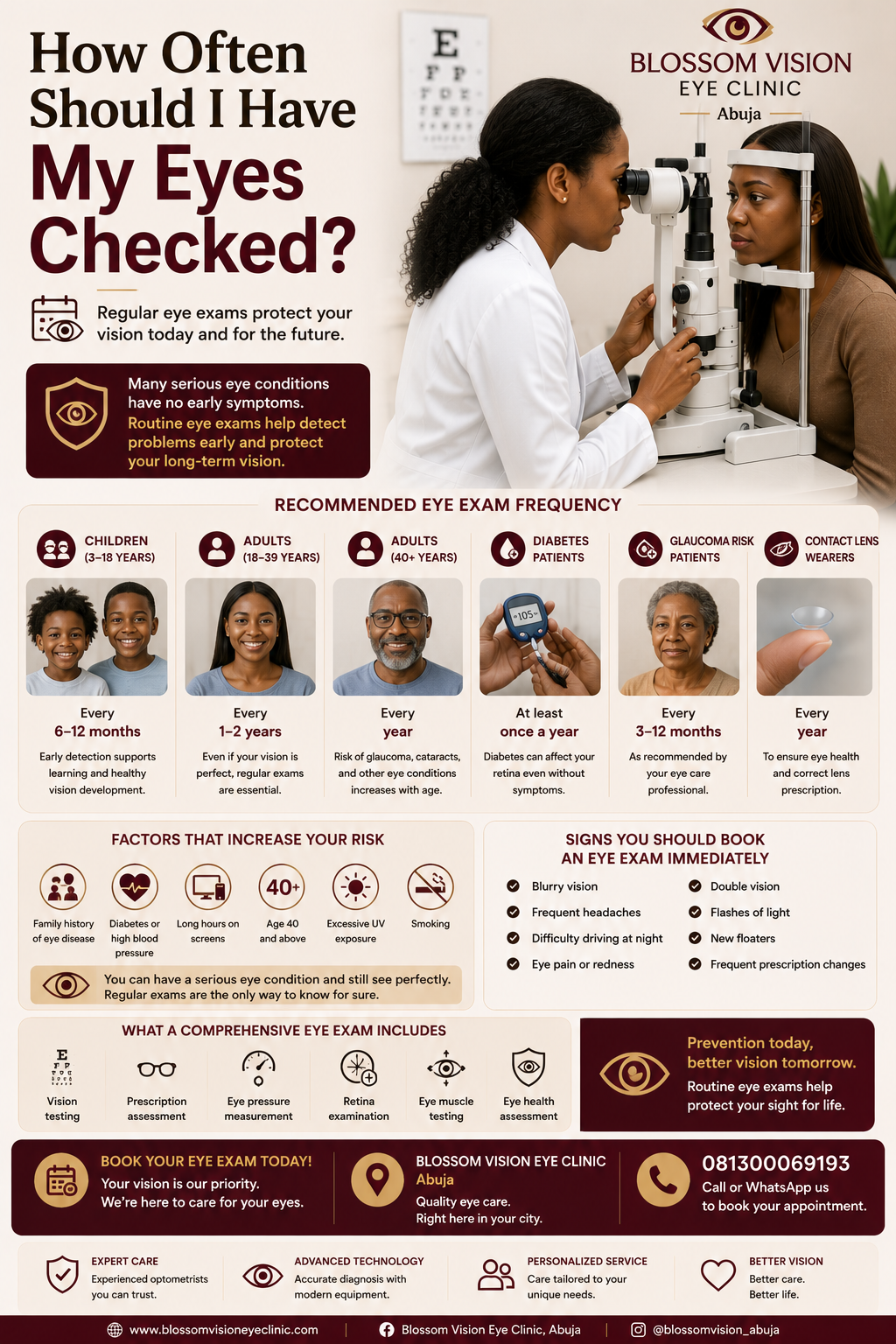
How Often Should I Have My Eyes Checked?
Most adults should have a comprehensive eye examination at least once every year, even if they have no symptoms. Children, seniors, people with diabetes, hypertension, or a family history of glaucoma may need more frequent examinations.
How Often Should I Have My Eyes Checked?
You feel fine.
Your glasses still work.
You can read.
You can drive.
So you start wondering:
“How often should I have my eyes checked if nothing is wrong?”
The answer is:
It depends on your eyes.
There is no single eye-examination timetable that is perfect for every person.
How often you should have your eyes checked depends on things such as:
- Your age
- Whether you wear glasses
- Whether you wear contact lenses
- Diabetes
- Family history of glaucoma
- Previous eye problems
- Childhood myopia
- Your last examination findings
- New symptoms
- Other medical conditions
Someone with completely healthy eyes and low risk may not need the same review schedule as someone with diabetes, progressing glaucoma or a child whose myopia is rapidly increasing.
The important thing is to know when you personally should return.
Book Appointment
Quick Guide: How Often Should You Have Your Eyes Checked?
There is no single timetable that is right for everyone. A simple guide is:
Healthy adults with no symptoms or known eye-health risks:
An eye examination is commonly recommended every 1–2 years, depending on your previous findings and your eye-care professional's advice.
Adults with eye-health risk factors:
You may need your eyes checked at least once a year or more often, depending on the risk involved.
Older adults:
As the risk of conditions such as cataracts, glaucoma and other eye diseases increases with age, more regular eye examinations are usually recommended.
Children:
How often a child needs an eye examination depends on their age, symptoms, previous findings and vision needs.
Children with progressing myopia:
Children whose short-sightedness is getting worse may need more frequent monitoring to track progression and assess whether treatment is working.
People living with diabetes:
The timing depends on the type of diabetes and what is found during the retinal examination. Some people require annual or more frequent checks, while others with consistently normal findings may be advised differently.
People with glaucoma or suspected glaucoma:
Follow the specific review schedule given by your optometrist or ophthalmologist. The timing depends on your eye pressure, optic nerve, visual field, treatment and rate of progression.
Contact-lens wearers:
Regular eye and contact-lens reviews are important, commonly once a year or as advised.
Anyone with new or changing eye symptoms:
Do not wait for your next routine appointment. New blurry vision, eye pain, double vision, flashes, sudden floaters or other significant changes should be assessed sooner.
The most useful question to ask at the end of every eye examination is:
“Based on what you found today, when should I have my eyes checked again?”
Do I Need an Eye Test Every Year?
Not everybody requires exactly the same interval.
This is important because you will see different advice online.
Some professional guidance recommends annual comprehensive examinations as a proactive approach.
Other guidance allows longer intervals, such as every two years, for younger low-risk adults whose eyes are healthy.
So instead of giving everybody the same rule, a better approach is:
Have a proper examination, understand your risk, and leave knowing when you personally should return.
At Blossom Vision, the next review date should be based on what we actually find in your eyes.
Why Should I Check My Eyes If I Can See Clearly?
Because:
Clear vision and healthy eyes are not exactly the same thing.
You can have excellent central vision and still have an eye condition developing quietly.
For example, early open-angle glaucoma may cause little or no noticeable visual difficulty initially.
Diabetic retinal changes can also occur before a person notices significant symptoms.
So being able to read the smallest line on the chart does not answer every eye-health question.
This is why a comprehensive examination looks beyond whether you need glasses.
If you want to understand what actually happens during the appointment, read What Happens During a Comprehensive Eye Exam?.
How Often Should Healthy Adults Have Their Eyes Checked?
For a healthy adult with:
- No symptoms
- No eye disease
- No significant family history
- No major medical risk factors
- Stable vision
the appropriate interval may be around one to two years, depending on the guidance being followed and what your optometrist found at your previous examination.
Current AOA patient guidance lists at least every two years for low-risk adults aged 18–64 and annually for people aged 65 and older, while its more recent adult clinical guideline advocates annual examinations as a proactive approach.
That difference is precisely why I would not tell every patient:
“Everyone must come every 12 months.”
Your individual findings matter.
How Often Should I Have My Eyes Checked If I Wear Glasses?
Wearing glasses does not automatically mean your eyes are unhealthy.
But your prescription can change.
Regular review helps determine:
- Whether your prescription remains accurate
- Whether your glasses still meet your needs
- Whether your eye health has changed
- Whether your symptoms are actually coming from the prescription
If your vision is stable and your eyes are healthy, your optometrist can recommend an appropriate interval.
If your glasses seem to stop working frequently, do not simply wait for a routine date.
Read Why Do I Keep Changing My Glassasses Prescription?.
What If My Glasses Are Still Working Perfectly?
That is good.
But it does not necessarily mean you never need another examination.
Glasses tell you about vision correction.
They do not tell you everything about:
- Eye pressure
- Retina
- Optic nerve
- Cornea
- Natural lens
- Other aspects of eye health
If it has been a long time since your last comprehensive examination, having your eyes reassessed may still be appropriate even if your glasses feel fine.
How Often Should Children Have Their Eyes Checked?
Children should not all be placed automatically on a “every six months” schedule.
Their needs vary.
Children require age-appropriate vision assessment, and school-age children should continue having regular eye and vision care.
AOA guidance, for example, recommends an examination before first grade and annually thereafter for children aged 6–17, with more frequent examination when risk factors or symptoms are present.
A child may need to be seen sooner if you notice:
- Squinting
- Difficulty seeing the classroom board
- Sitting unusually close to the television
- One eye turning
- Closing one eye
- Complaints of blurry vision
- Rapidly changing prescription
If you are unsure what to watch for, read How Do I Know If My Child Needs Glasses?.
What If My Child Sits Close to the TV?
Sitting close by itself does not automatically mean your child needs glasses.
But if your child also:
- Squints
- Cannot see the classroom board
- Holds everything very close
- Complains that distant objects are blurry
then their vision should be assessed.
Read Why Does My Child Sit So Close to the TV?.
How Often Should a Child With Myopia Be Checked?
A child with progressing myopia is different from a child with stable normal vision.
The prescription may need closer monitoring because we want to know:
Is the myopia getting worse?
How quickly is it progressing?
Is the current treatment working?
The review interval depends on:
- Age
- Prescription
- Previous progression
- Type of myopia-management treatment
- Other risk factors
Some children receiving myopia management may need reviews more frequently than once a year.
If your child's prescription keeps becoming stronger, read How Can I Stop My Child's Eyesight From Getting Worse?.
How Often Should I Check My Eyes If I Have Diabetes?
This deserves a more precise answer than simply:
“Once every year.”
Current American Diabetes Association guidance recommends:
Type 1 diabetes: an initial comprehensive dilated eye examination about five years after the onset of diabetes.
Type 2 diabetes: an initial comprehensive dilated examination at the time diabetes is diagnosed.
After that, the interval depends on what the retina shows.
If one or more examinations show no diabetic retinopathy and blood sugar indicators are within target, screening every 1–2 years may be considered.
If diabetic retinopathy is present, retinal examination is generally required at least annually, and progressing or sight-threatening disease requires more frequent specialist follow-up.
So diabetes does not mean everybody follows exactly the same schedule.
If you live with diabetes, read Can Diabetes Affect My Eyes Even If I Can See Clearly?.
I Have Diabetes but My Vision Is Perfect. Do I Still Need an Eye Check?
Yes, according to diabetic-retinopathy screening recommendations.
This is because retinal damage can develop before you notice obvious changes in your vision.
The purpose of diabetic eye monitoring is not simply:
“Can you still read?”
It is:
“Is diabetes affecting the retina before you notice it?”
How Often Should I Get Checked for Glaucoma?
There is no safe universal answer such as:
“Every six months.”
Glaucoma monitoring depends heavily on:
- Whether glaucoma is actually diagnosed
- Eye pressure
- Optic-nerve appearance
- Visual-field results
- Rate of progression
- Family history
- Age
- Other risk factors
- Current treatment
Someone merely at increased risk may require a very different schedule from a person with established progressing glaucoma.
If you have already been diagnosed with glaucoma, follow the review interval set by the clinician managing your condition.
If you are asking whether you may have glaucoma in the first place, read How Do I Know If I Have Glaucoma?.
Do I Need More Eye Tests Because I Am Over 40?
Age matters, but I would not tell every 40-year-old that they automatically require exactly one examination every 12 months.
Around this period of life:
- Near focusing begins to change
- Glaucoma risk becomes more relevant
- Cataracts become increasingly important with advancing age
- Medical conditions such as diabetes and hypertension may also affect eye risk
The American Academy of Ophthalmology recommends establishing a baseline comprehensive eye examination around age 40, with subsequent frequency based on findings and risk factors.
So 40 is a useful reminder to take eye health seriously.
It is not a magic birthday on which everyone suddenly needs the same schedule.
Book Appointment
Why Do I Suddenly Need Reading Glasses After 40?
This is often because of presbyopia.
Presbyopia is the normal age-related reduction in the eye's ability to focus at close distance.
You may notice:
- Holding your phone farther away
- Small print becoming difficult
- Needing more light
- Tired eyes during reading
This is common and does not automatically mean your eyes are diseased.
But an examination can confirm what is happening instead of assuming every change is simply age.
How Often Should Older Adults Have Their Eyes Checked?
Older adults generally need more regular eye care because the likelihood of conditions such as cataract, glaucoma and macular disease increases with age.
AOA patient guidance recommends annual examinations from age 65, with more frequent review where risk factors or existing disease require it.
Your own examination findings should determine the exact schedule.
How Often Should Contact-Lens Wearers Have Their Eyes Checked?
Contact lenses sit directly on the eye.
That means regular review is important even if:
“My lenses still feel okay.”
A contact-lens review may assess:
- Corneal health
- Lens fit
- Prescription
- Tear film
- Wearing habits
- Contact-lens hygiene
Contact-lens wear itself is considered a reason for closer eye-care follow-up in AOA guidance.
Many wearers are reviewed yearly, but your optometrist should determine the appropriate interval for you.
Do not wait for your scheduled examination if you develop:
- Pain
- Significant redness
- Light sensitivity
- Reduced vision
especially while wearing contact lenses.
Do I Need More Frequent Checks If Glaucoma Runs in My Family?
Possibly.
A family history of glaucoma increases concern, particularly if a close relative such as a parent or sibling has the condition.
Your optometrist may therefore recommend closer monitoring based on:
- Your age
- Eye pressure
- Optic nerve
- Family history
- Visual-field findings
- Other risk factors
Do not wait until you develop symptoms because early open-angle glaucoma may have no obvious warning signs.
What About High Blood Pressure?
High blood pressure can affect the retinal blood vessels.
Having hypertension does not automatically dictate one universal eye-test interval.
The appropriate schedule depends on:
- How well controlled the blood pressure is
- Your retinal findings
- Other health conditions
- Your overall eye risk
And remember:
An eye examination does not replace proper blood-pressure monitoring by your healthcare provider.
Do Screens Mean I Need an Eye Exam Every Year?
Spending eight hours on a laptop does not automatically mean your eyes are becoming damaged.
Screen use can contribute to:
- Eye strain
- Dryness
- Tired eyes
- Headaches
- Temporary blur
If these symptoms persist, an examination may help determine if you have:
- An uncorrected prescription
- Dry eye
- Focusing difficulty
- Another eye problem
If screen use is your main concern, read Why Do My Eyes Feel Tired After Using a Computer?.
Should I Have My Eyes Checked Because I Drive at Night?
You do not need an eye examination simply because you drive after sunset.
But you should have your vision assessed if you notice:
- Headlights becoming overwhelming
- Road signs becoming difficult to see
- Halos
- Starbursts
- Poor night vision
- Increasing glare
Night-driving difficulty can sometimes reveal a prescription problem, dry eye, cataract or another visual issue.
Read Why Do Headlights Blind Me at Night?.
What If I Have No Symptoms at All?
That is where routine eye care becomes useful.
Some eye conditions may not cause obvious symptoms initially.
So:
“Nothing hurts.”
and
“I can still see.”
do not automatically mean:
“I never need another eye examination.”
If your previous examination was normal, your optometrist should tell you the appropriate interval for your next check.
What Symptoms Mean I Should Not Wait for My Next Routine Eye Exam?
Book an eye examination sooner if you notice:
- New persistent blurry vision
- One eye becoming blurrier
- Frequent prescription changes
- Increasing glare
- Difficulty driving at night
- Persistent headaches associated with vision
- Double vision
- Persistent itchy or watery eyes
- A noticeable change in your child's vision
Do not wait for an arbitrary yearly date when your eyes are already telling you something has changed.
Which Eye Problems Need Urgent Attention?
Some symptoms should not wait for a routine appointment.
Seek urgent eye or medical assessment for:
- Sudden significant loss of vision
- A curtain or shadow over your vision
- Sudden new flashes with many floaters
- Severe eye pain
- A very red painful eye
- Sudden double vision
- Significant eye injury
- Chemical exposure
- Vision problems associated with weakness, facial drooping or difficulty speaking
These are different from routine eye-check timing.
What Happens During a Routine Eye Examination?
A comprehensive examination may include:
- Medical and eye history
- Visual acuity
- Refraction
- Eye pressure
- Eye alignment and movements
- Examination of the front of the eye
- Retina and optic-nerve assessment
- Other tests where clinically appropriate
Not everyone requires exactly the same tests.
Read our full guide on what happens during a comprehensive eye exam to understand the process step by step.
How Much Does an Eye Test Cost in Abuja?
You can see our current guide explaining the cost of an eye test in Abuja and what is included.
Knowing the price is useful, but the more important question is making sure the examination is appropriate for your age, symptoms and risks.
Where Can I Get My Eyes Checked in Abuja?
At Blossom Vision Eye Clinic in Games Village, Abuja, we provide comprehensive eye examinations for adults and children.
The examination helps us determine:
- How clearly you see
- Whether you need glasses
- Whether your prescription has changed
- How your eyes appear clinically
- Whether additional tests are needed
- Whether you need treatment
- Whether referral is required
- When you should come back
That last point matters.
A good eye examination should not finish without you understanding:
“When should I return?”
Frequently Asked Questions
How often should I have my eyes checked?
It depends on your age, eye health, symptoms, medical history and risk factors. Many healthy adults are examined around every one to two years, while higher-risk patients may need more frequent reviews.
Do I need an eye exam every year?
Not necessarily everybody. Professional recommendations differ, and your previous findings and risk factors should help determine your personal schedule.
How often should I have my eyes checked if I wear glasses?
Regular review is useful because prescriptions and eye health can change. The exact interval depends on your age, prescription stability and previous examination findings.
How often should children have eye tests?
Children require age-appropriate regular eye care. School-age children may be examined annually under some professional guidance, with closer monitoring when symptoms, myopia or other risk factors are present.
How often should someone with diabetes have an eye exam?
It depends on diabetes type and retinal findings. Current ADA guidance allows screening every 1–2 years in some people after normal examinations and good glycaemic indicators, while retinopathy generally requires at least annual or more frequent retinal examination.
How often should someone with glaucoma be checked?
There is no single schedule. The interval depends on the severity of the disease, eye pressure, optic-nerve and visual-field findings, progression and treatment.
How often should I have my eyes checked after 40?
Age increases the importance of eye-health assessment, but the exact interval should reflect your risk factors and examination findings. A baseline comprehensive examination around 40 is commonly recommended.
Do I need an eye test if I can see clearly?
Sometimes. Certain eye diseases can develop before you notice obvious changes in central vision.
Should contact-lens wearers have regular eye exams?
Yes. Contact lenses interact directly with the cornea and eye surface, so regular professional review is important.
Should I wait until my next routine appointment if my vision changes?
No. New or worsening symptoms should be assessed rather than waiting for a scheduled date.
Where can I get an eye exam in Abuja?
Blossom Vision Eye Clinic provides comprehensive eye examinations in the Games Village/Kaura District area of Abuja.
Don't Ask Only “Is It Time Yet?”
There is no calendar that can look inside your eyes.
Two people of the same age can need completely different review schedules.
One may have healthy eyes and stable vision.
The other may have diabetes, progressive myopia or glaucoma risk that requires much closer monitoring.
So instead of following an internet rule blindly, ask:
“Based on what you found in my eyes today, when should I come back?”
At Blossom Vision Eye Clinic in Games Village, Abuja, your recommended review interval should be based on your age, symptoms, medical history, prescription and actual eye-health findings.
If you cannot remember when your eyes were last properly examined, or something about your vision has changed, book a comprehensive eye examination.