What Is Astigmatism? Symptoms, Causes & Treatment | Abuja Eye Clinic
Astigmatism is one of the most common vision problems in the world.
Millions of people have it, many without even knowing.
The good news?
It's usually easy to diagnose and, in most cases, can be corrected very successfully.
Let's talk about what astigmatism really is and why it causes blurry vision.
Quick Answer: What Is Astigmatism?
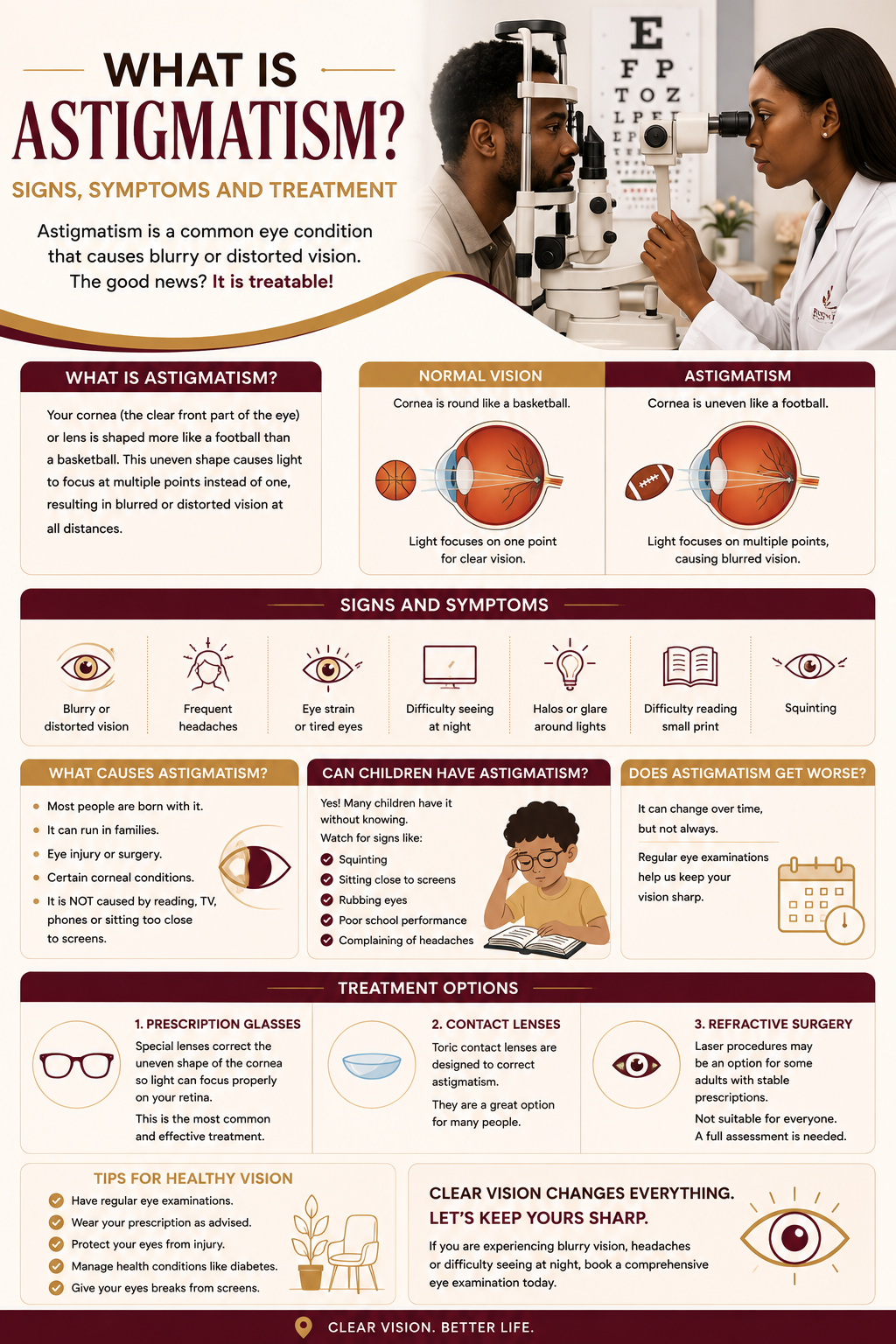
Astigmatism is a common focusing problem.
It happens when the cornea at the front of the eye, or sometimes the natural lens inside the eye, does not focus light evenly.
Instead of light forming one sharp focus, it is focused differently in different directions.
That can make vision appear:
- Blurry
- Distorted
- Less sharp
- Stretched or shadowed
Astigmatism can affect:
distance vision, near vision or both.
It often occurs together with short-sightedness or long-sightedness.
The good news is that ordinary astigmatism can usually be corrected very effectively with:
- Prescription glasses
- Contact lenses
- In suitable adults, certain refractive procedures
Book Appointment
What Does the Word “Astigmatism” Actually Mean?
Think about how a camera needs light to focus sharply to produce a clear picture.
Your eye works in a similar way.
Light passes through the front of the eye and needs to be focused accurately onto the retina at the back.
With astigmatism, light does not focus evenly.
The result is a picture that may look:
blurred
or:
distorted.
This is why someone with astigmatism may say:
“I can see the letters, but they don't look perfectly sharp.”
Is My Eye Shaped Like a Rugby Ball?
You may have heard this explanation:
Normal eye = basketball
Astigmatism = rugby ball
It is useful as a simple illustration, but it is not a perfect description.
The cornea does not literally have to look like a rugby ball.
The point is simply that its curvature may be different in one direction than another.
Imagine a surface that bends slightly more vertically than horizontally.
Light passing through those different curves will not all focus in exactly the same place.
Also remember:
Astigmatism can come from the lens inside the eye too, not only the cornea.
The National Eye Institute describes astigmatism as occurring when either the cornea or the lens has a shape that makes light bend differently.
Is Astigmatism Common?
Yes.
Astigmatism is a very common refractive error.
Some people have such a small amount that they hardly notice it.
Others need significant correction to see clearly.
You can also have:
- Astigmatism alone
- Astigmatism with myopia
- Astigmatism with hyperopia
So hearing:
“You have astigmatism”
does not automatically mean you have a serious eye disease.
Is Astigmatism a Disease?
Usually, no.
Ordinary astigmatism is a refractive error.
That means it is primarily a problem with how the eye focuses light.
Myopia, hyperopia and presbyopia are also refractive problems.
Most astigmatism is managed simply by correcting the optics of the eye.
However, some corneal diseases can produce irregular or changing astigmatism, which is why a rapidly changing prescription deserves closer attention.
What Causes Astigmatism?
There is not always one identifiable reason.
Some people are born with it.
Others develop astigmatism during childhood or young adulthood.
It may also change throughout life.
Possible contributors include:
- Natural shape of the cornea
- Natural shape of the internal lens
- Family tendency
- Eye injury
- Previous eye surgery
- Certain corneal conditions
The National Eye Institute notes that some people are born with astigmatism while others develop it later. Injury or surgery can also contribute.
Is Astigmatism Caused by Using My Phone?
No.
Your phone does not reshape your cornea into astigmatism.
Astigmatism is not caused by:
- Using a phone
- Watching television
- Reading books
- Using a computer
- Sitting close to a screen
Prolonged screen work can make visual discomfort more noticeable if your prescription is not properly corrected.
For example, someone with uncorrected astigmatism may become more aware of:
- Blur
- Squinting
- Headache
- Eye strain
after spending hours concentrating.
If prolonged screen use also makes your eyes tired, read Why Do My Eyes Feel Tired After Using a Computer?.
Does Sitting Close to the Television Cause Astigmatism?
No.
Sitting close to television does not create astigmatism.
For a child, however, repeatedly sitting unusually close may sometimes be a clue that they are not seeing clearly at distance.
That is a different question.
Read Why Does My Child Sit Too Close to the TV? if you have noticed that behaviour in your child.
What Does Astigmatism Vision Look Like?
It varies.
Some people simply notice:
“Everything is slightly blurry.”
Others may describe:
- Fuzzy letters
- Shadow around text
- Ghost images
- Distorted edges
- Difficulty seeing small details
- Lights appearing stretched or star-shaped
- Reduced clarity at night
Higher or irregular astigmatism may produce more distortion than a small ordinary prescription.
What Are the Symptoms of Astigmatism?
Possible symptoms include:
- Blurry vision
- Distorted vision
- Squinting
- Headaches
- Eye strain
- Difficulty seeing clearly at night
- Tired eyes after prolonged visual work
These are among the recognised symptoms of astigmatism.
But there is an important point:
You cannot diagnose astigmatism from symptoms alone.
Dry eye, cataracts, myopia and other conditions can produce similar complaints.
An eye examination tells us what is actually happening.
Can Astigmatism Cause Blurry Vision Far Away?
Yes.
Astigmatism can reduce distance clarity.
Someone may struggle with:
- Road signs
- Television
- Classroom boards
- Faces at a distance
But distance blur can also be caused by myopia.
The eye test separates the two.
Can Astigmatism Make Reading Blurry?
Yes.
Astigmatism can affect near vision too.
You may notice:
- Letters are not crisp
- Small print looks shadowed
- You need to squint
- Reading becomes tiring
Astigmatism can exist independently of presbyopia, so needing reading help after age 40 and having astigmatism are not the same condition.
Can Astigmatism Cause Headaches?
It can be associated with headaches in some people, especially when the astigmatism is uncorrected and prolonged visual tasks make symptoms more noticeable.
But this needs careful wording.
A headache does not automatically mean:
“I have astigmatism.”
Headaches have many possible causes.
If the headache is:
- New
- Severe
- Persistent
- Associated with neurological symptoms
- Associated with sudden visual changes
it deserves appropriate medical assessment rather than simply prescribing glasses.
Why Do I Squint if I Have Astigmatism?
Squinting temporarily changes the way light enters the eye and can sometimes make a blurry image seem slightly sharper.
That is why people with uncorrected refractive error may unconsciously squint.
If you repeatedly squint to recognise:
- Faces
- Road signs
- Television
- Classroom writing
get your vision checked instead of simply continuing to squint.
Can Astigmatism Make Night Driving Difficult?
Yes.
Astigmatism can make low-light visual tasks more difficult for some people.
You might notice:
- Headlights look smeared
- Lights form streaks
- Road signs are less sharp
- Glare feels more troublesome
At night, visual imperfections can become more noticeable.
If headlights are specifically your problem, read Why Do Headlights Blind Me at Night?.
But remember that astigmatism is only one possible reason for difficult night driving.
Cataract, dry eye and other visual problems can also cause glare.
Does Astigmatism Cause Halos Around Lights?
It can contribute to halos, starbursts, glare or other distortions around lights.
But halos are not specific to astigmatism.
They can also occur with:
- Dry eye
- Cataract
- Corneal disease
- Contact-lens issues
- Other optical problems
And sudden rainbow halos accompanied by:
- Severe eye pain
- Redness
- Headache
- Nausea
- Blurry vision
are not ordinary astigmatism and require emergency eye assessment because acute angle-closure glaucoma must be considered.
Can Astigmatism Make One Eye Blurrier Than the Other?
Yes.
Your two eyes do not have to have identical prescriptions.
For example:
Right eye: small astigmatism
Left eye: much stronger astigmatism
That can leave one eye noticeably less clear.
But a persistent difference between the two eyes has several possible causes.
If one eye consistently seems worse, read Why Is One Eye Blurrier Than the Other?.
And if one eye suddenly becomes much blurrier, do not assume that ordinary astigmatism suddenly changed overnight. Sudden significant visual change needs prompt assessment.
Can Children Have Astigmatism?
Yes.
Astigmatism is common in children.
And children may not complain.
A child who has always seen slightly blurry may believe:
“This is normal.”
AAPOS notes that astigmatism can occur in babies and young children and that significant uncorrected refractive errors can interfere with normal visual development.
Possible clues include:
- Squinting
- Difficulty seeing distant details
- Moving closer
- Complaining of blur
- Headaches associated with visual tasks
But some children have no obvious symptoms.
If you are concerned about your child's vision, read How Do I Know If My Child Needs Glasses?.
Can Astigmatism Cause Lazy Eye?
Significant uncorrected astigmatism during childhood can contribute to amblyopia, particularly when one eye is affected more than the other or the blur is significant.
Amblyopia means vision has not developed normally during childhood.
It is not simply:
“one lazy eyeball.”
AAPOS explains that significant refractive errors can lead to amblyopia if a child's brain repeatedly receives an unclear image during visual development.
That is one reason childhood astigmatism should not always be dismissed as:
“They will grow out of it.”
Can Children Outgrow Astigmatism?
Astigmatism can change as children grow.
Some children may have smaller prescriptions later.
Others continue needing correction.
So the correct answer is:
Sometimes it changes, but do not assume it will disappear.
The decision about glasses depends on:
- The amount of astigmatism
- Age
- Vision in each eye
- Difference between the two eyes
- Risk of amblyopia
- Other examination findings
If you are wondering more broadly whether your child's eyesight may improve as they grow, your Can Children Outgrow Poor Eyesight? article should be linked here once its exact published URL is confirmed.
Does Astigmatism Get Worse With Age?
Astigmatism can change over time.
For some people, it remains fairly stable for years.
For others, the power or axis changes.
That is not automatically dangerous.
But:
rapid or repeated changes deserve more attention.
Especially in a young person, rapidly increasing astigmatism, increasing distortion or frequent prescription changes may sometimes indicate a corneal condition rather than ordinary stable astigmatism.
What If My Astigmatism Keeps Increasing?
Do not simply keep making stronger glasses indefinitely without asking why.
A changing prescription can occur normally.
But your optometrist may want to look more closely if there is:
- Frequent prescription change
- Increasing astigmatism
- Increasing irregularity
- Ghost images
- Distortion
- Reduced vision that glasses no longer correct well
One condition that may need to be excluded is keratoconus.
What Is Keratoconus?
Keratoconus is a corneal condition where the cornea becomes thinner and progressively changes shape.
It often begins in teenagers or young adults and can cause:
- Increasing astigmatism
- Increasing myopia
- Blurry or distorted vision
- Glare
- Frequent prescription changes
The National Eye Institute describes keratoconus as progressive thinning and bulging of the cornea that can cause astigmatism and blurry vision.
Moorfields Eye Hospital also lists frequent prescription changes, blurred vision and glare among common presentations.
This does not mean everyone whose astigmatism changes has keratoconus.
It means rapidly changing or unusual astigmatism deserves proper investigation.
Does Rubbing My Eyes Cause Astigmatism?
Ordinary occasional eye rubbing is not how we diagnose the cause of someone's astigmatism.
However, repeated vigorous eye rubbing is undesirable, particularly in people susceptible to corneal problems.
If your eyes itch frequently, treat the reason you are rubbing rather than repeatedly rubbing hard.
Read Why Are My Eyes Itchy All the Time in Abuja? if itching is a major problem.
How Is Astigmatism Diagnosed?
Astigmatism is diagnosed during an eye examination.
Your optometrist may check:
- How clearly each eye sees
- Your refractive prescription
- How much astigmatism is present
- The direction, or axis, of the astigmatism
- Your overall eye health
The National Eye Institute notes that an eye examination is required to determine whether astigmatism is present.
If the astigmatism appears unusually irregular or changes rapidly, additional corneal assessment or referral may be appropriate.
What Does CYL Mean on My Prescription?
This is a question many patients ask.
A spectacle prescription may show something like:
SPH -1.00
CYL -1.50
AXIS 180
The CYL, or cylinder, represents the amount of astigmatism correction.
For example:
CYL -0.50
usually represents less astigmatism correction than:
CYL -2.50.
But bigger numbers alone do not tell the entire story about your visual health.
What Does Axis Mean?
The axis tells us the orientation of the astigmatism correction.
It is written between:
1 and 180 degrees.
For example:
CYL -1.00 AXIS 180
and:
CYL -1.00 AXIS 90
contain the same amount of cylinder power but in different orientations.
That is why copying only the cylinder number is not enough when ordering glasses.
Is Axis 180 Worse Than Axis 90?
No.
The axis number does not tell you how severe the astigmatism is.
It tells you its orientation.
Think of it like the direction an arrow points.
A direction of 180 is not “worse” than 90.
The cylinder value tells us more about how much astigmatism correction is being prescribed.
Book Appointment
What Is Regular Astigmatism?
In common forms of astigmatism, the main curves of the eye follow a pattern that can usually be corrected well with ordinary spectacle cylinder lenses.
This is often called regular astigmatism.
Many patients with regular astigmatism achieve excellent vision with glasses.
What Is Irregular Astigmatism?
Sometimes the corneal surface is more irregular.
This can happen with conditions such as:
- Keratoconus
- Corneal scarring
- Certain injuries
- Some post-surgical changes
Ordinary spectacle lenses may not correct irregular astigmatism as effectively.
Specialised contact lenses or further corneal management may sometimes be required.
This is different from the very common ordinary astigmatism found during routine eye examinations.
How Is Astigmatism Corrected?
There are several options.
1. Prescription Glasses
For most people, glasses are the simplest option.
Astigmatism lenses include cylinder correction that helps compensate for the eye's uneven focusing.
The glasses do not physically reshape the cornea.
They change how light is focused before it enters the eye.
Many patients see significantly more clearly once the correct prescription is worn.
Why Do My New Astigmatism Glasses Feel Strange?
This can happen.
Particularly if:
- You have never worn cylinder correction before
- The astigmatism is relatively strong
- The axis changed significantly
- Your overall prescription changed
You may temporarily notice:
- Floors seem slightly tilted
- Objects appear different in shape
- Mild dizziness
- General awareness that vision looks different
Some people adapt quickly.
Others take longer.
But do not assume weeks of significant discomfort must always be endured.
If the glasses continue to feel wrong, have:
- The prescription
- Lens manufacture
- Axis
- Fit
checked.
If your glasses still do not provide clear vision, read Why Can't I See Clearly Even With My Glasses?.
2. Contact Lenses
Yes, people with astigmatism can wear contact lenses.
Certain soft contact lenses designed for astigmatism are called toric contact lenses.
Unlike an ordinary spherical lens, the lens has to maintain the correct orientation on the eye so the astigmatism correction remains properly positioned.
Other specialised contact lenses may be used for certain irregular corneal conditions.
Contact lenses need appropriate fitting.
Do not simply convert your glasses prescription into a contact-lens order yourself.
Why Does My Toric Contact Lens Sometimes Go Blurry?
Because its orientation matters.
If a toric lens rotates excessively, vision may fluctuate.
The lens design and fit help it remain in the appropriate position.
If you notice:
clear → blurry → clear
with blinking while wearing toric lenses, lens movement or tear-film issues may be contributing.
If this keeps happening, the lens fit should be checked.
3. Refractive Surgery
Some adults with stable prescriptions may be candidates for procedures that correct astigmatism by changing the focusing properties of the cornea.
But:
not everyone with astigmatism should have surgery.
Suitability depends on factors such as:
- Age
- Prescription stability
- Corneal health
- Corneal thickness and shape
- Other eye conditions
Blossom Vision does not need to present refractive surgery as something every patient should pursue.
If surgery is being considered, appropriate specialist assessment is required.
Can Astigmatism Be Cured?
It depends what you mean by “cured.”
Glasses and contact lenses correct the blur while you are wearing them.
They do not remove the underlying astigmatism from the eye.
Certain refractive surgical procedures can alter the corneal focusing system in suitable adults.
But ordinary astigmatism is not generally something that needs to be viewed as:
“a disease that must be cured.”
The main goal is:
clear, comfortable vision.
Will Astigmatism Make Me Blind?
Ordinary astigmatism itself does not normally cause blindness.
It is a refractive error.
Most people see well once appropriately corrected.
There is, however, an important childhood distinction.
Significant uncorrected astigmatism in a young child can interfere with visual development and contribute to amblyopia.
And if your changing astigmatism is being caused by a separate corneal disease, that underlying condition needs its own management.
So:
astigmatism itself is generally not a blinding disease, but the correct diagnosis still matters.
Can Astigmatism Suddenly Appear?
A person's prescription can change.
But a large sudden visual change should not automatically be explained as:
“My astigmatism suddenly increased.”
If vision suddenly becomes:
- Significantly blurry
- Distorted
- Reduced in one eye
- Associated with pain
- Associated with flashes or many new floaters
seek appropriate assessment.
Sudden visual change has many possible causes beyond ordinary refractive error.
Can Diabetes Affect Astigmatism?
Diabetes can cause changes in refraction when blood glucose levels fluctuate, but this is not the same thing as saying diabetes simply “causes astigmatism.”
More importantly, diabetes can affect the retina.
Someone with diabetes and changing vision should therefore have the cause assessed rather than repeatedly making new glasses.
Read Can Diabetes Affect My Eyes Even If I Can See Clearly?.
Why Does My Astigmatism Prescription Keep Changing?
Several possibilities exist.
Sometimes prescriptions simply change over time.
Other possibilities include:
- Measurement variation
- Tear-film instability
- Corneal change
- Keratoconus
- Other refractive changes
If your prescription keeps changing, read Why Do I Keep Changing My Glasses Prescription?.
Frequent change is especially worth investigating when each new pair of glasses quickly stops providing good clarity.
Can Astigmatism Be Prevented?
There is no proven way to prevent ordinary naturally occurring astigmatism.
You did not create it by:
- Reading
- Studying
- Using a computer
- Watching television
General eye protection is still sensible because injury can change the cornea.
That includes wearing appropriate protective eyewear for work or activities where debris or trauma could injure the eye.
Do I Need Glasses if My Astigmatism Is Very Small?
Not necessarily.
The National Eye Institute notes that mild astigmatism may not require treatment when it is not causing meaningful visual problems.
The decision depends on things such as:
- Your visual acuity
- Symptoms
- Amount of astigmatism
- Other parts of the prescription
- Work and driving needs
- Whether you are a child at risk of abnormal visual development
A number printed on the prescription is not the only factor.
Do I Need to Wear My Astigmatism Glasses All the Time?
Again, it depends.
Some people have glasses mainly for:
- Driving
- Work
- School
- Distance viewing
Others benefit from wearing them most of the day.
Children may have specific wearing instructions because glasses are sometimes important for normal visual development.
Follow the wearing recommendation given for your individual prescription rather than copying somebody else's routine.
Can Ready-Made Reading Glasses Correct Astigmatism?
Ordinary ready-made reading glasses usually provide simple equal spherical powers.
They generally do not include the individual:
- Cylinder
- Axis
required to correct astigmatism.
That is why someone can put on a supermarket reader and say:
“The writing looks bigger, but it still isn't sharp.”
A custom prescription may be needed if astigmatism is materially affecting near vision.
Can I Buy Astigmatism Glasses Online?
Yes, lenses containing astigmatism correction can be manufactured online.
But the prescription must be entered accurately.
Cylinder and axis are particularly important.
For example:
CYL -1.50 AXIS 10
is not interchangeable with:
CYL -1.50 AXIS 100.
If your vision has changed or you do not have a current prescription, get the eyes checked first rather than guessing.
What Happens During an Astigmatism Eye Examination?
At Blossom Vision Eye Clinic in Games Village, Abuja, our goal is not simply to tell you:
“You have astigmatism.”
We want to determine:
- How clearly each eye sees
- How much astigmatism is present
- Whether the two eyes differ
- What other refractive error is present
- How well glasses improve the vision
- Whether the eye itself looks healthy
Depending on your individual needs, assessment may include:
- Visual acuity
- Refraction
- Eye-pressure measurement
- Slit-lamp examination
- Retina and optic-nerve assessment
- Other tests where clinically appropriate
If the astigmatism appears unusually irregular or rapidly progressive, further corneal assessment or specialist referral may be recommended.
How Much Does an Eye Examination Cost in Abuja?
If you want to know the current cost before coming in, see our guide to eye test costs in Abuja and what is included.
Frequently Asked Questions
What is astigmatism in simple language?
Astigmatism is a common focusing problem caused when the cornea or internal lens bends light unevenly, making vision blurry or distorted.
Is astigmatism an eye disease?
Ordinary astigmatism is usually a refractive error rather than a disease.
What does astigmatism vision look like?
People may describe blur, distortion, shadowing, lack of sharpness or problems with lights at night.
What causes astigmatism?
It may be present from birth or develop later. The exact cause is not always known. Injury, surgery and certain corneal conditions can also affect astigmatism.
Is astigmatism caused by using a phone?
No.
Does reading in dim light cause astigmatism?
No.
Can astigmatism cause headaches?
It can be associated with eye strain and headaches in some people, but headaches have many other possible causes.
Can astigmatism affect night driving?
Yes. Blur, glare or distorted lights may become particularly noticeable at night.
Can children have astigmatism?
Yes. Astigmatism is common in children, and significant uncorrected refractive error can interfere with visual development.
Can children outgrow astigmatism?
Astigmatism can change during childhood, but parents should not assume significant astigmatism will simply disappear.
Can astigmatism cause lazy eye?
Significant uncorrected astigmatism during childhood can contribute to amblyopia.
Does astigmatism get worse?
It can change. Rapid or repeated changes deserve assessment because conditions such as keratoconus can produce progressive astigmatism.
Does astigmatism cause blindness?
Ordinary astigmatism itself is not generally a cause of blindness.
Can glasses correct astigmatism?
Yes. Prescription glasses are one of the most common and effective ways to correct it.
Can contact lenses correct astigmatism?
Yes. Toric soft lenses and other types of contact lenses can be used depending on the prescription and corneal condition.
What does CYL mean on my glasses prescription?
Cylinder indicates the amount of astigmatism correction.
What does AXIS mean?
Axis tells us the orientation of the cylinder correction and is written from 1 to 180 degrees.
Is axis 180 worse than axis 90?
No. Axis is a direction, not a severity score.
Why can't I see clearly even though my astigmatism is corrected?
Other factors such as prescription accuracy, dry eye, cataract, corneal disease or retinal problems may also affect vision. Read Why Can't I See Clearly Even With My Glasses?.
Where can I get tested for astigmatism in Abuja?
Blossom Vision Eye Clinic provides comprehensive optometric eye examinations and refraction in the Games Village/Kaura District area of Abuja.
Astigmatism Sounds Complicated. Usually, It Isn't.
If an optometrist tells you:
“You have astigmatism,”
you do not need to panic.
For most people, it simply means the eye is focusing light differently in different directions.
That can make vision:
blurry
distorted
or:
less sharp.
And in most cases, the solution is straightforward:
the correct prescription.
What matters is recognising when something does not behave like ordinary astigmatism.
If:
- Your prescription changes repeatedly
- One eye becomes much worse
- Glasses no longer give good vision
- Distortion keeps increasing
- Vision changes suddenly
then the question becomes:
“Is this really just ordinary astigmatism?”
At Blossom Vision Eye Clinic in Games Village, Abuja, we can measure your prescription, examine your eyes and explain exactly what your astigmatism means.
If it is straightforward, we can help correct it.
If the pattern suggests another corneal or eye-health problem, appropriate further assessment or referral can be arranged.
Astigmatism is common. Understanding what kind you have is more important than being frightened by the name.